
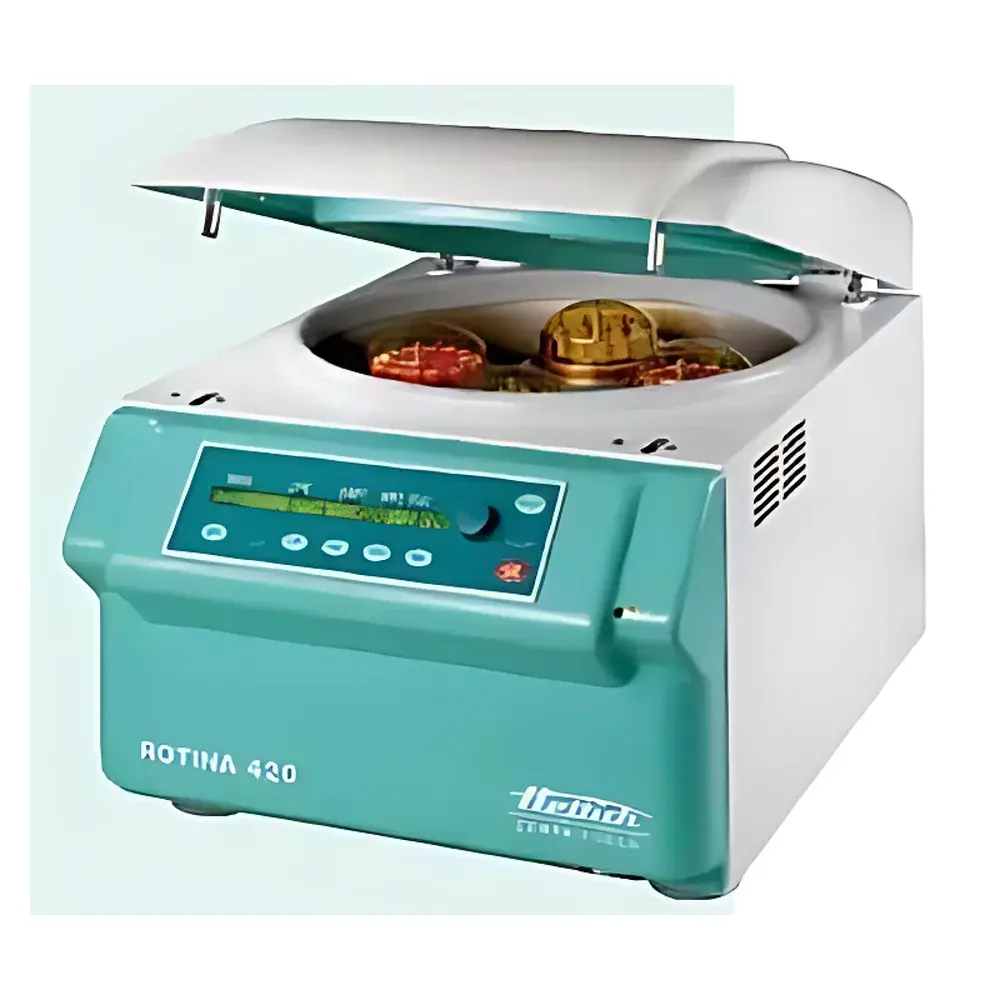
Hettich ROTINA 420R Refrigerated Benchtop Centrifuge
| Brand | Hettich |
|---|---|
| Origin | Germany |
| Model | ROTINA 420R |
| Instrument Type | Benchtop Centrifuge |
| Speed Range | 100–15,000 min⁻¹ |
| Max RCF | 24,400 × g |
| Max Capacity | 4 × 600 mL |
| Temperature Range | –20 °C to +40 °C (adjustable in 0.1 °C increments) |
| Dimensions (W × D × H) | 713 × 654 × 423 mm |
| Weight | 117 kg |
| Power Supply | 200–240 V, 1~, 50–60 Hz |
| Max Power Consumption | 1600 VA |
| Safety Certifications | ISO 9001, ISO 13485/MDSAP, ISO 14001, EC Declaration of Conformity, Biosafety Lid Certificate (Zertifikat_1752) |
| Electromagnetic Compatibility | EN/IEC 61326-1 Class B |
Overview
The Hettich ROTINA 420R is a high-performance refrigerated benchtop centrifuge engineered for demanding routine and research applications in clinical diagnostics, bioprocessing, and life sciences laboratories. Utilizing fixed-angle and horizontal rotor configurations—compatible with a wide range of tube formats—the instrument operates on the principle of sedimentation force generation via controlled rotational acceleration. Its robust brushless frequency-controlled motor delivers precise speed regulation across the full operational range (100–15,000 min⁻¹), enabling reproducible separation of biological particles—including cells, organelles, macromolecules, and precipitates—based on density, size, and shape. Unlike floor-standing systems, the ROTINA 420R achieves large-volume throughput (up to 4 × 600 mL per run) within a compact footprint (713 × 654 × 423 mm), making it ideal for space-constrained core facilities, hospital labs, and GMP-compliant QC environments where thermal stability and mechanical reliability are non-negotiable.
Key Features
- Refrigerated operation with continuous temperature control from –20 °C to +40 °C, including standby cooling mode to maintain setpoint during idle periods
- Stainless steel centrifuge chamber and reinforced metal housing for chemical resistance and long-term structural integrity
- Large transparent lid window for real-time sample monitoring without interrupting runs
- Motorized lid locking mechanism with ergonomic actuation and emergency manual release lever
- Automatic rotor recognition system preventing mismatched rotor–speed combinations and enforcing safe operating limits
- Integrated imbalance detection with automatic deceleration and audible/visual alerts upon deviation exceeding tolerance thresholds
- Overheat protection for both drive motor and chamber interior, compliant with IEC 61000-6-2 immunity requirements
- 99 programmable methods with recall functionality, supporting repeatable SOP execution across shifts and operators
- Three acceleration/deceleration profiles (standard, soft, fast) to optimize pelleting integrity or supernatant clarity
Sample Compatibility & Compliance
The ROTINA 420R accommodates diverse primary sample containers: standard 600 mL bottles (4-position horizontal rotor), 140 × 13 mm blood collection tubes, or 16 × 96-well microtiter plates using optional carriers. All rotors are certified for autoclavability (121 °C, 20 min) and meet DIN EN 61010-1 safety standards for laboratory electrical equipment. The system complies with ISO 13485:2016 for medical device manufacturing environments and supports GLP/GMP workflows through audit-ready event logging (including rotor ID, speed, time, temperature, and error codes). Optional biosafety-certified lids (Zertifikat_1752) fulfill containment requirements for BSL-2 handling of infectious specimens. Electromagnetic emissions conform to EN/IEC 61326-1 Class B, ensuring stable co-location with sensitive analytical instrumentation.
Software & Data Management
While the ROTINA 420R operates via an intuitive front-panel interface with LED display and tactile membrane keys, its embedded firmware supports traceable data governance. Each run logs timestamped metadata—including actual vs. set RCF, cumulative rotor hours, and thermal deviation history—stored internally for ≥10,000 cycles. For integration into LIMS or electronic lab notebook (ELN) ecosystems, optional RS-232 or USB interfaces enable export of CSV-formatted reports. Firmware updates preserve backward compatibility with legacy rotor libraries and adhere to FDA 21 CFR Part 11 principles through configurable user access levels (operator, supervisor, administrator) and mandatory electronic signatures for critical parameter changes.
Applications
This centrifuge serves as a primary workhorse in clinical chemistry laboratories for serum/plasma separation prior to immunoassay or mass spectrometry analysis; in biomanufacturing for harvest and clarification steps during upstream processing of monoclonal antibodies; and in academic research for subcellular fractionation, nucleic acid purification, and virus concentration. Its validated thermal performance supports cold-chain integrity for thermolabile proteins and exosome isolation protocols requiring sustained sub-zero rotor temperatures. Regulatory-grade documentation—including ISO 9001-certified manufacturing records and MDSAP-audited quality management files—is available upon request for validation packages (IQ/OQ/PQ).
FAQ
What rotor types are compatible with the ROTINA 420R?
Standard configurations include horizontal carriers for 600 mL bottles, swing-out buckets for blood tubes, and microplate adapters. Fixed-angle rotors (e.g., 12 × 50 mL) are also supported with appropriate certification documentation.
Does the unit support continuous operation at maximum speed and low temperature?
Yes—thermal management is rated for sustained operation at 15,000 min⁻¹ and –20 °C, provided ambient conditions remain ≤25 °C and relative humidity <80% non-condensing.
Is rotor calibration required after installation?
No. Automatic rotor identification eliminates manual input errors; however, annual verification of speed accuracy and temperature uniformity is recommended per ISO/IEC 17025 guidelines.
Can the centrifuge be integrated into automated liquid handling systems?
While not natively robotic, the RS-232 port enables external PLC-triggered start/stop commands and status polling, facilitating semi-automated workflows in modular lab setups.
What documentation is supplied for regulatory submissions?
Factory test reports, CE marking documentation, ISO 13485/MDSAP certificates, biosafety lid validation data, and electromagnetic compatibility test summaries are included in the technical dossier.



