
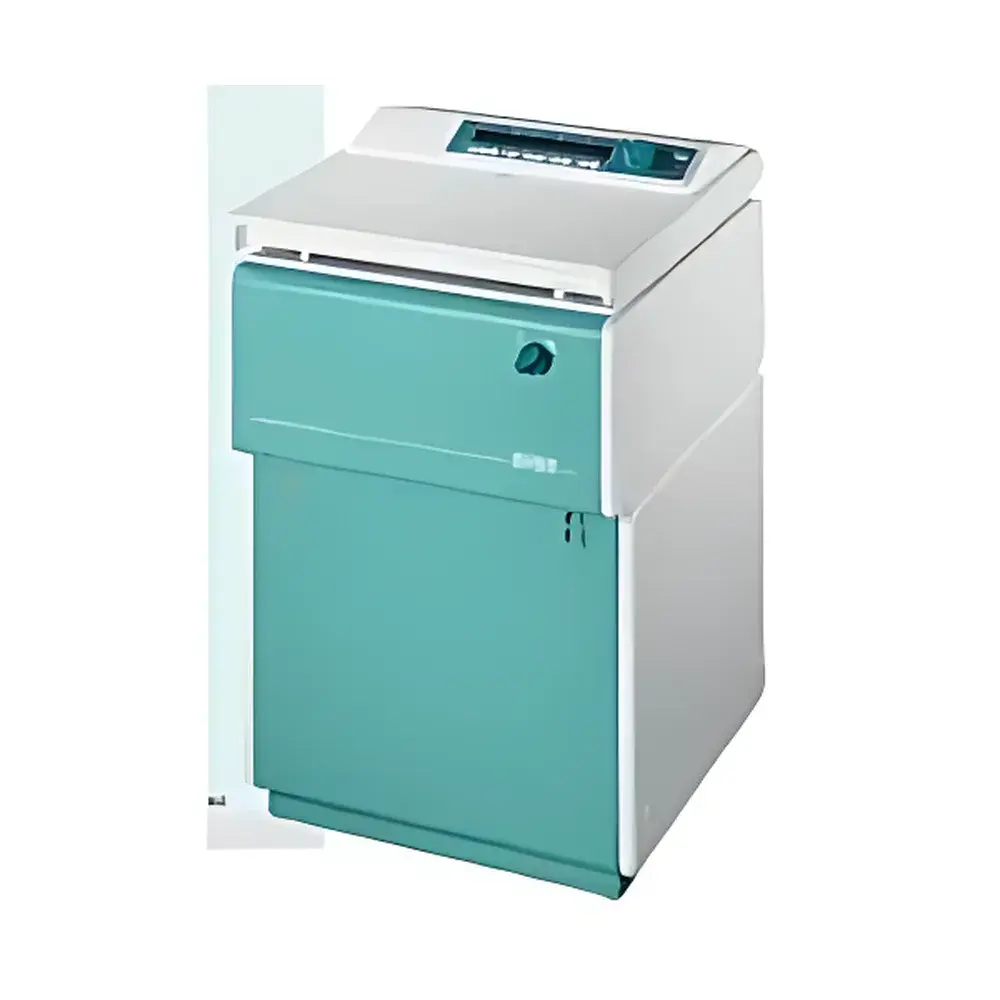
Hettich ROTIXA 500 RS Floor-standing High-speed Centrifuge
| Brand | Hettich |
|---|---|
| Origin | Germany |
| Model | ROTIXA 500 RS |
| Instrument Type | Floor-standing Centrifuge |
| Speed Range | 10,000–30,000 rpm (Max. 11,500 rpm) |
| Max. Capacity | 4 × 1000 mL |
| Max. RCF | 18,038 × g |
| Dimensions (W×D×H) | 814 × 973 × 650 mm |
| Weight | 219 kg |
| Temperature Range | –20 °C to +40 °C (continuously adjustable) |
| Acceleration/Deceleration | Ultra-fast ramp profiles |
| Control Interface | RS232 port for PC connectivity (up to 29 units per host), 89 programmable protocols |
| Motor | Frequency-controlled brushless DC motor |
| Compliance | EN/IEC 61326-1 Class B (EMC), UVV-compliant maintenance design |
| Power Supply | 230–240 V, 50–60 Hz, 3800 VA |
Overview
The Hettich ROTIXA 500 RS is a high-performance floor-standing centrifuge engineered for demanding routine and research applications in life sciences, clinical diagnostics, and industrial quality control laboratories. Utilizing a robust brushless DC drive system with frequency-controlled motor regulation, the ROTIXA 500 RS delivers exceptional rotational stability, minimal vibration, and rapid acceleration/deceleration kinetics—critical for reproducible separation of thermolabile or shear-sensitive samples. Its rotor dynamics are calibrated to meet stringent mechanical safety standards under variable load conditions, and its sealed refrigerated chamber maintains precise temperature control across the full operational range (–20 °C to +40 °C), enabling consistent sedimentation behavior regardless of ambient lab fluctuations. Designed for continuous operation in GLP- and GMP-aligned environments, the unit complies with EN/IEC 61326-1 Class B electromagnetic compatibility requirements and adheres to German UVV occupational safety guidelines for maintenance and service accessibility.
Key Features
- Ultra-fast acceleration and deceleration profiles—reducing cycle time without compromising sample integrity or rotor longevity
- Integrated transparent polycarbonate lid with real-time speed visualization—enabling non-invasive monitoring during operation
- “S”-series control panel supporting up to 89 user-defined centrifugation protocols, each configurable with independent setpoints for speed, time, temperature, acceleration rate, and braking profile
- RS232 serial interface allowing centralized control of up to 29 ROTIXA units from a single PC—ideal for high-throughput core facilities or multi-user laboratory infrastructures
- Dual-stage independent speed calibration system—ensuring traceable accuracy across the entire speed range (100–11,500 rpm) via internal reference sensors and external verification routines
- Refrigerated chamber with continuously adjustable temperature control and active condensate management—preventing frost accumulation and maintaining thermal homogeneity throughout the rotor cavity
- Heavy-duty structural frame (219 kg mass) and precision-balanced base design—minimizing transmission of mechanical resonance to adjacent instrumentation
Sample Compatibility & Compliance
The ROTIXA 500 RS accommodates a broad spectrum of sample types and container formats—including conical tubes (up to 1000 mL), blood bags, centrifuge bottles, and custom adapters for specialized vessels—making it suitable for applications ranging from plasma fractionation and microbial pellet recovery to food emulsion analysis and environmental sediment processing. Its horizontal swing-out rotor configuration ensures uniform sedimentation geometry and optimal pelleting efficiency for low-density suspensions. The system supports compliance workflows required in regulated environments: audit-trail-capable protocol execution, electronic signature-ready software integration (via optional Hettich LabWorld software), and alignment with ISO 13485, ASTM D1193 (for water purity testing), and USP sterility assay preparation guidelines. All safety interlocks, lid locking mechanisms, and imbalance detection circuits conform to EN 61010-2-020 for laboratory centrifuges.
Software & Data Management
While the ROTIXA 500 RS operates autonomously via its embedded controller, its RS232 interface enables seamless integration into laboratory information management systems (LIMS) and enterprise-level data archives. Protocol logs—including actual vs. setpoint RCF, elapsed time, temperature deviation, and motor current draw—are timestamped and exportable in CSV format. Optional Hettich LabWorld software provides remote scheduling, multi-unit synchronization, and automated report generation compliant with FDA 21 CFR Part 11 requirements (when deployed with validated authentication and electronic signature modules). All firmware updates are delivered via signed binary packages with SHA-256 checksum validation to ensure integrity and traceability.
Applications
- Clinical laboratories: High-volume serum/plasma separation, PBMC isolation, and urine sediment concentration
- Biopharmaceutical QA/QC: Clarification of cell culture harvests, virus particle pelleting, and excipient suspension homogenization
- Food & beverage R&D: Fat globule separation in dairy emulsions, starch granule isolation, and pesticide residue extraction from homogenized matrices
- Environmental testing labs: Soil suspension fractionation, microplastic recovery from aqueous effluents, and heavy metal precipitate concentration
- Academic research: Subcellular organelle isolation, nucleic acid purification support, and polymer nanoparticle size classification prior to DLS or TEM analysis
FAQ
What is the maximum relative centrifugal force (RCF) achievable with the ROTIXA 500 RS?
The unit achieves a maximum RCF of 18,038 × g at its rated maximum speed of 11,500 rpm with the standard 4 × 1000 mL horizontal rotor.
Does the ROTIXA 500 RS support continuous operation mode?
Yes—it features an ∞ (infinite) runtime setting, enabling unattended overnight or extended-duration runs with automatic thermal stabilization and rotor wear monitoring.
Can third-party rotors be used with this centrifuge?
No—only Hettich-certified rotors with validated mechanical and thermal performance profiles are approved for use to maintain safety certification and warranty coverage.
Is the temperature control system validated for ISO/IEC 17025 calibration?
The chamber temperature sensor is factory-calibrated; users may perform in-house verification using NIST-traceable probes per ISO/IEC 17025 Clause 6.4.3, though formal accreditation requires documented procedure validation.
How does the dual-stage speed calibration system improve measurement reliability?
It combines real-time Hall-effect rotor speed sensing with periodic reference calibration against an internal quartz oscillator—reducing long-term drift to ≤ ±0.2% of set speed over 12 months under normal operating conditions.



