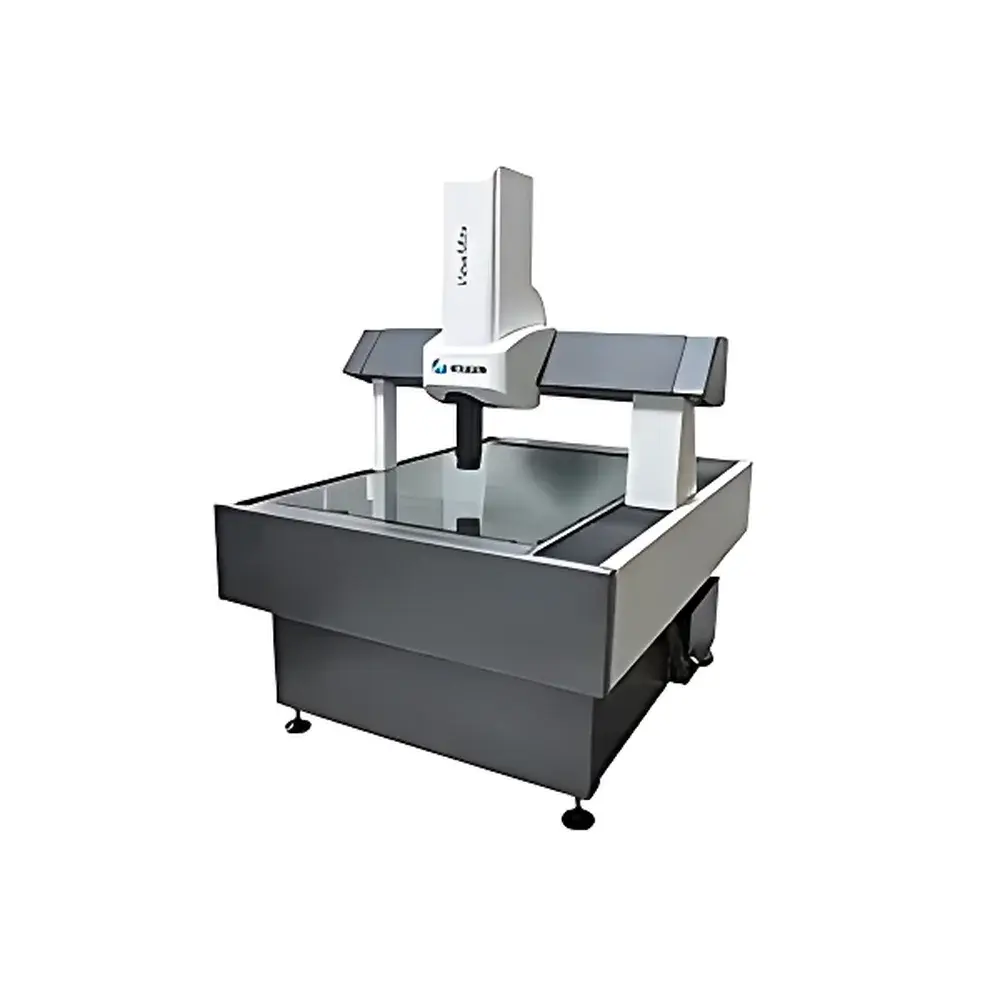
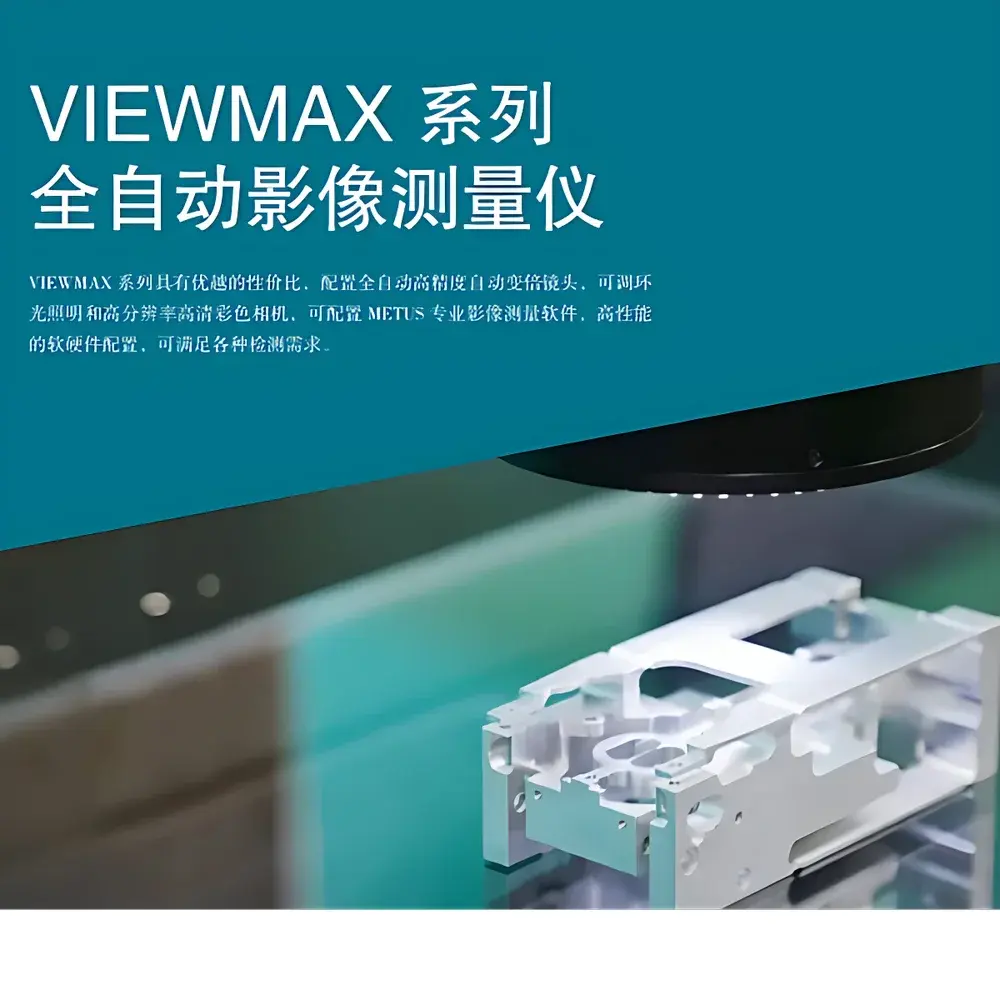
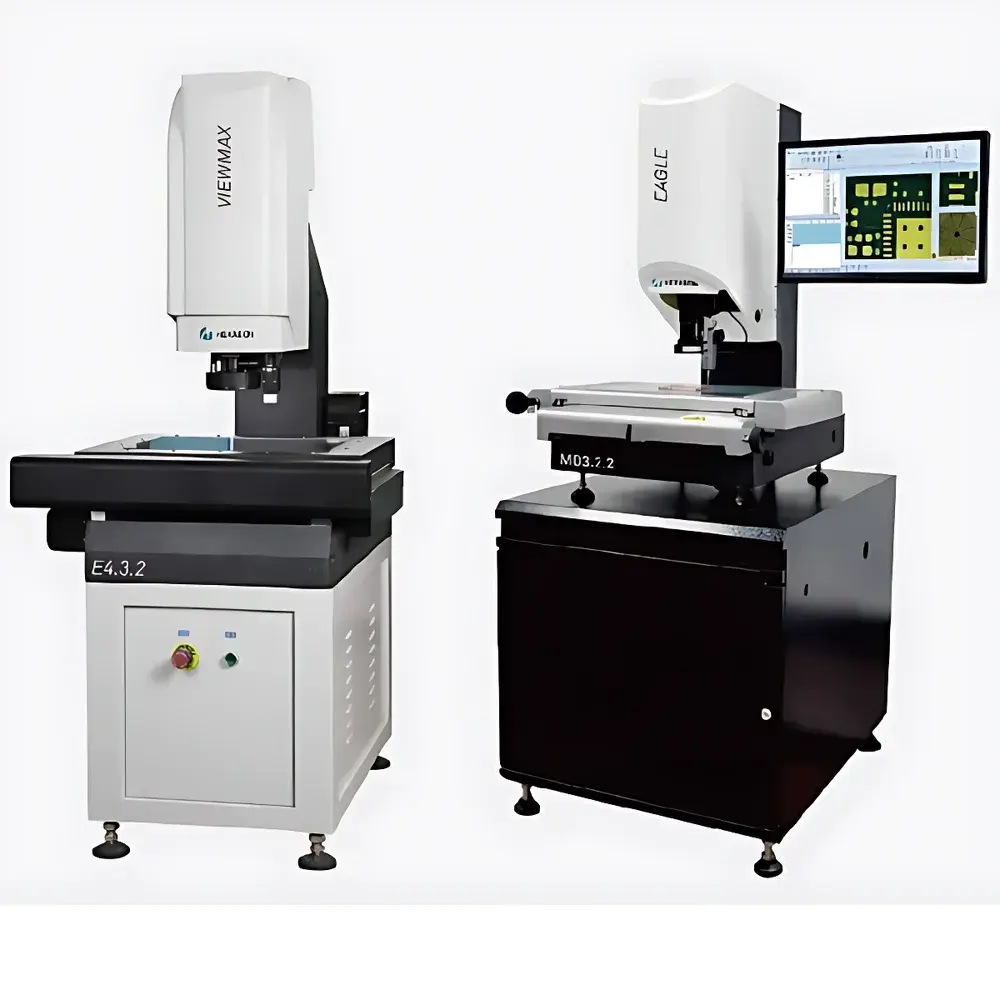
Hexagon Metrology VIEWMAX L Automated Vision Measuring Machine
| Brand | Hexagon |
|---|---|
| Origin | Shandong, China |
| Manufacturer Type | Authorized Distributor |
| Country of Origin | China |
| Model | VIEWMAX L |
| Operation Mode | Fully Automatic |
| Measurement Range | 500 × 600 × 250 mm to 1800 × 2470 × 250 mm |
| Grating Scale Resolution | 0.4 µm |
| Maximum Traverse Speed | 290 mm/s |
| Optional Zoom Lenses | 0.5×, 0.75×, 1.5×, 2× |
| Camera | High-Resolution Industrial CMOS Camera |
| Illumination System | White LED Coaxial Light, Green LED Transmitted Light, 4×90° Dual-Ring Surface Ring Light |
| Software Platform | METUS or PC-DMIS Vision |
| Optional Probes | Renishaw TP20 Touch Probe |
| Optional Z-Axis Extension | Up to 400 mm |
| Optional Sensor | CWS Confocal White Light Sensor |
| Compliance | ISO 10360-7, VDI/VDE 2617 Part 7, ASTM E29, USP <1059>, GLP/GMP-ready audit trail support |
Overview
The Hexagon Metrology VIEWMAX L is a high-precision, fully automated vision measuring machine engineered for large-format geometric metrology in demanding industrial quality control environments. Built upon a rigid triangular bridge architecture with a granite base and air-bearing guideways, the system delivers exceptional structural stability and thermal homogeneity—critical for maintaining measurement repeatability across extended working volumes (up to 1800 × 2470 × 250 mm). Its optical measurement principle relies on high-magnification digital imaging combined with sub-micron encoder feedback (0.4 µm grating resolution) and real-time edge detection algorithms to determine 2D feature positions with traceable uncertainty. When equipped with optional tactile probes (e.g., Renishaw TP20) or confocal white-light sensors (CWS), the platform extends into true 3D coordinate metrology—enabling simultaneous evaluation of planar geometry, height variations, surface texture, and form deviations on complex parts such as aerospace structural panels, automotive body-in-white components, and precision sheet metal assemblies.
Key Features
- Moving bridge design with thermally stable granite base and precision-ground granite crossbeam
- Air-bearing X/Y guideways eliminating mechanical wear and ensuring long-term motion accuracy
- Ground-grade ball screws driven by three-axis DC servo motors for smooth, high-speed positioning (up to 290 mm/s)
- 0.4 µm linear encoder resolution on all axes, certified per ISO 10360-2 and VDI/VDE 2617 Part 2
- High-resolution industrial CMOS camera with programmable exposure and dynamic range optimization
- Motorized zoom lens options (6.5:1 or 10:1) plus interchangeable fixed-magnification auxiliary lenses (0.5×, 0.75×, 1.5×, 2×) for multi-scale inspection
- Multi-spectral illumination suite: white coaxial LED (for reflective surface contrast), green transmitted LED (for transparent or translucent materials), and dual 90° ring light (for diffuse surface topography enhancement)
- Laser pointer integrated for rapid visual alignment and feature targeting prior to automated measurement
- Z-axis extension capability up to 400 mm for tall part clearance and vertical feature access
- Modular sensor integration—including tactile probing and confocal white-light scanning—for hybrid 2D/3D metrology workflows
Sample Compatibility & Compliance
The VIEWMAX L accommodates diverse sample geometries—from thin-walled plastic housings and flexible PCBs to heavy cast aluminum brackets and composite laminates—without requiring specialized fixturing in most cases. Its open-stage architecture supports manual loading of parts up to 40 kg, while optional motorized stage extensions enable robotic integration for lights-out operation. The system complies with international metrological standards including ISO 10360-7 (acceptance and reverification testing of vision systems), VDI/VDE 2617 Part 7 (characterization of optical measuring systems), and ASTM E29 (standard practice for using significant digits in test data). For regulated industries, METUS and PC-DMIS Vision software versions support 21 CFR Part 11 compliance through electronic signatures, role-based access control, and immutable audit trails—meeting GLP and GMP documentation requirements for medical device, pharmaceutical packaging, and aerospace component inspection.
Software & Data Management
VIEWMAX L operates exclusively with Hexagon’s industry-standard metrology software platforms: METUS (for intuitive, workflow-driven programming) or PC-DMIS Vision (for advanced GD&T analysis and enterprise-level reporting). Both environments provide full support for ISO GPS (Geometrical Product Specifications), including profile, position, concentricity, and runout tolerancing. Measurement programs are stored in encrypted project files with version history; raw image frames, coordinate data, and calibration logs are timestamped and archived in structured SQLite or SQL Server databases. Export formats include XML, CSV, PDF reports with embedded images, and STEP AP242 for CAD-based deviation mapping. Data integrity is reinforced via checksum validation, automatic backup scheduling, and optional networked storage with RAID redundancy.
Applications
Typical use cases span Tier-1 automotive suppliers performing first-article inspection of stamped chassis brackets; electronics manufacturers verifying solder paste volume and pad registration on HDI PCBs; medical device firms validating dimensional conformance of injection-molded syringe barrels and catheter hubs; and renewable energy producers inspecting blade root interfaces on wind turbine components. The system excels in applications requiring high-throughput verification of flatness, parallelism, hole pattern location, slot symmetry, radius consistency, and edge break geometry—particularly where traditional CMMs lack field-of-view efficiency or optical comparators lack programmability and traceability.
FAQ
What is the maximum allowable part weight for the standard VIEWMAX L worktable?
Standard models support up to 40 kg; heavier loads require custom base reinforcement and recalibration.
Can the VIEWMAX L perform measurements under controlled environmental conditions?
Yes—operational specifications require temperature stability between 18–22°C, temporal gradient ≤1°C/h, spatial gradient ≤1°C/m, and relative humidity 40–70% for optimal performance.
Is calibration certification included with delivery?
Each unit ships with a factory-issued ISO/IEC 17025-accredited calibration certificate valid for 12 months, traceable to NIST and PTB standards.
How does the CWS confocal white-light sensor integrate with the vision system?
The CWS module mounts directly to the Z-axis carriage and shares the same optical path and coordinate frame, enabling seamless switching between 2D imaging and point-cloud-based 3D surface profiling without re-referencing.
What power supply configuration is required for reliable operation?
A dedicated 220 V ±10%, 50/60 Hz circuit with low-impedance grounding (<4 Ω) and ≥1000 VA capacity is mandatory to prevent encoder noise and image sensor interference.