
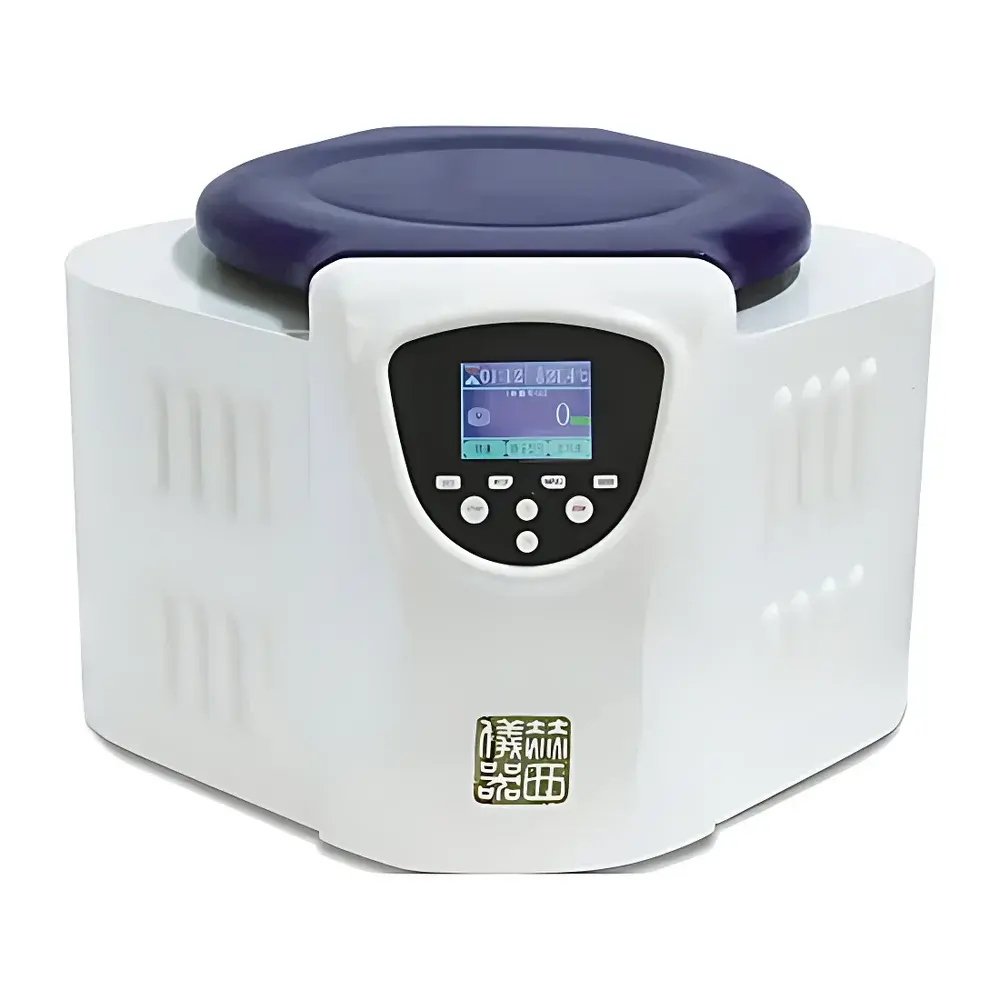
Hexion H/T16MM Benchtop High-Speed Refrigerated-Free Centrifuge
| Brand | Hexion |
|---|---|
| Origin | Hunan, China |
| Model | H/T16MM |
| Instrument Type | Benchtop Centrifuge |
| Speed Range | 10,000–30,000 rpm (Max. 16,500 rpm) |
| Max. RCF | 19,600 × g |
| Max. Capacity | 4 × 100 mL |
| Dimensions (W×D×H) | 500 × 440 × 330 mm |
| Weight | 35 kg |
| Power Supply | AC 220 V, 50 Hz |
| Total Power | 500 W |
| Noise Level | ≤60 dB(A) |
| Timer Range | 1 min – 99 h 59 min |
| Stored Programs | 20 |
| Rotor Types | Fixed-angle, Swing-bucket, Microplate |
| Compliance | CE-marked per IEC 61010-1 & IEC 61010-2-020 (Safety Requirements for Laboratory Equipment) |
Overview
The Hexion H/T16MM is a high-performance benchtop centrifuge engineered for precision separation of biological macromolecules—including nucleic acids, proteins, subcellular organelles, and viral particles—under ambient temperature conditions. Operating on the principle of sedimentation equilibrium and rate-zonal centrifugation, it delivers reproducible RCF (Relative Centrifugal Force) up to 19,600 × g at its maximum rotational speed of 16,500 rpm. Designed for laboratories where space efficiency, operational safety, and protocol repeatability are critical, the H/T16MM integrates a brushless frequency-controlled motor, electromagnetic door interlock, and stainless-steel rotor chamber compliant with ISO 13485-informed manufacturing practices. Its non-refrigerated architecture eliminates compressor-related maintenance while maintaining thermal stability within ±2 °C of ambient over extended runs—making it ideal for routine purification workflows in molecular biology, clinical diagnostics, food safety testing, and agricultural biotechnology.
Key Features
- Brushless frequency-converter motor ensures low-vibration operation, extended service life, and noise levels ≤60 dB(A) under full-load conditions.
- TFT 4.3-inch true-color touchscreen with dual-control interface displays real-time RCF, rpm, elapsed time, remaining time, and temperature (ambient-sensed), enabling simultaneous monitoring and adjustment of setpoints.
- Electromechanical door lock system prevents accidental opening during operation and automatically engages/disengages based on rotor status and speed threshold.
- Dedicated RCF key allows instant conversion between rotational speed (rpm) and relative centrifugal force (×g), supporting method transfer across platforms and compliance with ASTM E29-23 rounding conventions.
- 20 programmable protocols support multi-step routines—including acceleration/deceleration ramp control, hold-at-speed segments, and auto-brake selection—facilitating GLP-aligned documentation and audit readiness.
- Full stainless-steel centrifuge chamber and rotor housing resist corrosion from common reagents (e.g., ethanol, chloroform, guanidine thiocyanate) and enable rapid decontamination via validated wipe-down procedures.
Sample Compatibility & Compliance
The H/T16MM accommodates a broad spectrum of sample formats through interchangeable rotors: fixed-angle rotors for high-RCF pelleting (e.g., 24 × 1.5/2.0 mL at 14,000 rpm / 18,220 × g), swing-bucket rotors for density-gradient separations (e.g., 4 × 100 mL at 4,000 rpm / 2,490 × g), and microplate carriers for high-throughput cell harvesting (2 × 48-well plates at 3,000 rpm / 1,120 × g). All rotors are dynamically balanced per ISO 21501-4 and certified for use with standard polypropylene, polycarbonate, and glass tubes meeting ISO 7218 microbiological sampling requirements. The instrument conforms to IEC 61010-1 (safety of electrical equipment for laboratory use) and IEC 61010-2-020 (particular requirements for centrifuges), and supports traceability under FDA 21 CFR Part 11 when integrated with compliant LIMS or ELN systems via RS232/USB data export.
Software & Data Management
While the H/T16MM operates as a standalone unit, its embedded firmware supports timestamped parameter logging for each run—including start/stop times, selected rotor ID, final speed, actual RCF, and user-defined program number. Data can be exported via USB flash drive in CSV format for integration into laboratory quality management systems (QMS). The interface supports multilingual display (English, Spanish, French, German) and includes built-in error diagnostics (e.g., imbalance detection, overspeed warning, lid-open fault codes) aligned with ISO/IEC 17025 clause 7.7 on equipment malfunction response. Audit trails are retained locally for ≥1,000 cycles and persist through power loss due to non-volatile memory architecture.
Applications
- Purification of plasmid DNA and genomic DNA from bacterial lysates using silica-membrane or phenol-chloroform extraction protocols.
- Isolation of exosomes and extracellular vesicles from serum, plasma, or conditioned cell culture media (e.g., 100,000 × g equivalent via sequential spins).
- Clarification of crude enzyme extracts prior to chromatographic analysis or kinetic assay setup.
- Preparation of yeast spheroplasts and mammalian nuclei for downstream sequencing library construction.
- Routine hematology sample processing—including packed cell volume (PCV) determination and leukocyte enrichment—in CLIA-waived clinical labs.
- Quality control testing of dairy products, fruit juices, and grain extracts for particulate stability and phase separation behavior.
FAQ
Does the H/T16MM support refrigeration?
No. It is a constant-temperature (non-refrigerated) centrifuge designed for ambient-condition operation only. For temperature-sensitive applications requiring 4 °C stabilization, a separate cold room or pre-chilled rotor/tubes are recommended.
Can I use this centrifuge for blood separation in clinical settings?
Yes—provided local regulatory requirements for in vitro diagnostic use are met. The 4 × 100 mL swing-bucket configuration enables efficient plasma/serum separation at 4,000 rpm (2,490 × g) per CLSI H18-A3 guidelines.
What rotor certifications are included with purchase?
Each rotor ships with a manufacturer-issued certificate of conformance listing maximum speed, RCF, material composition (AISI 304 or 316L stainless steel), and dynamic balance test results per ISO 1940-1 G2.5 grade.
Is remote monitoring or network connectivity available?
Not natively. However, optional third-party IoT adapters (e.g., RS232-to-Ethernet gateways) may be deployed to integrate run logs into centralized lab infrastructure, subject to IT security review.
How often does the centrifuge require calibration verification?
Annual speed and timer verification is recommended per ISO/IEC 17025 and internal SOPs. Certified tachometers and stopwatch-grade timers are used; no factory recalibration is required unless mechanical impact or abnormal vibration occurs.



