
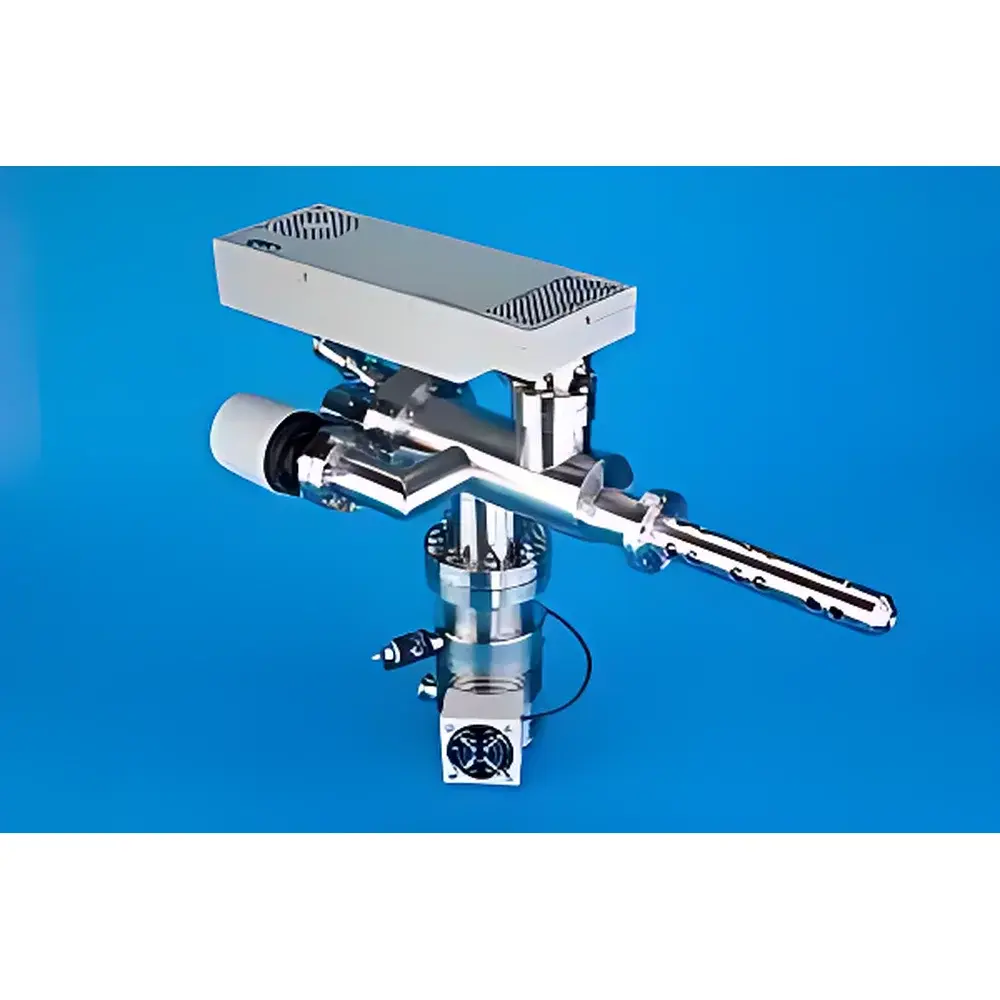
Hiden IG5C Caesium Ion Gun
| Brand | Hiden |
|---|---|
| Origin | United Kingdom |
| Manufacturer Type | Authorized Distributor |
| Origin Category | Imported |
| Model | IG5C |
| Price | Upon Request |
| Ion Energy Range | 500 eV – 5 keV |
| Maximum Beam Current | 200 nA |
| Minimum Spot Size | 20 µm |
| Ion Source Lifetime | ~500 hours |
| Flange Type | DN-35 CF Conflat Wedge Flange |
| Power Consumption | 8 W |
| Filament Configuration | Dual-filament |
| Vacuum Compatibility | Optimized for UHV systems (<1×10⁻⁹ mbar) |
| Beam Blanking | Integrated electrostatic blanking for rapid beam on/off switching in grating applications |
Overview
The Hiden IG5C Caesium Ion Gun is a compact, high-performance ion source engineered specifically for integration with Secondary Ion Mass Spectrometry (SIMS) and other surface analysis platforms requiring stable, well-focused Cs⁺ ion beams. Operating on the principle of surface ionization—where neutral caesium atoms are thermally evaporated and subsequently ionized upon contact with a hot, negatively biased rhenium or tungsten surface—the IG5C delivers exceptional brightness and long-term current stability. Its design prioritizes UHV compatibility, mechanical robustness, and seamless integration into existing analytical chambers without compromising chamber base pressure. Unlike plasma-based or liquid-metal ion sources, the IG5C’s thermionic surface ionization mechanism ensures low energy spread (<1.5 eV FWHM), minimal source contamination, and intrinsic immunity to metal alloy sputtering artifacts—critical attributes for quantitative depth profiling and high-spatial-resolution imaging in semiconductor metrology, thin-film characterization, and geological microanalysis.
Key Features
- Stable thermionic caesium ion source with dual-filament redundancy for extended operational uptime and graceful degradation
- Integrated self-calibrating ion optics enabling consistent beam alignment across energy ranges without external realignment tools
- Compact conflat wedge flange (DN-35 CF) for rapid installation and minimal footprint—designed to interface directly with standard SIMS sample stages and differential pumping apertures
- Electrostatic beam blanking module supporting sub-microsecond beam gating, essential for synchronized data acquisition in raster-scanned depth profiling and time-of-flight mass spectrometry
- UHV-optimized internal pumping architecture incorporating non-evaporable getter (NEG) elements and ion pump coupling to maintain chamber pressures below 1×10⁻⁹ mbar during operation
- Low-power consumption (8 W nominal) and thermally decoupled housing minimizing heat load on adjacent instrumentation and cryo-cooled detectors
Sample Compatibility & Compliance
The IG5C is compatible with conductive, semi-conductive, and insulating solid samples—including Si wafers, oxide films, perovskite layers, mineral sections, and polymer composites—when used in conjunction with charge compensation systems (e.g., electron flood guns). It meets the mechanical and vacuum interface requirements of ISO 3567 (vacuum flange standards) and conforms to CE marking directives for electromagnetic compatibility (2014/30/EU) and low-voltage safety (2014/35/EU). While not an analytical instrument per se, its performance characteristics support compliance with ASTM E1527–22 (Standard Guide for Use of SIMS in Surface Analysis) and ISO/IEC 17025:2017 when deployed within accredited laboratories performing certified depth profiling or dopant mapping. No radioactive materials are employed; caesium is sealed within a stainless-steel reservoir and handled only during factory-recommended source replacement procedures.
Software & Data Management
The IG5C operates as a hardware-controlled peripheral, interfaced via analog voltage inputs (beam energy, current setpoint) and TTL-level digital signals (blanking trigger, filament enable). It does not include embedded firmware or proprietary software but is fully compatible with industry-standard SIMS control suites—including Cameca’s WinMSI, ION-TOF’s SurfaceLab, and custom LabVIEW- or Python-based DAQ environments. All operational parameters—including filament temperature history, emission current logs, and blanking timing stamps—can be recorded alongside mass spectral data using timestamp-synchronized acquisition systems. For GLP/GMP-regulated environments, audit trails for ion gun parameter changes may be maintained through host system logging protocols compliant with FDA 21 CFR Part 11 when integrated with validated electronic lab notebooks (ELNs) or LIMS platforms.
Applications
- High-resolution depth profiling of dopant distributions (e.g., B, P, As) in advanced CMOS and FinFET structures
- Isotopic imaging of trace elements in zircon, monazite, and apatite for geochronology and petrogenetic modeling
- Interface chemistry analysis of solid-state battery cathode/electrolyte stacks under controlled atmosphere transfer
- Quantitative oxygen and nitrogen depth profiling in nitrided steel surfaces and TiN hard coatings
- In situ ion-beam-induced secondary electron yield calibration for low-energy electron microscopy (LEEM) and spin-polarized LEED systems
FAQ
What vacuum level is required for optimal IG5C operation?
The IG5C is rated for continuous operation at chamber pressures ≤1×10⁻⁹ mbar. A dedicated ion pump or combination of turbomolecular and NEG pumps is recommended to sustain this regime during beam extraction.
Can the IG5C be retrofitted onto legacy SIMS instruments?
Yes—its DN-35 CF wedge flange and standardized 0–10 V analog control interface allow integration with most commercial and custom-built SIMS systems manufactured since 2005, provided mechanical clearance and UHV compatibility are verified.
How often must the caesium reservoir be refilled?
Under typical usage (20–50 nA beam current, 1–3 keV), the integrated reservoir supports ~500 hours of operation before replacement. Refills are performed exclusively by Hiden-certified service engineers using proprietary sealed cartridges.
Is beam energy scanning supported?
Yes—the IG5C accepts analog voltage input (0–10 V) corresponding linearly to 500 eV–5 keV output energy, enabling automated energy ramping for work function mapping or energy-filtered SIMS experiments.
Does the IG5C require water cooling?
No—its 8 W power budget and passive thermal design eliminate the need for active cooling, reducing system complexity and vibration coupling in ultra-high-resolution imaging configurations.




