
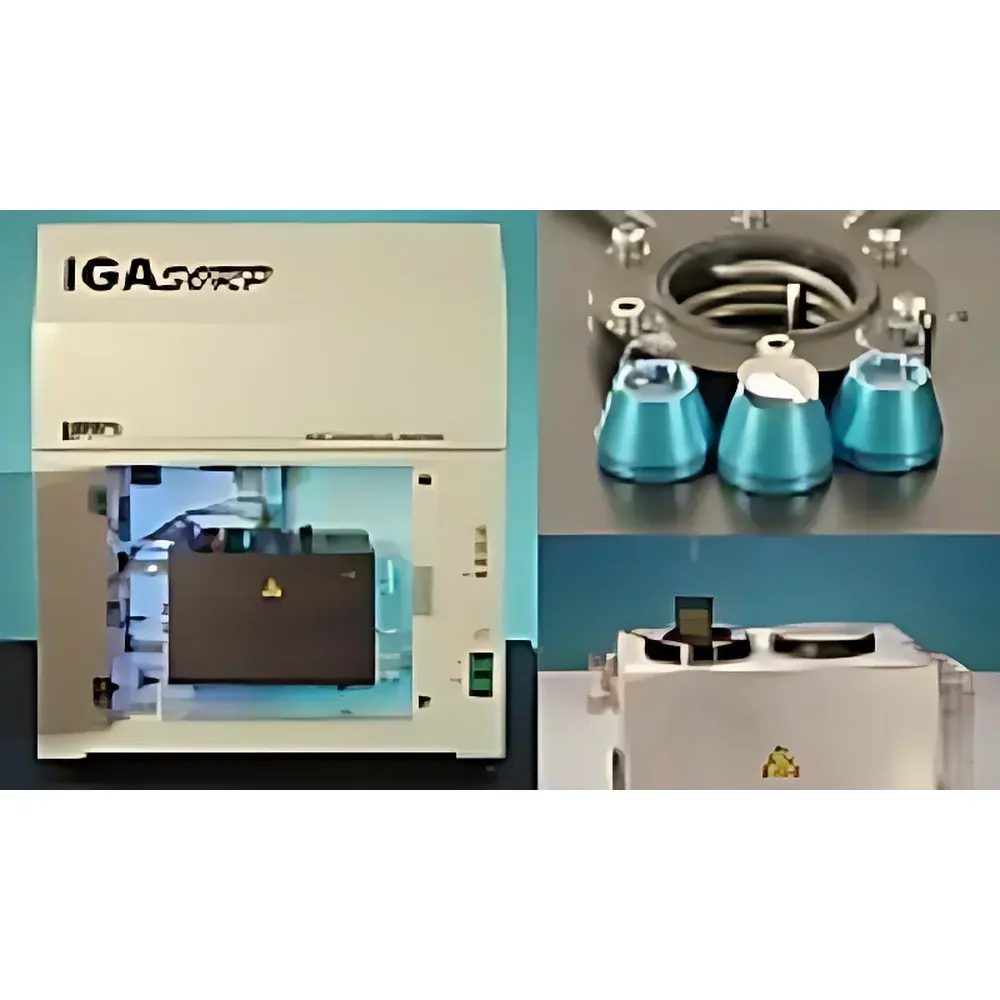
Hiden IGAsorp Moisture and Vapor Sorption Analyzer
| Brand | Hiden |
|---|---|
| Origin | United Kingdom |
| Model | IGAsorp |
| Measurement Principle | Gravimetric (Microbalance-Based Dynamic Vapor Sorption) |
| Sample Capacity | Up to 4.5 g |
| Minimum Sample Mass | ~1 mg |
| Microbalance Resolution | 0.1 µg (at 100 mg range) |
| Long-Term Stability | ±1 µg/week |
| RH Control Range | 0–95% RH |
| RH Accuracy | ±0.1% RH (control), ±1% RH (0–90% RH), ±2% RH (90–100% RH) |
| RH Response Time | <15 s to 90% of step change |
| RH Ramp Rate | 0.1–100% RH/hour |
| Temperature Range | 5–85 °C (ambient-controlled chamber) |
| Temp Stability | ±0.05–±0.1 °C |
| Carrier Gas | Dry air or N₂ |
| Flow Rate | 100–500 mL/min |
| Humidification Reservoir | 200 mL |
| Sample Holders | Borosilicate glass or stainless-steel mesh crucibles |
Overview
The Hiden IGAsorp is a high-precision, gravimetric vapor sorption analyzer engineered for quantitative characterization of moisture and organic vapor interactions with solid materials. Operating on the dynamic vapor sorption (DVS) principle, the instrument continuously monitors mass changes of a sample under precisely controlled relative humidity (RH) and temperature conditions using an ultra-stable microbalance. This enables direct measurement of adsorption/desorption isotherms, kinetic uptake profiles, hysteresis behavior, and diffusion coefficients—critical parameters for understanding hygroscopicity, stability, shelf-life, and structural integrity of porous and polymeric systems. Designed specifically for regulated industrial environments, the IGAsorp meets the metrological rigor required in pharmaceutical development (e.g., ICH Q5C, Q1A), food science (ISO 187, ASTM E104), and advanced packaging qualification (ASTM F1249, ISO 15106).
Key Features
- High-resolution microbalance with 0.1 µg resolution (100 mg range) and long-term stability of ±1 µg/week—ensuring reproducible, traceable mass tracking across multi-day isotherm experiments.
- Active RH control from 0–95% RH with ±0.1% RH setpoint accuracy and sub-15-second response time to RH step changes—enabling rapid, high-fidelity kinetic profiling.
- Integrated dual-zone temperature control: precision environmental chamber (5–85 °C, ±0.05 °C stability) plus optional high-temperature heater (up to 350 °C, 10 °C/min ramp rate) for combined thermogravimetric-vapor sorption (TGA-DVS) studies.
- Modular gas handling system supporting dry air or nitrogen carrier gas, with programmable flow rates (100–500 mL/min) and a 200 mL saturator reservoir for consistent humidification over extended runs.
- Sample compatibility with standard borosilicate glass or stainless-steel mesh crucibles—suitable for powders, granules, films, fibers, and coated substrates without mechanical disturbance during vapor exposure.
- Fully automated operation via dedicated IGAsorp Control & Analysis software, supporting method scripting, real-time data visualization, and compliance-ready audit trails.
Sample Compatibility & Compliance
The IGAsorp accommodates samples ranging from ~1 mg to 4.5 g, making it suitable for high-value pharmaceutical actives, excipients, lyophilized formulations, food powders (e.g., milk protein isolates, starches), desiccant materials (silica gel, MOFs), barrier films, and electronic encapsulants. Its hardware architecture and software framework support GLP/GMP-aligned workflows: full electronic signatures, user access levels, version-controlled method storage, and 21 CFR Part 11-compliant audit logging—including timestamped metadata for every RH/temperature step, balance reading, and system event. Instrument validation documentation (IQ/OQ/PQ protocols) and calibration certificates (mass, RH, temperature) are provided per ISO/IEC 17025 requirements.
Software & Data Management
IGAsorp Control & Analysis software provides a unified interface for experiment design, real-time monitoring, and post-acquisition modeling. Users define multi-step RH/temperature programs—including cyclic sorption, stepwise isotherms, and dynamic ramp profiles—with automatic equilibrium detection based on configurable mass-change thresholds (e.g., ≤0.2 µg/min over 10 min). Raw data (time, mass, RH, T, flow) are stored in vendor-neutral CSV and HDF5 formats. Built-in analysis modules calculate isosteric heat of adsorption (via Clausius–Clapeyron), BET surface area (for microporous/mesoporous solids), GAB and Peleg model fits, and diffusion coefficient estimates (using Fickian and non-Fickian models). All processing steps are logged with full parameter provenance for regulatory submission readiness.
Applications
- Pharmaceuticals: Excipient compatibility screening, API hydrate formation kinetics, lyophilized cake reconstitution behavior, and stability prediction under ICH climatic zones.
- Food Science: Water activity mapping, glass transition (Tg) estimation, crumb firmness modeling, and shelf-life extension via moisture barrier optimization.
- Packaging: Quantitative permeation resistance assessment of multilayer films, coatings, and laminates under variable RH gradients.
- Electronics: Moisture-induced delamination risk evaluation in PCB substrates and conformal coatings.
- Materials R&D: Characterization of MOFs, zeolites, silica aerogels, and polymer membranes for selective vapor capture and separation applications.
FAQ
What vapor species can the IGAsorp measure besides water?
The system supports any condensable organic vapor compatible with the humidification module and inert carrier gas—commonly methanol, ethanol, acetone, toluene, and ethyl acetate—subject to chemical compatibility verification with wetted components.
Is the microbalance internally calibrated?
Yes—the balance includes automated internal calibration routines triggered at user-defined intervals or prior to critical measurements, traceable to NIST-certified weights.
Can the IGAsorp be integrated into a laboratory LIMS or ELN?
Raw data export (CSV/HDF5) and RESTful API support enable seamless integration with major ELN platforms (e.g., LabArchives, Benchling) and enterprise LIMS systems via middleware configuration.
How is RH accuracy verified during operation?
A reference chilled-mirror dew point hygrometer (traceable to NPL standards) is used for periodic verification; optional in-line secondary RH sensor integration is available for continuous cross-validation.
Does the system comply with ASTM E104 and ISO 187 for paper and board testing?
Yes—pre-configured test templates and environmental control specifications fully satisfy the RH and temperature tolerances mandated in both standards for conditioning and testing hygroscopic cellulose-based materials.
Related Products



