
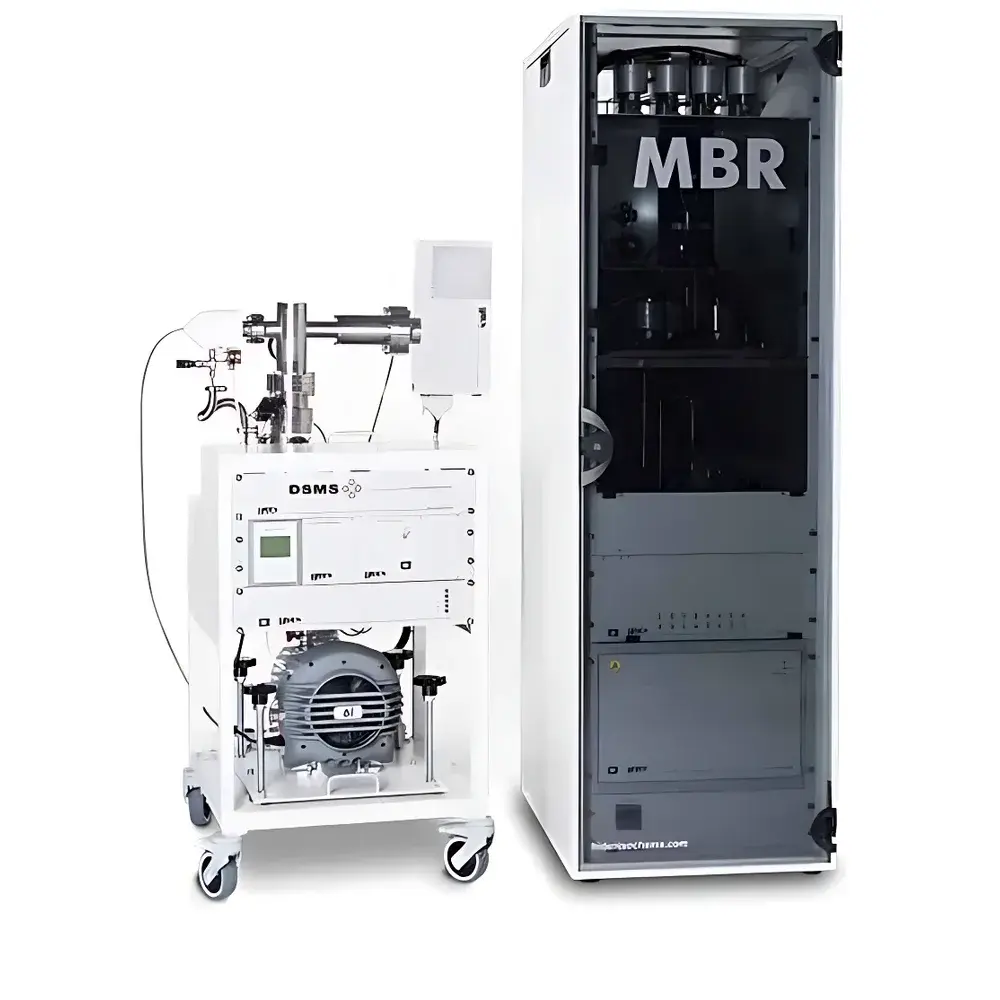
Hiden Isochema MBR Membrane Breakthrough Reactor for Gas Permeation and Separation Testing
| Brand | Hiden |
|---|---|
| Origin | United Kingdom |
| Model | MBR |
| Instrument Type | Physical/Chemical Adsorption Analyzer |
| Operating Pressure Range | Up to 10 bar |
| Temperature Range | 120°C to 300°C |
| Flow Configuration Modes | Co-current and Cross-flow |
| Integrated Detection | Close-coupled Quadrupole Mass Spectrometer (QMS) |
| Valve Architecture | Pneumatically Actuated, Ultra-Low-Dead-Volume Switching Valves |
| Control System | Fully Programmable, Automated Sequence Execution |
| Membrane Cell | Precision-Machined, Integral Support Structure |
| Compliance | Designed for ASTM D1434, ISO 15105-1, and ISO 2556 gas permeation test protocols |
Overview
The Hiden Isochema MBR (Membrane Breakthrough Reactor) is a purpose-built, fully automated benchtop system engineered for quantitative evaluation of gas transport properties in polymeric, ceramic, and mixed-matrix membranes. It operates on the fundamental principles of transient permeation analysis and steady-state breakthrough measurement, enabling precise determination of key membrane performance parameters—including permeability (P), selectivity (α), diffusion coefficient (D), and solubility (S)—under rigorously controlled thermodynamic conditions. Unlike generic sorption analyzers, the MBR integrates a close-coupled quadrupole mass spectrometer directly into the gas handling manifold, minimizing transmission delay and signal dispersion. This architecture ensures real-time, species-resolved detection of permeating gases with sub-second temporal resolution—critical for capturing early-stage breakthrough behavior and kinetic sorption/desorption transients. The system supports both co-current flow (with helium sweep gas) and cross-flow (dead-end) configurations, allowing users to decouple convective transport effects from intrinsic membrane diffusivity and to validate performance under industrially relevant feed conditions.
Key Features
- Fully automated, PC-controlled operation with customizable sequence scripting via Hiden’s QGA software suite
- Integrated high-sensitivity quadrupole mass spectrometer (mass range 1–100 amu, resolution <1 amu FWHM) mounted within <15 cm of the membrane cell outlet
- Pneumatically actuated, ultra-low-dead-volume (<5 µL) switching and shutoff valves compliant with ISO 15105-2 dead-volume specifications
- High-stability pressure control system (±0.01 bar repeatability) capable of maintaining upstream pressures from vacuum to 10 bar absolute
- Temperature-controlled membrane cell with dual-zone heating (120°C to 300°C), calibrated to ±0.5°C across full operating range
- Modular reactor design accommodating circular or rectangular membrane samples (diameter up to 25 mm; thickness 10–500 µm), with interchangeable gasketed flanges and integrated leak-check functionality
- Multi-gas inlet manifold supporting up to four independent, mass-flow-controlled feed streams (N₂, O₂, CO₂, CH₄, He, H₂, etc.) with optional humidity control
Sample Compatibility & Compliance
The MBR accommodates a broad spectrum of membrane formats—including dense films, asymmetric hollow-fiber cross-sections, supported liquid membranes, and thin-film composite (TFC) structures—without requiring specialized mounting fixtures. Sample installation is performed under inert atmosphere using a dedicated loading chamber to prevent surface oxidation or moisture adsorption. All fluidic pathways are electropolished stainless steel or VCR-sealed Swagelok components rated for UHV compatibility (≤1×10⁻⁹ mbar base pressure). The system conforms to ASTM D1434 (gas transmission rate), ISO 15105-1 (permeability determination), ISO 2556 (gas permeability of plastics), and supports audit-ready data acquisition per FDA 21 CFR Part 11 requirements when configured with electronic signature and audit trail modules. Calibration traceability is maintained to NIST-traceable pressure transducers and certified gas standards.
Software & Data Management
Control and data acquisition are managed through Hiden’s QGA (Quantitative Gas Analysis) software, a Windows-based platform offering real-time spectral visualization, multi-channel time-series plotting, and automated peak integration for all detected m/z signals. The software implements built-in permeation models—including time-lag analysis for diffusion coefficient calculation and dual-mode sorption fitting for rubbery/glassy polymers—and exports results in CSV, Excel, and HDF5 formats. Raw mass spectra and process logs are timestamped and digitally signed to ensure data integrity. Optional GLP/GMP modules provide user role management, electronic signatures, change control logs, and 21 CFR Part 11-compliant audit trails for regulated laboratories.
Applications
- Development and validation of CO₂ capture membranes for post-combustion and pre-combustion separation processes
- Hydrogen purification and recovery in PEM electrolyzer and fuel cell systems
- Helium enrichment from natural gas streams
- Permeability screening of MOF- and zeolite-filled mixed-matrix membranes
- Accelerated aging studies under elevated temperature/pressure stress conditions
- Interfacial resistance quantification at polymer/ceramic support interfaces
- Validation of molecular simulation predictions (e.g., MD, GCMC) against experimental permeation data
FAQ
What membrane geometries can be tested on the MBR?
The system accepts flat-sheet membranes (circular or square) with active areas up to 4.9 cm² and thicknesses between 10 µm and 500 µm. Custom adapters are available for testing cut hollow-fiber segments and tubular configurations.
Does the MBR support humidity-controlled feed gas?
Yes—optional integrated saturators and chilled-mirror dew-point sensors enable precise control of relative humidity (5–95% RH) in the upstream gas stream, critical for evaluating water-vapor-induced plasticization effects.
Can the system operate without mass spectrometry detection?
No—the MBR is fundamentally designed as a mass-spec-coupled platform; alternative detection (e.g., TCD, GC) is not supported due to inherent latency and resolution limitations incompatible with breakthrough kinetics analysis.
Is calibration required before each test run?
A full system calibration (pressure, temperature, and mass spec sensitivity) is recommended prior to any new material study series; however, daily verification using certified gas mixtures satisfies ISO/IEC 17025 intermediate checks.
How is membrane sealing integrity verified?
The MBR includes an automated leak-check routine that pressurizes the upstream side while monitoring downstream m/z = 4 (He) signal; acceptable leakage is defined as <1×10⁻⁸ mol·m⁻²·s⁻¹ at 5 bar differential pressure.



