
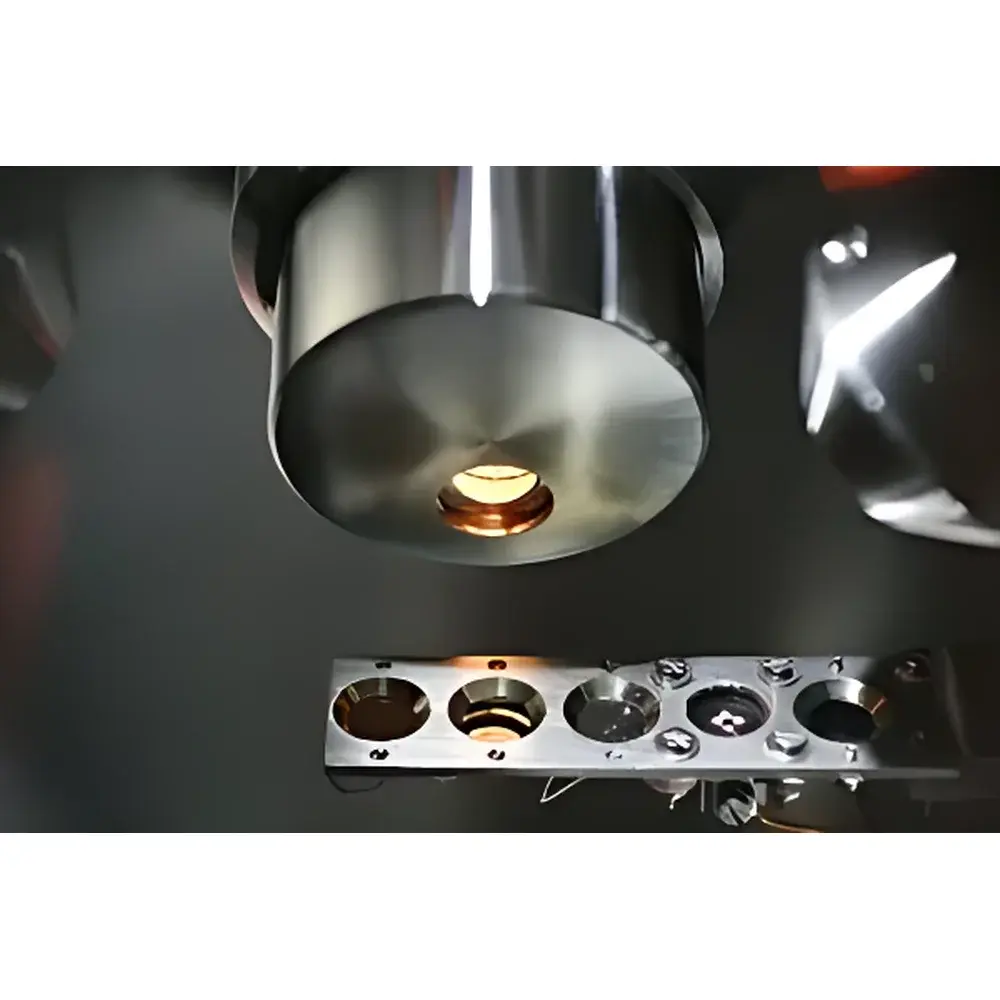
Hiden MAXIM Secondary Ion / Sputtered Neutral Mass Spectrometer
| Brand | Hiden |
|---|---|
| Origin | United Kingdom |
| Model | MAXIM |
| Mass Range Options | 300 amu / 500 amu / 1000 amu |
| Mass Analyzer | 3F Quadrupole (9 mm rod diameter) |
| Detector | Pulse-counting ion detector, dual-polarity (positive/negative ions), max. count rate 10⁷ cps |
| Ion Source | Electron Impact (single-filament), configurable for SNMS and Residual Gas Analysis (RGA) |
| Sample Stage Heating | Up to 250 °C |
| Optical Acceptance Angle | 30° for planar particle sampling in SIMS/SNMS geometry |
| Ion Transmission | Optimized for minimal trajectory perturbation across full energy range |
| Depth Profiling Capability | Enhanced via grating-controlled beam optics |
Overview
The Hiden MAXIM Secondary Ion / Sputtered Neutral Mass Spectrometer is a high-performance, ultra-high-vacuum (UHV)-compatible instrument engineered for quantitative surface and near-surface compositional analysis of solid materials. It operates on the fundamental principles of Secondary Ion Mass Spectrometry (SIMS) and Sputtered Neutral Mass Spectrometry (SNMS), enabling simultaneous detection of secondary positive ions, negative ions, and sputtered neutral species—after post-ionization—under controlled primary ion bombardment. Unlike conventional quadrupole mass spectrometers used solely for gas-phase analysis, the MAXIM integrates specialized ion optics with a 30° angular acceptance geometry that preserves the spatial distribution of sputtered particles, facilitating accurate depth profiling and matrix-matched quantification. Its design adheres to UHV standards (<1×10⁻⁹ mbar base pressure), ensuring minimal background interference and high signal-to-noise ratios essential for trace elemental and isotopic surface mapping.
Key Features
- Configurable 3F quadrupole mass filter with 9 mm rod diameter, delivering high mass resolution and long-term stability under continuous operation.
- Dual-polarity pulse-counting ion detector with linear dynamic range up to 10⁷ counts per second, supporting both positive- and negative-ion mode acquisition without hardware reconfiguration.
- Electron impact ion source based on a single, robust tungsten filament—optimized for SNMS neutral atom ionization and compatible with residual gas analysis (RGA) protocols.
- Grating-controlled primary beam optics system that enables precise energy dispersion and improved depth resolution during sputter profiling.
- Sample stage with programmable heating up to 250 °C, supporting thermal desorption studies, dopant activation monitoring, and contamination control during in situ analysis.
- Minimal ion trajectory perturbation across the full kinetic energy range (typically 0–100 eV), achieved through electrostatic lens design and field-free drift regions—critical for maintaining mass accuracy and transmission efficiency.
Sample Compatibility & Compliance
The MAXIM accommodates conductive and semi-conductive solid samples—including thin films, semiconductors, catalysts, oxides, and layered heterostructures—mounted on standard 25 mm diameter sample holders. Non-conductive specimens require charge compensation via low-energy electron flooding, integrated into the optical column. The system complies with ISO/IEC 17025 requirements for analytical laboratory competence and supports audit-ready data acquisition when paired with Hiden’s QGA software suite. All vacuum components meet ASTM E576 and ISO 14644-1 Class 4 cleanroom specifications. Instrument control firmware includes timestamped parameter logging and user-access-level management aligned with GLP/GMP documentation practices.
Software & Data Management
Controlled via Hiden’s proprietary QGA (Quantitative Gas Analysis) software platform, the MAXIM supports real-time spectral acquisition, multi-channel peak integration, and time-resolved depth profiling. The software provides native support for ASTM E1527-compliant reporting templates and exports fully annotated datasets in ASCII, CSV, and HDF5 formats for third-party processing (e.g., MATLAB, Python-based SciPy workflows). Audit trail functionality records all operator actions, method changes, and calibration events—fully compliant with FDA 21 CFR Part 11 requirements when deployed with electronic signature modules. Batch processing scripts enable automated sequence execution across multiple samples, reducing operator dependency in high-throughput QC environments.
Applications
- Depth-resolved impurity profiling in Si, GaAs, and compound semiconductor wafers.
- Interface chemistry analysis of ALD-grown dielectric stacks (e.g., HfO₂/SiO₂/Si).
- In situ monitoring of oxidation kinetics and interdiffusion at metal/ceramic interfaces.
- Isotopic ratio measurement for tracer diffusion studies in battery electrode materials.
- Contamination identification and quantification in photomask blanks and EUV optics substrates.
- Real-time gas-phase reaction product analysis during plasma-enhanced CVD or atomic layer etching.
FAQ
What vacuum level is required for optimal MAXIM performance?
The instrument requires an ultra-high vacuum environment with a base pressure ≤1×10⁻⁹ mbar, typically achieved using a combination of turbomolecular pumping and cryogenic or ion-getter backing.
Can the MAXIM perform true neutral atom detection without post-ionization?
No—neutral species must be ionized prior to mass analysis; the system uses electron impact ionization within the source region, optimized for high-efficiency conversion of sputtered neutrals.
Is the 30° acceptance angle adjustable or fixed?
The 30° angular acceptance is a fixed optical configuration designed to match the angular distribution of sputtered particles in typical SIMS/SNMS geometries; it is not mechanically variable but may be complemented by beam steering for off-normal incidence.
How is mass calibration maintained over extended operation?
Calibration is performed using known reference gases (e.g., N₂, Ar, CO₂) and verified daily via internal lock-mass routines embedded in QGA software; long-term stability is ensured by temperature-stabilized RF electronics and quartz-coated quadrupole rods.
Does the MAXIM support imaging capabilities?
The standard MAXIM configuration is non-imaging; however, it can be integrated with external focused ion beam (FIB) sources or scanning stages for rastered depth profiling—imaging functionality requires optional beam blanking and position-synchronized data acquisition modules.
Related Products





