
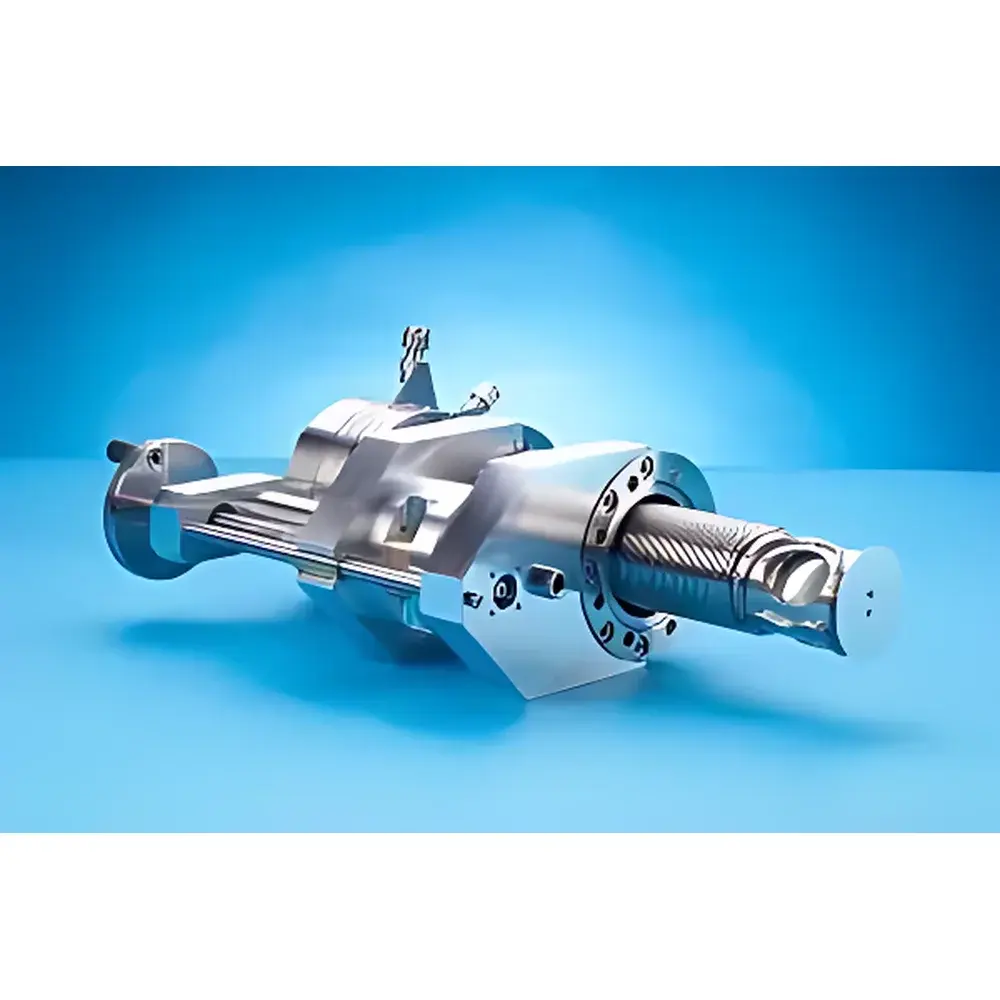
Hiden XBS Triple-Filter Quadrupole Mass Spectrometer for MBE Deposition Rate Monitoring and Control
| Brand | Hiden |
|---|---|
| Origin | United Kingdom |
| Manufacturer Type | Authorized Distributor |
| Origin Category | Imported |
| Model | XBS |
| Pricing | Upon Request |
| Ion Source | Crossed-beam, ±35° acceptance angle, 2 mm aperture |
| Detection Limit | 30 ions/s (for molecular beam studies) |
| Mass Range | 0–510 amu |
| Sensitivity | 100% down to 5 ppb |
| Long-term Stability | < ±0.5% peak height drift over 24 h |
| Cooling | Integrated UHV-compatible water-cooled shield |
| Ionization | Tunable electron energy for soft ionization and appearance potential mass spectrometry |
| Signal Enhancement | RF-assisted primary filtering for improved high-mass transmission |
| Interface | RS232, RS485, Ethernet |
| Software | MASsoft™ for Windows® with automated mass list generation and real-time process control |
Overview
The Hiden XBS is a purpose-engineered triple-filter quadrupole mass spectrometer designed specifically for in situ, real-time monitoring and closed-loop control of molecular beam epitaxy (MBE) deposition rates under ultra-high vacuum (UHV) conditions. Operating on the principle of mass-resolved ion current detection via sequential RF/DC filtering, the XBS delivers quantitative, time-resolved partial pressure measurements of effusive and directed molecular beams—enabling precise stoichiometric control during thin-film growth of compound semiconductors (e.g., GaAs, InP, GaN), oxide heterostructures (e.g., SrTiO₃/LaAlO₃), and 2D materials (e.g., graphene, TMDCs). Its crossed-beam ion source geometry—featuring a ±35° angular acceptance and 2 mm collimated aperture—maximizes signal capture from directional fluxes while minimizing background scattering, making it uniquely suited for integration into MBE chambers equipped with standard CF-63 or CF-100 viewports.
Key Features
- Triple-stage quadrupole filtration architecture with RF-enhanced first filter, significantly improving transmission efficiency for ions above m/z 200 and extending dynamic range across the full 0–510 amu mass range
- UHV-compatible, water-cooled detector housing rated for continuous operation at base pressures ≤1×10⁻¹⁰ mbar, eliminating thermal drift and enabling long-duration growth runs
- Tunable electron impact ionization source supporting both hard ionization (for total pressure calibration) and soft ionization modes (for fragmentation minimization and appearance potential analysis)
- Real-time sensitivity optimization via automated mass list generation in MASsoft™—prioritizing acquisition dwell time on target species (e.g., As₂, Ga⁺, Se⁺, O₂⁺) without sacrificing temporal resolution
- Sub-second response time (< 500 ms) for feedback-controlled shutter actuation, supporting deposition rate regulation down to 0.01 Å/min with statistical uncertainty < ±1.2% (1σ, 10 s averaging)
- RS232, RS485, and TCP/IP Ethernet interfaces compliant with industrial automation protocols (Modbus RTU/TCP), facilitating integration into PLC-based MBE process controllers
Sample Compatibility & Compliance
The XBS is compatible with all standard MBE source configurations—including effusion cells, valved cracker sources, and solid-source e-beam evaporators—and supports simultaneous multi-species monitoring (e.g., group III and group V fluxes, residual chamber contaminants such as H₂O, CO, and hydrocarbons). Its ion optics are optimized for low-energy beam detection (kinetic energy < 10 eV), ensuring minimal surface charging or beam perturbation during in situ measurement. The system conforms to ISO 14001 environmental management standards for laboratory instrumentation and meets mechanical and electrical safety requirements per IEC 61010-1. While not certified for clinical or pharmaceutical GMP environments, its MASsoft™ software supports audit-trail-enabled data logging (timestamped, user-ID-tagged spectra) aligned with GLP documentation practices and FDA 21 CFR Part 11 principles for electronic records retention.
Software & Data Management
MASsoft™ for Windows® provides a deterministic, deterministic real-time acquisition engine with configurable scan modes: discrete mass monitoring (single-ion counting), stepped-scan profiling (user-defined mass windows), and full-spectrum acquisition (up to 10 Hz frame rate). All raw data—including ion counts, dwell times, electron energy settings, and detector voltage—are stored in vendor-neutral HDF5 format with embedded metadata (chamber pressure, substrate temperature, shutter status). Batch processing tools enable post-run quantification using pre-calibrated relative sensitivity factors (RSFs) traceable to NIST SRM 1967 (gas mixture standards). Export options include CSV, MATLAB .mat, and ASCII-compatible formats suitable for integration with MATLAB-based growth modeling frameworks (e.g., kinetic Monte Carlo simulations).
Applications
- In situ stoichiometry verification during III–V and II–VI semiconductor heterostructure growth
- Real-time detection of cracking efficiency and beam homogeneity from valved arsenic/oxygen sources
- Contamination diagnostics—identifying and quantifying residual gases (H₂O, CO, N₂, O₂, hydrocarbons) contributing to point defects or interface states
- Calibration-free flux ratio determination for multicomponent alloy growth (e.g., InGaAs, AlGaAs)
- Time-of-flight synchronized MBE studies coupled with pulsed laser deposition (PLD) or atomic layer epitaxy (ALE)
- Fundamental surface science investigations including adsorption kinetics, desorption activation energies, and reaction intermediates in catalytic MBE
FAQ
Can the XBS be used for non-MBE vacuum processes, such as sputtering or CVD?
Yes—the XBS operates effectively in any UHV or HV environment where partial pressure analysis of reactive or inert gases is required. Its robust ion source design and wide mass range support applications in plasma etching endpoint detection, residual gas analysis in deposition tools, and catalyst surface reaction monitoring.
Is calibration required before each MBE run?
No. The XBS employs factory-characterized relative sensitivity factors (RSFs) traceable to NIST-certified gas standards. Users may perform optional single-point calibration using a known leak (e.g., Ar or N₂) to verify absolute pressure scaling; however, relative flux ratios remain stable without recalibration between runs.
How does the system handle beam divergence from multi-slot effusion cells?
The ±35° acceptance angle and 2 mm aperture provide sufficient solid angle coverage to integrate flux from typical 3–5 slot effusion cells without significant signal loss. Optional custom apertures (e.g., 1 mm slit) are available for high-resolution angular discrimination studies.
Does MASsoft™ support automated deposition rate feedback loops?
Yes—via programmable logic controller (PLC) interface or direct digital output (0–10 V analog or TTL), MASsoft™ can trigger shutter modulation or source temperature adjustments based on user-defined setpoints and PID parameters configured within the software.




