
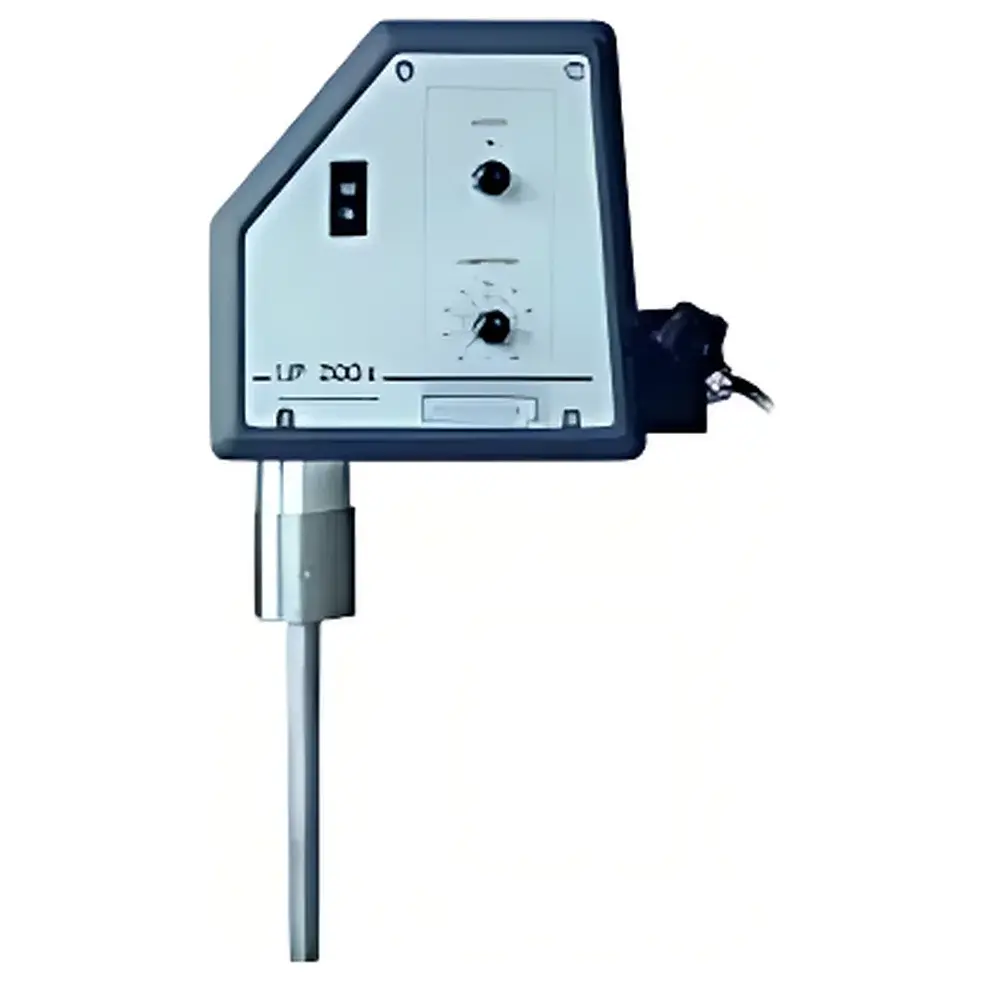
Hielscher UP200S Fixed-Mount Ultrasonic Cell Disruptor
| Brand | Hielscher |
|---|---|
| Origin | Germany |
| Model | UP200S |
| Ultrasonic Power | 200 W |
| Operating Frequency | 24 kHz |
| Amplitude Control Range | 20–100% |
| Pulse Mode Duty Cycle | 0–100% |
| Dimensions (L×W×H) | 290 × 210 × 100 mm |
| Weight | 2.3 kg |
| Input Voltage | 230 V, 2 A, 50–60 Hz |
| Sample Volume Capacity | 0.1–1000 mL (batch) |
| Probe Material | Grade 5 Titanium Alloy (Ti-6Al-4V) |
| Sterilization Compatibility | Autoclavable (121 °C, 20 min, 1 bar) |
| Cooling | Optional integrated coolant jacket for continuous-flow tubing |
Overview
The Hielscher UP200S is a fixed-mount, high-intensity ultrasonic processor engineered for reliable and reproducible cell disruption, homogenization, emulsification, dispersion, and extraction in life science and bioprocessing laboratories. Based on piezoelectric transduction technology, it generates high-amplitude mechanical longitudinal waves at a nominal frequency of 24 kHz, which propagate through the probe into liquid samples—inducing controlled cavitation, shear forces, and microstreaming. These physical mechanisms enable efficient lysis of bacterial, yeast, fungal, and mammalian cells without chemical additives or thermal degradation, making the UP200S suitable for downstream applications requiring intact biomolecules (e.g., recombinant protein purification, nucleic acid isolation, organelle enrichment). Its compact benchtop design integrates the generator and transducer into a single unit, eliminating signal loss from external cables and ensuring stable energy transfer under variable load conditions.
Key Features
- Integrated 200 W ultrasonic generator and transducer assembly with real-time amplitude stabilization—maintains consistent output across voltage fluctuations and changing sample impedance.
- Digitally adjustable amplitude (20–100%) and pulse mode (0–100% duty cycle), enabling precise control over energy input to prevent overheating or macromolecular denaturation.
- Autoclavable titanium alloy (Ti-6Al-4V) sonotrode—resistant to corrosion, erosion, and chemical attack; validated for repeated sterilization at 121 °C for 20 minutes under 1 bar steam pressure.
- Modular probe compatibility: Standard microtips (e.g., 2 mm, 3 mm, 7 mm diameter) support batch volumes from 0.1 mL to 1000 mL; optional continuous-flow cell with integrated cooling jacket enables scalable processing up to 2.5 L/h.
- Intelligent frequency tracking system automatically detects and locks onto the resonant frequency of the sonotrode-sample system, compensating for temperature-induced drift and probe wear.
- RS232 interface supports remote operation and data logging via PC software (Hielscher’s UP-Control suite), including timestamped parameter recording and export in CSV format for audit compliance.
Sample Compatibility & Compliance
The UP200S accommodates a broad range of biological matrices—including microbial cultures (E. coli, S. cerevisiae), tissue homogenates, plant extracts, and suspension-adapted mammalian cells—without requiring pre-filtration or viscosity adjustment. Its mechanical lysis mechanism avoids enzyme inhibitors or chaotropic agents that may interfere with downstream assays (e.g., PCR, ELISA, mass spectrometry). The device conforms to IEC 61000-6-3 (EMC emission limits) and IEC 61000-6-2 (immunity standards), and its operational parameters are fully traceable for GLP and GMP-aligned workflows. When used with validated protocols, the UP200S supports compliance with ISO 13485 (medical device manufacturing), USP (cell lysis validation), and FDA 21 CFR Part 11 requirements for electronic records when paired with Hielscher’s audit-trail-enabled software.
Software & Data Management
The UP200S communicates via RS232 to Hielscher’s UP-Control software (Windows-compatible), enabling full parameter scripting, real-time monitoring of amplitude, power output, and runtime, as well as automatic generation of electronic lab notebook (ELN)-ready reports. All user-defined settings—including amplitude setpoint, pulse profile, total sonication time, and probe ID—are stored with timestamps and operator credentials. Data exports include raw sensor logs and summary statistics (mean amplitude deviation, peak power variance), supporting root-cause analysis during process troubleshooting or regulatory review. Software configuration files can be version-controlled and deployed across multiple instruments to ensure inter-laboratory method consistency.
Applications
- Microbial cell lysis for plasmid DNA, inclusion body recovery, and periplasmic protein extraction.
- Chromatin shearing in ChIP-seq workflows—achieving fragment sizes between 200–500 bp with low thermal bias.
- Nanoparticle dispersion in lipid nanoparticle (LNP) formulation development for mRNA delivery systems.
- Enzyme activation and catalysis enhancement in non-thermal sonochemical reactions (e.g., transesterification, peptide coupling).
- Deagglomeration of nanomaterials and colloidal suspensions prior to DLS or TEM characterization.
- Cleaning of microfluidic channels and capillary surfaces via acoustic streaming-assisted removal of biofouling residues.
FAQ
Can the UP200S be used for in-line continuous processing?
Yes—the system supports continuous-flow operation using an optional thermostatically controlled flow cell; maximum throughput is 2.5 L/h with inlet/outlet tubing compatible with standard peristaltic pump interfaces.
Is the sonotrode compatible with aggressive solvents such as chloroform or HF?
Grade 5 titanium exhibits excellent resistance to most organic solvents and dilute acids, but prolonged exposure to hydrofluoric acid (HF) or hot concentrated alkalis is not recommended; consult Hielscher’s chemical compatibility chart before use.
Does the UP200S meet regulatory requirements for pharmaceutical R&D?
When operated with documented SOPs and integrated into a validated software environment (e.g., UP-Control with audit trail enabled), the UP200S supports adherence to FDA 21 CFR Part 11, EU Annex 11, and ICH Q5A/Q5D guidelines for bioprocess equipment qualification.
How is amplitude stability maintained during extended sonication cycles?
The built-in digital feedback loop continuously monitors electrical impedance across the piezoceramic stack and dynamically adjusts drive voltage to sustain target amplitude—ensuring consistent cavitation intensity regardless of sample temperature rise or viscosity changes.
Can the instrument be integrated into automated liquid handling platforms?
Yes—via TTL-triggered start/stop signals and RS232 command protocol, the UP200S can synchronize with robotic arms, autosamplers, and PLC-based process controllers for unattended multi-sample processing.



