
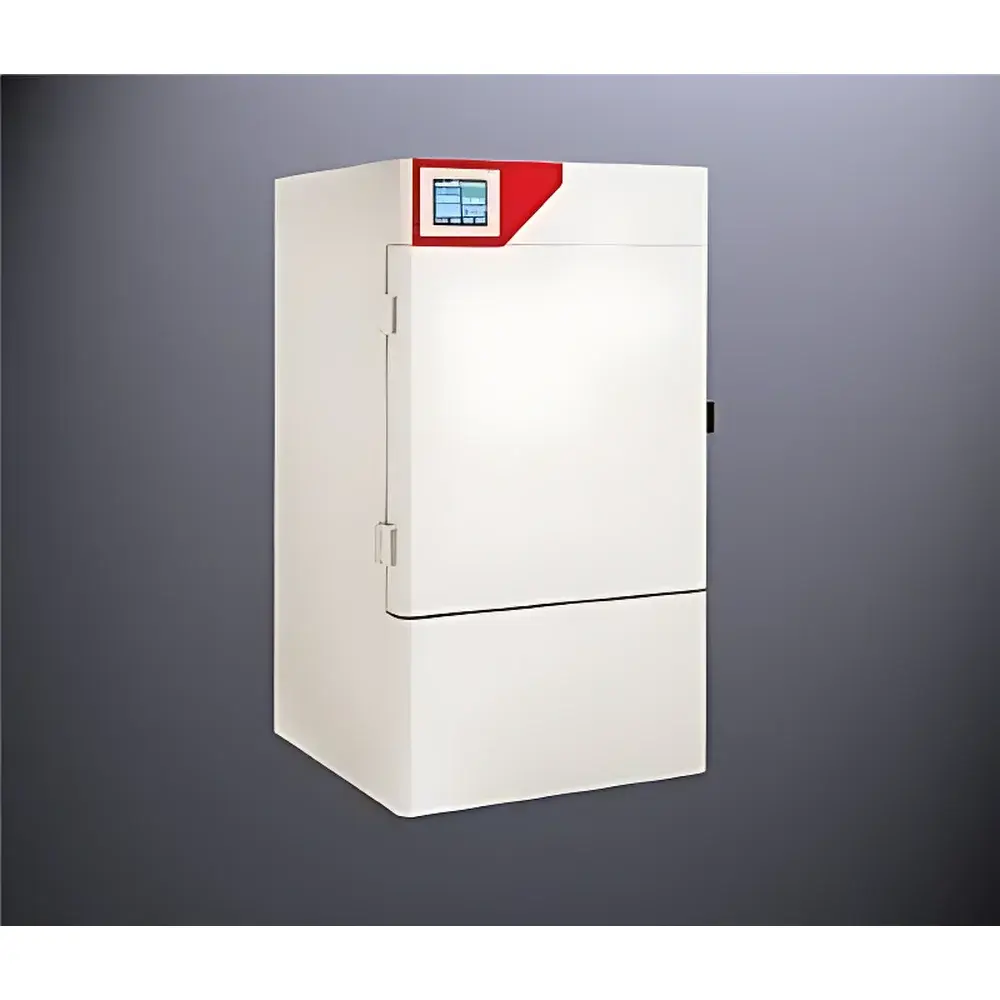
Hinds Instruments YP-150SDP Comprehensive Drug Stability Testing Chamber with Photostability Function
| Brand | Hinds Instruments |
|---|---|
| Origin | Shanghai, China |
| Model | YP-150SDP |
| Chamber Volume | 150 L |
| Internal Dimensions | 600 × 405 × 620 mm |
| External Dimensions | 800 × 910 × 1630 mm |
| Temperature Range (Dark) | 0–65 °C |
| Temperature Range (Illuminated) | 10–65 °C |
| Temperature Uniformity | ±0.5 °C |
| Humidity Range | 40–95 %RH |
| Humidity Uniformity | ±0.5 %RH |
| Illuminance Range | 0–4500 lx (adjustable) |
| Illuminance Accuracy | ≤ ±500 lx |
| Cooling System | Air-cooled, hermetic Danfoss compressor |
| Refrigerant | R404A/R23 |
| Control Interface | TEMI880 programmable touchscreen controller (Korean origin) |
| Temperature Sensor | Pt100 platinum resistance thermometer |
| Humidity Sensor | Imported high-accuracy capacitive transducer |
| Air Circulation | Optimized tangential fan system with rear-mounted centrifugal blower |
| Safety Protections | Compressor overheat, overload, water shortage, overtemperature, electrical short-circuit |
| Compliance | GB 10586–2006, Chinese Pharmacopoeia (2010 Edition) Stability Guidelines, ICH Q1A(R2), WHO TRS 953 Annex 2, FDA Guidance for Industry — Stability Testing of Drug Substances and Products |
Overview
The Hinds Instruments YP-150SDP Comprehensive Drug Stability Testing Chamber is an engineered environmental simulation platform designed to meet the stringent requirements of pharmaceutical stability testing under ICH Q1A(R2), WHO Technical Report Series No. 953 (Annex 2), and FDA Guidance for Industry — Stability Testing of Drug Substances and Products. It integrates precise temperature, humidity, and controlled photostability exposure within a single chamber, enabling concurrent or sequential execution of long-term (e.g., 25 °C/60 %RH), intermediate (30 °C/65 %RH), and accelerated (40 °C/75 %RH) storage condition protocols. The system operates on the principle of balanced heating/humidification and refrigerated dehumidification, ensuring thermodynamic equilibrium without condensation risk or thermal overshoot. Its dual-mode illumination subsystem—calibrated LED-based light source with adjustable intensity (0–4500 lx)—supports ICH Q5C photostability stress testing per Option 1 (near-UV/visible spectrum) and complies with ISO 8573-1 air purity class requirements for cleanroom-compatible operation.
Key Features
- Stainless steel interior (SUS304B mirror-finish) for corrosion resistance, ease of cleaning, and compliance with GMP surface finish standards (Ra ≤ 0.8 µm)
- Patented arc-shaped structural design enhancing mechanical rigidity and minimizing internal air dead zones
- Optimized airflow architecture with rear-mounted centrifugal blower and tangential circulation path, achieving ≤ ±0.5 °C temperature uniformity and ≤ ±0.5 %RH humidity uniformity across full working volume (per ISO 16770:2022 verification protocol)
- Danfoss BD50F hermetic refrigeration compressor (R404A/R23 dual-refrigerant compatible) delivering stable cooling performance from –25 °C to +55 °C evaporator range with <45 dB(A) acoustic emission
- TEMI880 programmable controller with PID auto-tuning, real-time deviation correction, and audit-trail-enabled parameter logging (compliant with FDA 21 CFR Part 11 Annex 11 requirements when paired with optional validation package)
- Large-view vacuum-insulated tempered glass door with magnetic silicone gasket, ensuring minimal thermal leakage and visual observation without compromising chamber integrity
- Configurable sample rack system with vertical adjustability and standardized 25 mm pitch; left-side cable access port (Φ50 mm) fitted with removable rubber grommet for sensor feedthrough
Sample Compatibility & Compliance
The YP-150SDP accommodates standard pharmaceutical packaging formats—including blister packs, HDPE bottles, amber vials, and aluminum-laminated pouches—on two included stainless steel trays (load capacity: 15 kg per tray). Chamber geometry permits placement of up to 48 × 10 mL vials or 24 × 50 mL bottles without airflow obstruction. All materials in contact with test samples conform to USP Class VI plastic equivalency and ISO 10993-5 cytotoxicity criteria. Regulatory alignment includes full traceability to ICH Q5C photostability stress test conditions (Option 1: cool white fluorescent + near-UV lamps), adherence to ASTM E2043–20 (Standard Practice for Calibration of Light Sources Used in Photostability Testing), and compatibility with qualification protocols per ISPE Good Practice Guide: Commissioning and Qualification of Stability Chambers. Optional IQ/OQ/PQ documentation packages support GMP-compliant 3Q certification (per ISO/IEC 17025 and EU Annex 15).
Software & Data Management
The embedded TEMI880 controller provides local data acquisition at 10-second intervals, storing ≥12 months of time-stamped temperature, humidity, and illuminance values internally. Export is supported via USB 2.0 (CSV format) or RS485 Modbus RTU interface for integration into LIMS or MES platforms. Optional HindsLink™ PC software enables remote monitoring, multi-chamber synchronization, alarm escalation (email/SMS), and automated report generation compliant with ALCOA+ principles (Attributable, Legible, Contemporaneous, Original, Accurate, Complete, Consistent, Enduring, Available). Audit trail functionality records all user actions—including setpoint changes, calibration adjustments, and manual overrides—with operator ID, timestamp, and reason-for-change fields. Data encryption (AES-256) and role-based access control (RBAC) are available upon request to satisfy GDPR and HIPAA-aligned data governance policies.
Applications
This chamber serves as a primary tool for forced degradation studies, shelf-life estimation, excipient compatibility screening, and regulatory submission dossier preparation (e.g., CTD Module 3.2.P.8). It supports stability-indicating method development by exposing APIs and formulations to defined oxidative, thermal, hydrolytic, and photolytic stressors. Beyond pharmaceuticals, it is validated for use in biologics lyophilization cycle development (pre-formulation freeze-drying trials), medical device packaging validation (ASTM F1980), nutraceutical stability assessment (FDA DSHEA), and polymer-based drug delivery system aging (ISO 10993-13). Academic research applications include photochemical kinetics modeling of UV-induced bond cleavage and humidity-driven crystallinity transitions in amorphous solid dispersions.
FAQ
Does the YP-150SDP comply with ICH Q1A(R2) long-term and accelerated testing conditions?
Yes — it maintains 25 °C/60 %RH (±2 °C/±5 %RH) and 40 °C/75 %RH (±2 °C/±5 %RH) with documented stability over 168 hours per ICH-defined acceptance criteria.
Can the illumination system be calibrated traceably to NIST standards?
Yes — optional factory calibration certificate (NIST-traceable lux meter, model ILT1700) is available with annual recalibration service.
Is remote validation support provided for 3Q documentation?
Yes — Hinds Instruments offers on-site or virtual IQ/OQ/PQ execution by qualified validation engineers, including URS review, risk assessment (FMEA), and final summary report aligned with EU Annex 15 and ASTM E2500.
What is the expected mean time between failures (MTBF) for continuous operation?
Based on field data from >200 installed units operating ≥16 h/day, MTBF exceeds 45,000 hours (≥5 years) under nominal load conditions.
Are custom chamber configurations (e.g., dual-zone or tri-zone) available?
Yes — YP-GSD (dual-zone) and YP-TSD (tri-zone) variants support independent control of illumination, humidification, and thermal modules for parallel condition testing.






