
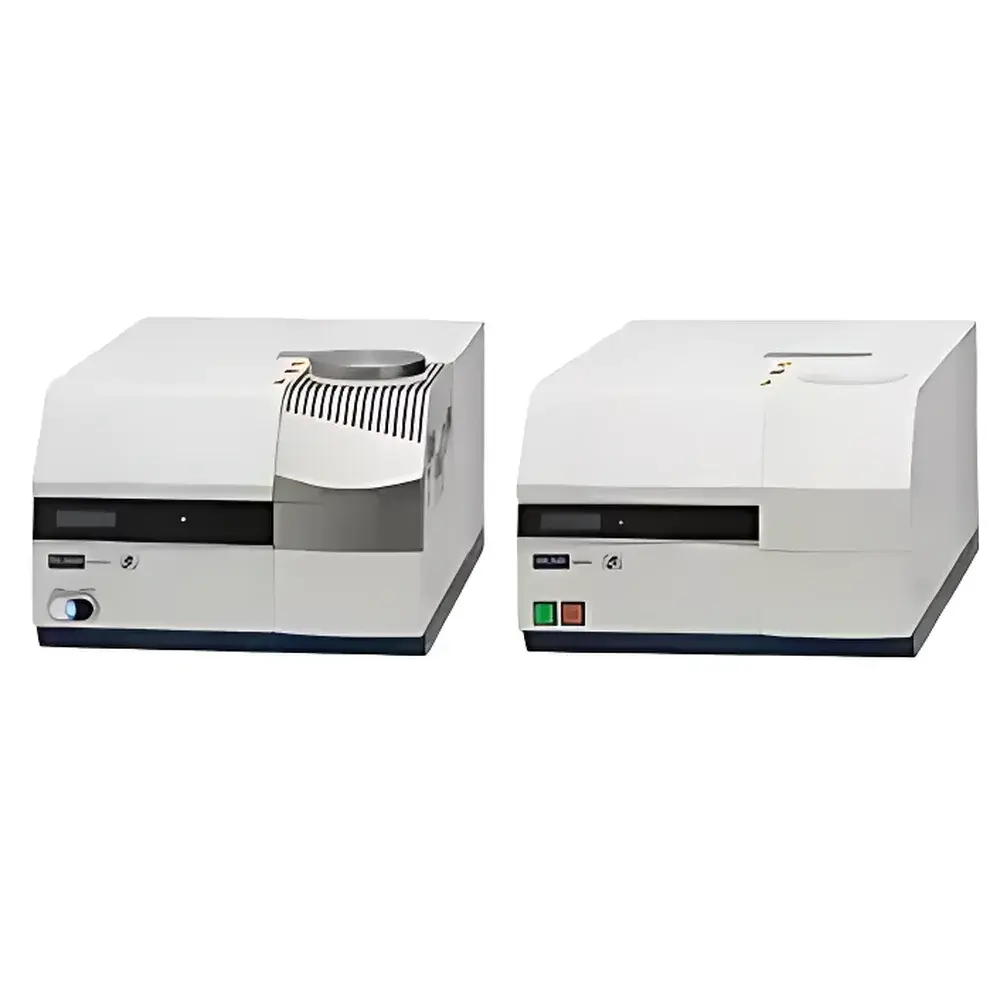
Hitachi DSC7000 Series Differential Scanning Calorimeter
| Brand | Hitachi |
|---|---|
| Origin | Japan |
| Model | DSC7000 |
| Heating Rate | 0.01–100 °C/min |
| Temperature Range | –150 to 725 °C |
| Baseline Stability | ±5 µW |
| Sensitivity | <0.1 µW |
| Maximum Sample Power Capacity | ±350 mW |
| Atmosphere Options | Ambient Air, Inert Gas (N₂, Ar) |
| Cooling Options | Integrated Peltier Cooling (–80 to 500 °C), Optional Automated Liquid Nitrogen Cooling (–150 to 725 °C) |
| Optional Modules | Mass Flow Controlled Gas Delivery System, Auto Sampler Unit, UV Irradiation Unit (with Intensity Meter & Wavelength-Selective Filters), Real-Time Sample Observation Unit |
Overview
The Hitachi DSC7000 Series Differential Scanning Calorimeter is a high-precision thermal analysis instrument engineered for quantitative measurement of heat flow differences between a sample and inert reference as a function of temperature or time. Based on the heat-flux DSC principle, it employs a multi-junction thermopile sensor architecture to deliver exceptional signal-to-noise ratio and thermal resolution. Designed for rigorous laboratory environments—including R&D centers, quality control laboratories, and regulatory-compliant manufacturing facilities—the DSC7000 supports ISO 11357, ASTM E794, ASTM E1269, and USP <1163> thermal characterization protocols. Its extended operational range (–150 °C to 725 °C), programmable heating/cooling rates (0.01–100 °C/min), and sub-microwatt baseline stability enable reliable detection of weak thermal transitions in polymers, pharmaceuticals, inorganic compounds, and food matrices—even at microgram-scale sample masses.
Key Features
- Triple-junction thermopile sensor with 3× higher sensitivity versus prior Hitachi DSC platforms—enabling detection of low-enthalpy transitions such as secondary relaxations in amorphous polymers or subtle crystallization exotherms in metastable APIs.
- Low-thermal-mass triple-layer metal furnace with active thermal shielding, delivering baseline stability better than ±5 µW across the full temperature range and ensuring reproducible baseline alignment for multi-day comparative studies.
- Dual-cooling architecture: integrated Peltier system (–80 °C to 500 °C) with rapid cooling capability (10 °C/min down to –50 °C), plus optional automated liquid nitrogen cooling for extended low-temperature operation (–150 °C) with minimized LN₂ consumption via vapor-phase delivery.
- Programmable mass-flow-controlled gas delivery system—replacing simple on/off gas switching—with precise, ramped, and stepwise flow regulation (0–200 mL/min) compliant with ASTM E1951 for atmosphere-dependent transition analysis.
- Modular expansion interface supporting concurrent integration of up to three optional units: Auto Sampler (48-position, temperature-controlled), UV Irradiation Module (254–405 nm, calibrated intensity output), and High-Resolution Sample Observation Camera (real-time video capture synchronized with thermal data acquisition).
Sample Compatibility & Compliance
The DSC7000 accommodates standard aluminum, gold-plated aluminum, and hermetic stainless-steel crucibles (20–40 µL volume), supporting sample masses from 0.1 mg to 30 mg depending on application requirements. It meets essential regulatory design criteria for GLP and GMP environments: audit-trail-enabled software (with user-level access control), electronic signature support per FDA 21 CFR Part 11, and hardware-level calibration traceability to NIST-certified reference materials (e.g., indium, zinc, tin). All gas-handling components are constructed from electropolished stainless steel and VCR-compatible fittings to ensure inertness during oxidative or moisture-sensitive measurements.
Software & Data Management
ThermoAnalysis Navigator™ (TAN) v4.x provides full instrument control, real-time data visualization, and post-acquisition analysis—including baseline correction, peak deconvolution, kinetic modeling (Ozawa-Flynn-Wall, Kissinger), and Cp normalization. Raw data files (.tan) are stored in vendor-neutral HDF5 format with embedded metadata (instrument ID, operator, timestamp, calibration history). Export options include ASTM E1951-compliant CSV, PDF reports with embedded spectra, and direct integration into LIMS via OPC UA or RESTful API. Audit trails record all parameter changes, calibration events, and user logins with immutable timestamps.
Applications
- Pharmaceutical solid-state characterization: polymorph screening, hydrate/anhydrate stability, excipient compatibility, and cold-crystallization kinetics under controlled humidity.
- Polymer science: glass transition (Tg) determination in blends, degree of crystallinity quantification, crosslink density estimation via enthalpy recovery, and aging-induced embrittlement analysis.
- Materials development: phase diagram construction for metallic alloys, decomposition onset of battery cathode materials (e.g., NMC, LFP), and thermal stability assessment of nanocomposites.
- Food science: fat crystallization profiling, starch gelatinization enthalpy, and shelf-life prediction based on oxidative induction time (OIT) under oxygen-rich atmospheres.
- Photo-responsive systems: quantitative photocalorimetry of photochromic molecules, photocrosslinking efficiency in dental resins, and wavelength-resolved quantum yield mapping using calibrated UV filters.
FAQ
What calibration standards are recommended for routine verification?
Indium (Tm = 156.6 °C, ΔHfus = 28.45 J/g), zinc (Tm = 419.5 °C), and tin (Tm = 231.9 °C) are used for temperature and enthalpy calibration. Certified reference materials from NIST or PTB are supported.
Is the DSC7000 compatible with hyphenated techniques such as TGA-DSC?
No—the DSC7000 is a standalone differential scanning calorimeter. For simultaneous thermal analysis, Hitachi offers the STA7000 Series, which integrates thermogravimetric and DSC measurements in a single furnace chamber.
Can the UV irradiation unit be operated independently of thermal ramps?
Yes—UV exposure timing, intensity, and wavelength can be programmed independently of temperature profiles, enabling isothermal photoreaction studies or light-triggered thermal event initiation.
How is data integrity ensured during long-duration measurements (e.g., 72-hour aging studies)?
Continuous power-failure recovery mode saves intermediate data to non-volatile memory; upon restart, acquisition resumes from the last recorded point without loss of thermal history or baseline continuity.
Does the auto sampler support cryogenic sample loading?
The standard auto sampler operates at ambient temperature. For sub-ambient sample handling, an optional cooled sample tray module (–20 °C) is available to minimize pre-measurement thermal drift in volatile or low-Tg samples.



