
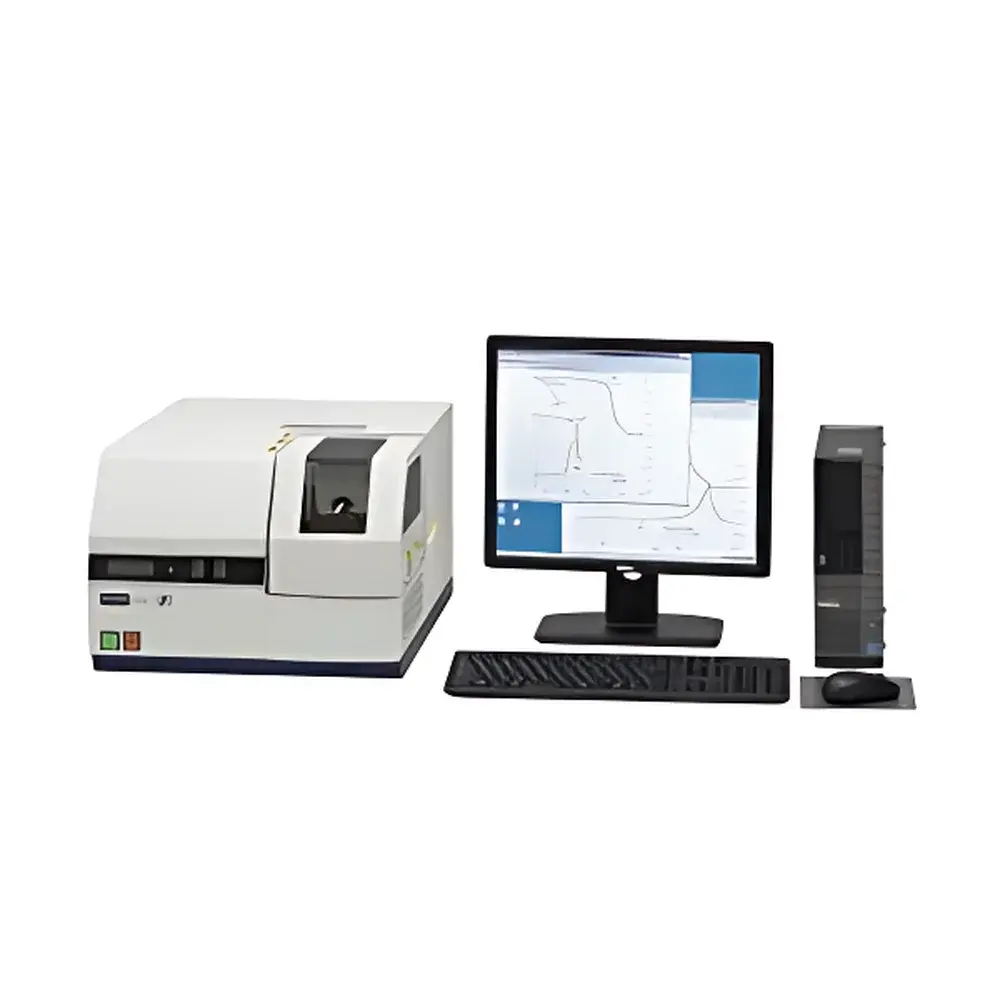
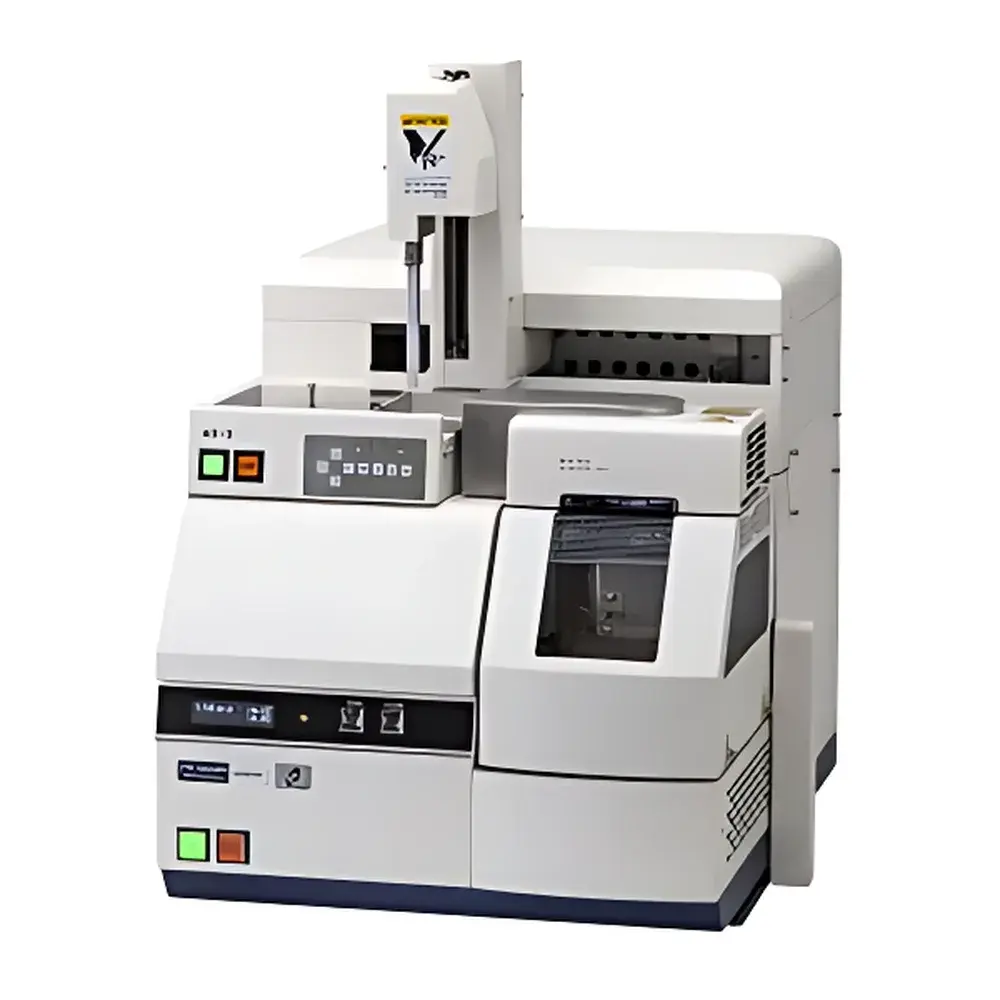
Hitachi STA7200 Series Simultaneous Thermal Analyzer (TG/DTA)
| Brand | Hitachi |
|---|---|
| Origin | Japan |
| Model Variants | STA7200, STA7200RV, STA7300 |
| Heating Rate | 0.01–150 °C/min |
| Temperature Range | Ambient to 1100 °C |
| Temperature Stability | ±0.1 °C over full range |
| Maximum Sample Capacity | ±400 mg |
| Atmosphere Options | Ambient air, inert gas (N₂, Ar), optional gas flow control via mass flow meter |
| Real-Time Sample Imaging | Up to 1000 °C with RV-3TG optical module |
| Autosampler Compatibility | AS-3T (50-position) |
| Control Architecture | Digital horizontal differential balance with active drift compensation |
| Cooling Method | FRONT-STREAM low-thermal-mass design |
Overview
The Hitachi STA7200 Series is a high-precision simultaneous thermal analyzer engineered for concurrent thermogravimetric (TG) and differential thermal analysis (DTA) measurements under controlled atmospheric conditions. Based on the fundamental principles of thermal decomposition, phase transition, and oxidative/reductive reactions, the system employs a digital horizontal differential microbalance coupled with a symmetrical furnace architecture to deliver exceptional baseline stability and sub-microgram mass resolution. Its core measurement methodology adheres to ASTM E1131, ISO 11358, and USP guidelines for thermal stability and compositional analysis. Designed for R&D laboratories, quality control departments, and regulatory-compliant manufacturing environments, the STA7200 platform supports GLP/GMP-aligned workflows through hardware-level temperature traceability, real-time data logging, and audit-ready instrument diagnostics.
Key Features
- Digital horizontal differential balance with active zero-point correction and automatic thermal drift compensation—ensuring TG baseline stability better than ±1 µg over 60 minutes at 1000 °C.
- FRONT-STREAM furnace design featuring ultra-low thermal mass and dual-zone heating elements, enabling rapid heating rates up to 150 °C/min and cooling from 1000 °C to 100 °C in under 12 minutes without external cryogenic assistance.
- Integrated DTA sensor with symmetrical thermocouple pairs (Type S) for high-sensitivity exo/endothermic peak detection; DTA resolution ≤ 0.1 °C at 10 °C/min.
- Modular atmosphere control: standard ambient and inert gas (N₂, Ar) compatibility; optional mass flow controller (MFC) for precise gas flow regulation (0–200 mL/min) and programmed gas switching during dynamic runs.
- Real-time visual monitoring via the RV-3TG optical module: 1080p CMOS camera with motorized zoom, calibrated field-of-view measurement tools, and synchronized video overlay on TG/DTA curves—operational up to 1000 °C under inert or static air conditions.
- AS-3T 50-position autosampler with programmable sample weighing, lid actuation, and sequential purge cycles—fully integrated into Hitachi’s TA-60WS software for unattended multi-day operation.
Sample Compatibility & Compliance
The STA7200 accommodates solid powders, granules, thin films, fibers, and small metallic coupons (max. Ø 5 mm × 2 mm height). Crystalline, amorphous, and composite materials—including pharmaceuticals, battery cathode/anode materials, polymers, catalysts, and geological specimens—are routinely analyzed. All models comply with IEC 61010-1 for laboratory electrical safety and meet electromagnetic compatibility (EMC) requirements per EN 61326-1. Data integrity is maintained per FDA 21 CFR Part 11 when used with TA-60WS v3.5+ and validated electronic signature modules. Calibration protocols follow ISO/IEC 17025-accredited procedures using certified reference materials (e.g., Ni, Al₂O₃, CaC₂O₄·H₂O).
Software & Data Management
TA-60WS is the dedicated Windows-based acquisition and analysis suite supporting real-time curve overlay, derivative (DTG) calculation, peak deconvolution, kinetic modeling (Kissinger, Ozawa-Flynn-Wall), and multi-step reaction simulation. Raw data files (.tdf) are stored in vendor-neutral HDF5 format with embedded metadata (operator ID, timestamp, instrument serial number, calibration history). Audit trails record all parameter modifications, manual interventions, and report exports. Export options include CSV, ASCII, and PDF with customizable templates compliant with internal SOPs or external regulatory submissions.
Applications
- Pharmaceutical: Quantification of residual solvents, hydrate/dehydrate transitions, excipient compatibility screening, and thermal degradation kinetics of APIs.
- Materials Science: Oxidation onset temperature of carbon composites, sintering behavior of ceramics, decomposition profiles of MOFs, and thermal stability of perovskite solar cell layers.
- Battery R&D: Solid-electrolyte interphase (SEI) formation analysis, cathode structural evolution upon cycling, and thermal runaway threshold determination under ARC-simulated conditions.
- Polymers: Crosslinking density estimation, filler dispersion assessment via char yield, and flame-retardant mechanism validation through gas-phase product correlation.
- Geochemistry: Clay mineral dehydration sequences, carbonate decomposition stoichiometry, and organic matter maturation modeling in shale samples.
FAQ
What is the maximum operating temperature for real-time imaging with the RV-3TG module?
The RV-3TG optical system is rated for continuous operation up to 1000 °C under inert atmosphere; image clarity remains stable with calibrated pixel-to-micron scaling.
Can the STA7200 perform quantitative gas evolution analysis?
While standalone TG/DTA does not identify evolved gases, the system is compatible with optional FTIR or QMS coupling via heated transfer line (up to 300 °C) for evolved gas analysis (EGA).
Is the autosampler compatible with corrosive or hygroscopic samples?
Yes—the AS-3T features sealed sample pans with inert-gas purged loading chamber and programmable pre-purge cycles to minimize moisture or oxygen exposure prior to measurement.
How often does the instrument require recalibration?
Mass calibration is recommended before each high-accuracy campaign using certified weights; temperature calibration using NIST-traceable standards is advised quarterly or after major maintenance.
Does the system support custom atmosphere programming (e.g., gas switching during a single run)?
Yes—when equipped with the optional 3-channel mass flow controller, users can define time- or temperature-triggered gas composition changes within a single method file.
Related Products



