
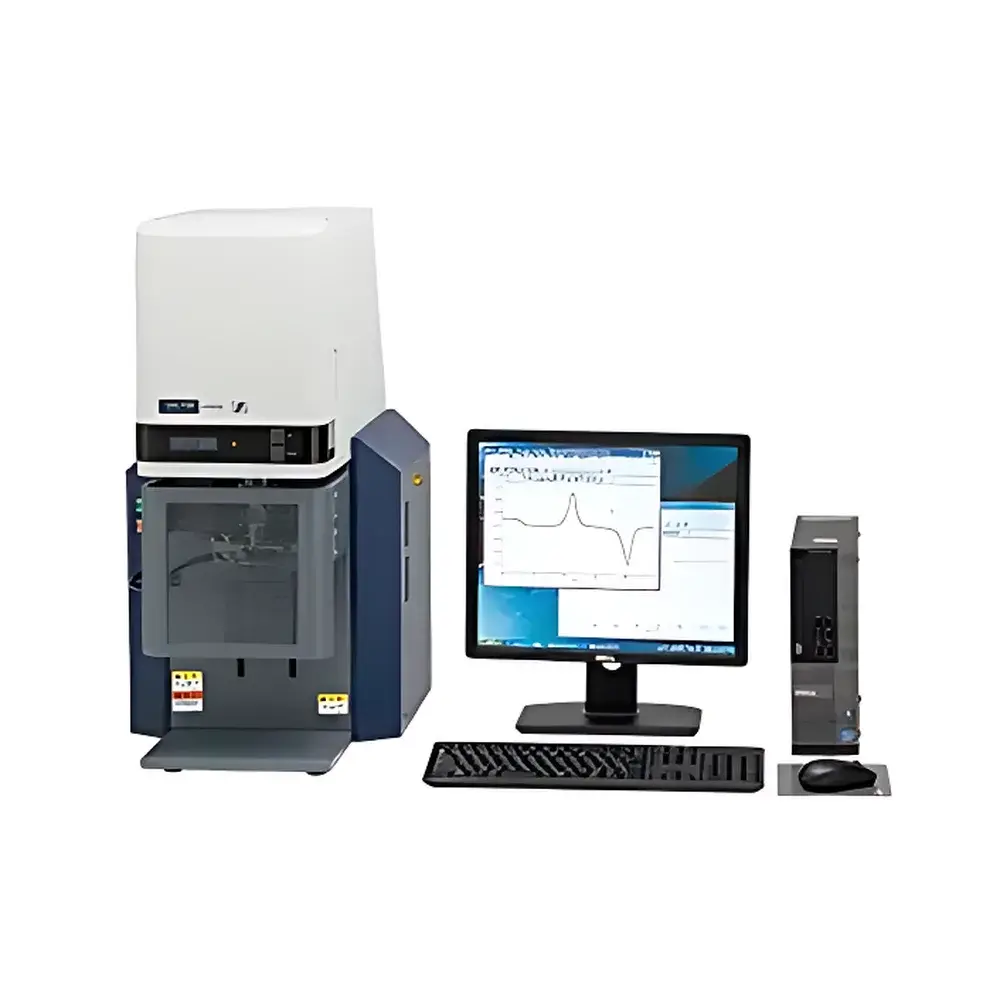
Hitachi TMA7100 Advanced Thermomechanical Analyzer
| Brand | Hitachi |
|---|---|
| Origin | Japan |
| Model | TMA7100/TMA7300 |
| Heating Rate | 0.01–100 °C/min |
| Temperature Range | –170 to 600 °C (standard) |
| Temperature Stability | ±0.1 °C over –170 to 600 °C |
| Maximum Sample Mass | ±400 mg |
| Atmosphere Control | Ambient air, inert gas (N₂, Ar), vacuum (~13 Pa)*² |
| Cooling Options | Liquid nitrogen (40% reduced consumption vs. prior models), optional Peltier-based electronic cooling |
| Gas Flow Control | Integrated mass flow controller for automated gas switching and precise atmosphere regulation |
| Humidity Capability | Optional high-temperature/humidity module for swelling and hygrothermal testing |
Overview
The Hitachi TMA7100 Advanced Thermomechanical Analyzer is a precision-engineered instrument designed for quantitative measurement of dimensional changes in solid and semi-crystalline materials as a function of temperature, time, and applied load. Operating on the fundamental principle of controlled-force thermomechanical displacement detection, the TMA7100 employs a high-resolution linear variable differential transformer (LVDT) coupled with a newly developed signal optimization circuit to achieve twice the sensitivity of conventional TMA systems. This enhanced resolution enables reliable detection of sub-nanometer-scale expansions, contractions, softening, and creep behavior across an exceptionally broad thermal range—from cryogenic conditions at –170 °C to ultra-high temperatures up to 1500 °C (with optional furnace configuration). Its modular probe architecture supports interchangeable mechanical configurations—including expansion, penetration, compression, and tension modes—without hardware recalibration, ensuring consistent traceability and minimizing inter-mode variability.
Key Features
- Enhanced Sensitivity Architecture: A proprietary low-noise signal processing pathway reduces baseline drift and thermal-electronic interference, delivering reproducible displacement resolution better than 1 nm under standard operating conditions.
- Multi-Mode Mechanical Flexibility: Single-probe-swapping capability allows rapid transition between expansion, needle penetration, uniaxial compression, and fiber/tape tensile configurations—each maintaining calibrated force application from 0.01 mN to 10 N.
- Extended Thermal Operational Range: Standard configuration covers –170 °C to 600 °C with ±0.1 °C stability; high-temperature variant extends to 1500 °C with optimized ceramic furnace and radiation shielding.
- Intelligent Atmosphere Management: Integrated mass flow controller (MFC) enables programmable, closed-loop regulation of purge gas (N₂, Ar, He) or vacuum down to 13 Pa, with automatic gas-switching sequences synchronized to temperature ramps.
- Energy-Efficient Thermal Control: Optimized cryogenic cooling design reduces liquid nitrogen consumption by ~40% versus legacy Hitachi TMA platforms; Peltier-based electronic cooling is available as a maintenance-free alternative for applications below 200 °C.
- Optional Environmental Modules: High-temperature/humidity accessory supports controlled RH environments (10–95% RH) up to 120 °C, enabling direct measurement of moisture-induced swelling, plasticization, and hygrothermal expansion coefficients per ASTM D5229 and ISO 11359-2.
Sample Compatibility & Compliance
The TMA7100 accommodates diverse geometries—including thin films (≥5 µm), irregular fragments, powders (in quartz crucibles), fibers, coatings, and bulk polymers—without requiring custom fixtures. Its contact-mode probe design eliminates shape-dependent artifacts common in optical dilatometers. The system complies with key international standards for thermal analysis instrumentation, including ISO 11359-1 (general principles), ISO 11359-2 (TMA-specific methodology), ASTM E831 (linear thermal expansion), and ASTM D696 (coefficient of linear thermal expansion for plastics). When configured with audit-trail-enabled software and electronic signature modules, it meets GLP and FDA 21 CFR Part 11 requirements for regulated pharmaceutical and medical device development laboratories.
Software & Data Management
Operation is managed via Hitachi’s TA-6000 Series software platform, supporting real-time visualization, multi-step program scripting (ramp-hold-isotherm cycles), and automated baseline correction algorithms. Data export conforms to ASTM E1447-compliant ASCII and universal .tdf formats, facilitating integration with LIMS and statistical process control (SPC) systems. All raw sensor outputs—including displacement, load, temperature, gas flow, and vacuum pressure—are time-stamped with microsecond resolution and stored with full metadata (operator ID, calibration history, environmental logs). Software validation packages are available for IQ/OQ/PQ documentation in GMP-regulated environments.
Applications
The TMA7100 serves critical roles in polymer science (glass transition Tg, coefficient of thermal expansion CTE, filler-matrix interface analysis), advanced ceramics (sintering kinetics, phase-transition strain), battery materials (electrode swelling during cycling, separator shrinkage onset), aerospace composites (out-of-plane expansion under thermal cycling), and semiconductor packaging (CTE mismatch assessment between die, mold compound, and leadframe). It is routinely deployed in R&D labs for formulation screening, QC release testing of high-performance resins, and failure analysis of thermally induced delamination or warpage.
FAQ
What sample geometries are supported without custom tooling?
Standard probes accommodate films, rods, powders (in crucibles), fibers, and irregular solids—no machining or mounting jigs required.
Can the TMA7100 operate under controlled humidity?
Yes, with the optional HT/HUM module, enabling RH-controlled measurements from 10% to 95% RH at temperatures up to 120 °C.
Is vacuum operation compatible with all temperature ranges?
Vacuum mode (~13 Pa) is fully functional from ambient to 600 °C; above 600 °C, inert gas purging is recommended for filament protection.
How is calibration traceability maintained across probe types?
Each probe carries a unique calibration certificate referencing NIST-traceable reference standards; software auto-applies correction factors upon recognition.
Does the system support 21 CFR Part 11 compliance?
Yes—when equipped with TA-6000 v4.2+ and optional security pack, including role-based access, electronic signatures, and immutable audit trails.



