
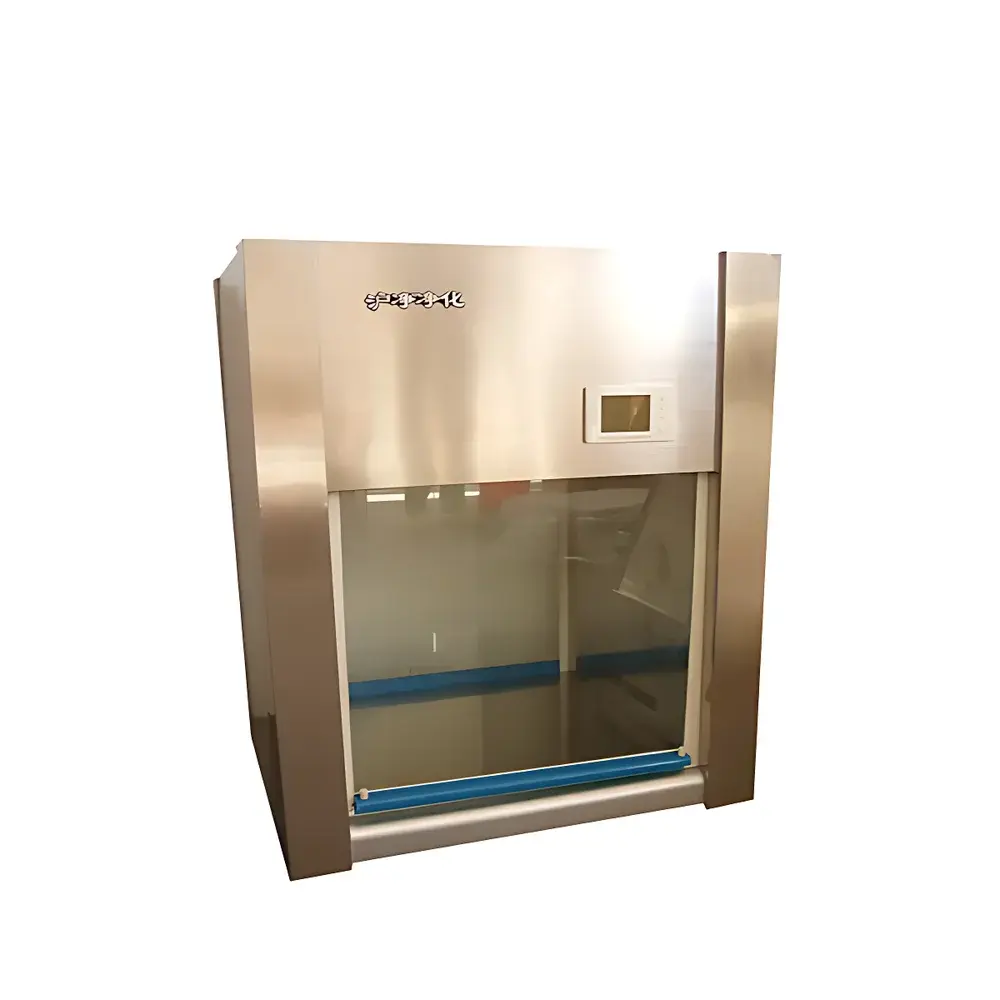
HJ APB-777 Stainless Steel Pass-Through Chamber
| Brand | HJ Purification |
|---|---|
| Origin | Shanghai, China |
| Manufacturer Type | Direct Manufacturer |
| Region Classification | Domestic (China) |
| Model | APB-777 |
| Price | USD 520 (FOB Shanghai) |
| Cleanroom Class | ISO Class 5 (equivalent to Fed. Std. 209E Class 100 @ ≥0.5 µm) |
| Average Air Velocity | 0.25–0.45 m/s |
| Sound Pressure Level | ≤62 dB(A) |
| Power Supply | AC 220 V, 50 Hz, Single Phase |
| HEPA Filter Dimensions | 480 × 460 × 38 mm (×1) |
| Internal Working Dimensions | 500 × 480 × 500 mm |
| Overall External Dimensions | 650 × 530 × 850 mm |
| Construction Material | 304 Stainless Steel (Interior & Frame) |
| Interlocked Door Control | Dual-door mechanical/electrical interlock with automatic fan activation on either door opening |
| UV Germicidal Lamp | 254 nm low-pressure mercury lamp, synchronized with fan operation |
| LED Illumination | Integrated white-light LED panel, fan-synchronized |
Overview
The HJ APB-777 Stainless Steel Pass-Through Chamber is an engineered solution for controlled material transfer between classified environments—specifically between ISO Class 5 (Fed. Std. 209E Class 100) cleanrooms and adjacent lower-classified or non-classified areas. Designed in accordance with core principles of unidirectional airflow containment and particulate mitigation, the unit functions as a static barrier that eliminates the need for direct door openings between zones, thereby preserving pressure differentials and minimizing airborne contamination ingress. Its operational principle relies on vertical laminar airflow generated by a centrifugal blower system, delivering filtered air across the transfer cavity at a validated velocity range (0.25–0.45 m/s) to sweep particles away from the work surface and through the downstream HEPA filter. The chamber is not a standalone cleanroom but a critical ancillary device integrated into cleanroom HVAC and contamination control protocols—commonly deployed in pharmaceutical manufacturing suites, biotechnology labs, medical device assembly rooms, and semiconductor front-end facilities where ISO 14644-1 compliance is mandatory.
Key Features
- 304 stainless steel construction throughout interior surfaces, frame, and door panels—electropolished finish ensures corrosion resistance, non-porosity, and compatibility with routine disinfection agents (e.g., 70% IPA, hydrogen peroxide vapor).
- Full-radius internal corner radii (R ≥15 mm) eliminate particle-trapping crevices and support effective wipe-down validation per ISO 14644-3 Annex B.
- Dual-door mechanical and electrical interlock prevents simultaneous door opening; fan activation is triggered automatically upon opening either door—ensuring immediate airflow re-establishment without operator intervention.
- Synchronized operation: HEPA-filtered airflow, UV-C germicidal irradiation (254 nm), and LED task lighting are all activated concurrently with fan startup—enabling concurrent decontamination and visibility during transfer cycles.
- Single-point power connection (220 V AC, 50 Hz) with internal circuit protection; no external control cabinet required—simplifies integration into existing cleanroom utility infrastructure.
- Modular HEPA filter housing allows field replacement without tools; filter service life is monitored via differential pressure gauge (optional add-on) aligned with ISO 14644-3 maintenance guidelines.
Sample Compatibility & Compliance
The APB-777 accommodates rigid, non-volatile, non-outgassing items up to 500 mm (W) × 480 mm (D) × 500 mm (H). It is unsuitable for heat-sensitive biological samples, open liquid containers, or powders prone to electrostatic dispersion. All materials contacting the interior—including gaskets and lamp housings—meet USP Class VI biocompatibility requirements. The unit complies with ISO 14644-1:2015 (Class 5 performance verification), IEC 60335-1 (general safety), and GB/T 25915.3–2010 (Chinese national standard for cleanroom equipment). While not certified to FDA 21 CFR Part 11, its design supports audit-ready documentation when paired with external logbooks or LIMS-integrated transfer records per GMP Annex 1 (2022) Section 8.42.
Software & Data Management
This pass-through chamber operates as a hardware-only device with no embedded firmware or network interface. All operational states—fan runtime, UV exposure duration, and door-open events—are observable via front-panel indicators. For regulated environments requiring traceability, integration with facility-wide Building Management Systems (BMS) or MES platforms is achievable via dry-contact relay outputs (available as factory option). Audit trails must be maintained externally using calibrated timers and signed paper logs aligned with ALCOA+ principles (Attributable, Legible, Contemporaneous, Original, Accurate, Complete, Consistent, Enduring, Available).
Applications
- Transfer of sterilized tools, glassware, and component trays between Grade A/B and Grade C/D cleanroom zones in aseptic processing lines.
- Handover of QC sample vials and analytical standards between microbiology labs and adjacent preparation rooms under EU GMP Annex 1 controls.
- Material exchange in Class 100 laminar flow hoods used for cell culture media preparation, where ambient particulate load must remain below 3,520 particles/m³ @ ≥0.5 µm.
- Supporting ISO 13485-certified medical device packaging lines where validated transfer integrity directly impacts sterility assurance level (SAL).
- Integration into ISO/IEC 17025-accredited calibration laboratories for passing reference standards without compromising metrological environment stability.
FAQ
Does the APB-777 include HEPA filter certification documentation?
Yes—each unit ships with a manufacturer-issued filter test report showing initial DOP/PAO scan results at ≥99.99% efficiency for 0.3 µm particles, compliant with EN 1822-1.
Can the UV lamp be disabled independently of the fan?
No—the UV-C lamp and LED lighting are hardwired to the fan control circuit to ensure consistent decontamination timing; manual override is not supported per safety standard IEC 62471.
Is the unit suitable for use in explosion-proof environments?
No—it lacks ATEX or IECEx certification and contains non-intrinsically safe components; installation in hazardous locations requires third-party explosion-proof enclosure retrofitting.
What is the recommended maintenance interval for the HEPA filter?
Under continuous operation in ISO Class 5 environments, replace the HEPA filter every 12–18 months—or sooner if differential pressure exceeds 250 Pa—as verified by in-situ manometer readings.
Does the interlock mechanism meet ISO 14644-3 functional testing requirements?
Yes—the dual-door interlock undergoes factory functional verification per ISO 14644-3 Clause 8.3.2.2, with failure mode testing confirming zero probability of concurrent door release under simulated fault conditions.



