
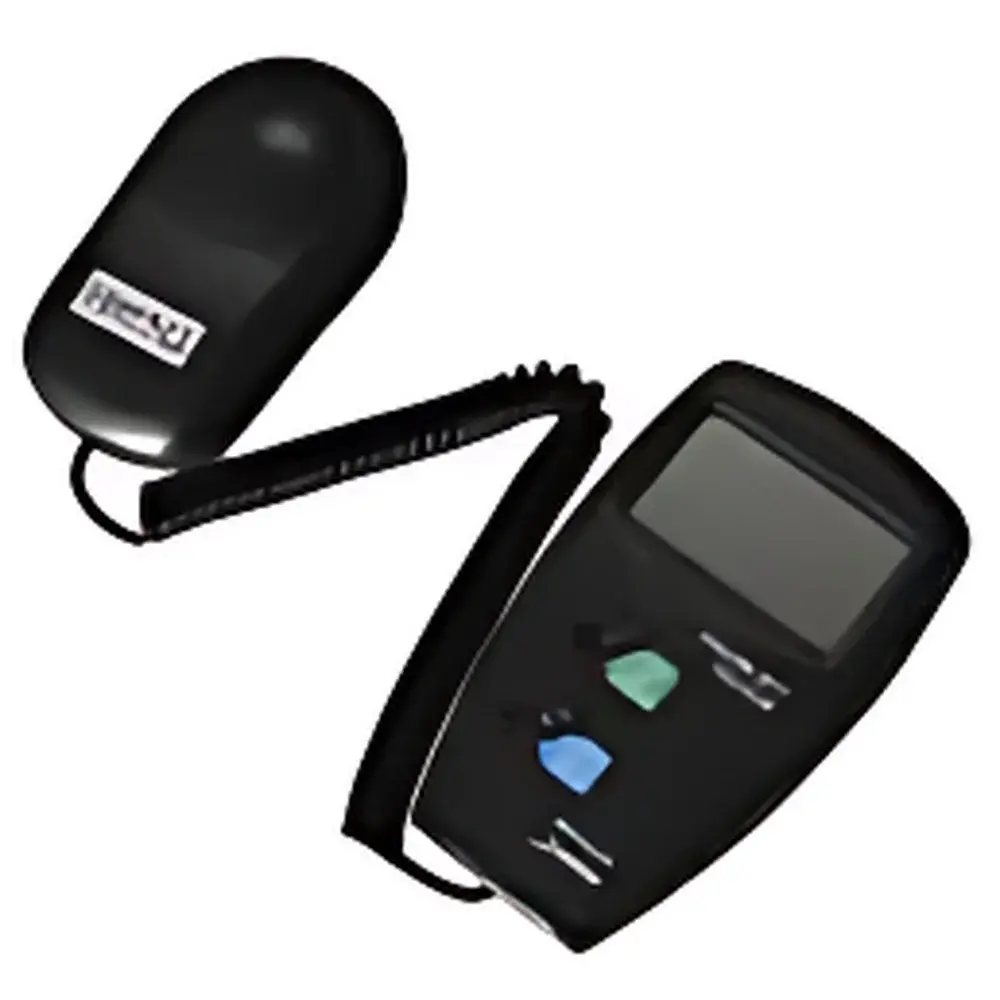
HJ LX1010B Digital Illuminance Meter
| Brand | HJ |
|---|---|
| Origin | Shanghai, China |
| Manufacturer Type | Direct Manufacturer |
| Product Origin | Domestic (China) |
| Model | LX1010B |
| Sensor Type | Silicon Photodiode with V(λ)-matched Optical Filter |
| Display | 3½-digit LCD (max. 1999 counts) |
| Accuracy | ±4% rdg ±0.5% f.s. (±5% rdg ±10 digits for >10,000 Lux range, calibrated against 2856 K standard tungsten lamp) |
| Ranges | 2000 Lux / 20,000 Lux (×10 multiplier) / 100,000 Lux (×100 multiplier) |
| Resolution | 1 Lux (on 2000 Lux range) |
| Repeatability | ±2% |
| Temperature Coefficient | ±0.1% / °C |
| Sampling Rate | 2 samples/sec |
| Hold Function | Yes |
| Photodetector | V(λ)-corrected silicon photodiode with diffuser and spectral filter |
| Dimensions (Sensor Head) | 106 × 57 × 26 mm |
| Dimensions (Main Unit) | 130 × 72 × 30 mm |
Overview
The HJ LX1010B Digital Illuminance Meter is a portable, hand-held optical measurement instrument engineered for reliable quantification of visible-light illuminance in accordance with the CIE photopic luminosity function V(λ). It employs a silicon photodiode sensor spectrally corrected to match the human eye’s relative luminous efficiency curve under standard illuminant A (2856 K), ensuring metrological traceability for general lighting assessment, workplace compliance verification, and environmental light monitoring. Designed for routine use in industrial facilities, cleanroom validation, architectural lighting design, educational laboratories, and facility management workflows, the LX1010B delivers stable, repeatable readings across three manually selected measurement ranges—2000 Lux, 20,000 Lux (×10 scaling), and 100,000 Lux (×100 scaling)—with a native resolution of 1 Lux on the lowest range. Its compact dual-unit architecture separates the cosine-corrected sensor head from the main display unit via a shielded cable, minimizing parallax error and enabling flexible positioning during spot or area measurements.
Key Features
- V(λ)-matched silicon photodiode sensor with integrated diffuser and precision optical filter for photometric accuracy compliant with CIE 1931 standard observer characteristics
- 3½-digit LCD display (1999-count maximum) with automatic decimal point positioning and real-time range indication
- Three manual range selections optimized for typical indoor (2000 Lux), industrial (20,000 Lux), and high-intensity (100,000 Lux) environments
- Hold function for freezing instantaneous readings during transient or hard-to-access measurements
- Temperature-compensated analog front-end with ±0.1% / °C drift correction to maintain stability across ambient conditions from 0 °C to 40 °C
- Robust mechanical design: sensor head (106 × 57 × 26 mm) and main unit (130 × 72 × 30 mm) constructed from impact-resistant ABS housing with ergonomic grip
- Sampling rate of 2 Hz supports dynamic light evaluation without aliasing in most non-pulsed lighting applications
Sample Compatibility & Compliance
The LX1010B is intended for measurement of steady-state or slowly varying broadband visible light sources—including incandescent, halogen, fluorescent, LED, and OLED luminaires—provided they emit within the 380–780 nm spectral band and exhibit minimal ultraviolet or near-infrared leakage. Its V(λ) correction is validated per ISO/CIE 6768:1997 (Photometry — Standard Luminous Efficiency Functions) and aligns with requirements outlined in IESNA RP-1-20, EN 12464-1:2021 (Lighting of work places), and GB/T 5700–2008 (Chinese national standard for illuminance measurement). While not certified for GLP/GMP audit trails or FDA 21 CFR Part 11 compliance, its documented calibration procedure (using NIST-traceable 2856 K tungsten reference lamps) supports internal quality control documentation and ISO 9001-aligned measurement processes.
Software & Data Management
The LX1010B operates as a standalone, battery-powered instrument without embedded data logging or PC connectivity. All measurements are displayed in real time and retained only while the Hold function is active. For traceable recordkeeping, users must manually transcribe values or integrate the device into external workflows using secondary recording tools (e.g., digital logbooks, spreadsheet templates, or LIMS-compatible entry forms). Calibration certificates—issued upon factory verification—include uncertainty budgets based on ISO/IEC 17025 principles and list reference standards used (e.g., calibrated tungsten-filament lamp with spectral irradiance traceability to national metrology institutes). Users are advised to perform periodic verification using a secondary reference meter or accredited calibration service at intervals consistent with organizational quality procedures.
Applications
- Verification of lighting levels in office, classroom, hospital, and manufacturing environments against regulatory or design specifications (e.g., ≥500 Lux for precision assembly, ≥300 Lux for general office tasks)
- Cleanroom illumination mapping per ISO 14644-1 and GMP Annex 1 requirements for pharmaceutical production areas
- Commissioning and maintenance of emergency egress lighting systems per NFPA 101 and local fire codes
- Educational demonstrations of photometric units (lux, lumens/m²), inverse square law, and spectral weighting effects
- Pre-commissioning checks of LED retrofit installations to confirm uniformity and avoid glare or under-illumination
- Baseline characterization of daylight harvesting system performance in smart building deployments
FAQ
What is the spectral response characteristic of the LX1010B sensor?
The sensor uses a silicon photodiode with an optically matched filter and diffuser to approximate the CIE V(λ) photopic luminosity function, calibrated against a 2856 K tungsten standard lamp per CIE Publication No. 69.
How do I interpret readings on the 20,000 Lux and 100,000 Lux ranges?
On the 20,000 Lux range, multiply the displayed value by 10; on the 100,000 Lux range, multiply by 100 to obtain the actual illuminance in lux.
Is the LX1010B suitable for measuring pulsed or modulated light sources?
No—it is designed for quasi-steady-state illumination. Fast PWM-driven LEDs or stroboscopic sources may yield inaccurate results due to its 2 Hz sampling rate and lack of peak-hold or RMS integration capability.
Does the instrument include factory calibration documentation?
Yes—each unit ships with a calibration certificate referencing traceable standards, measurement uncertainty, and date of verification.
Can the LX1010B be recalibrated in the field?
Field recalibration is not supported; users must return the instrument to an authorized service center or accredited calibration laboratory for adjustment and re-certification.




