
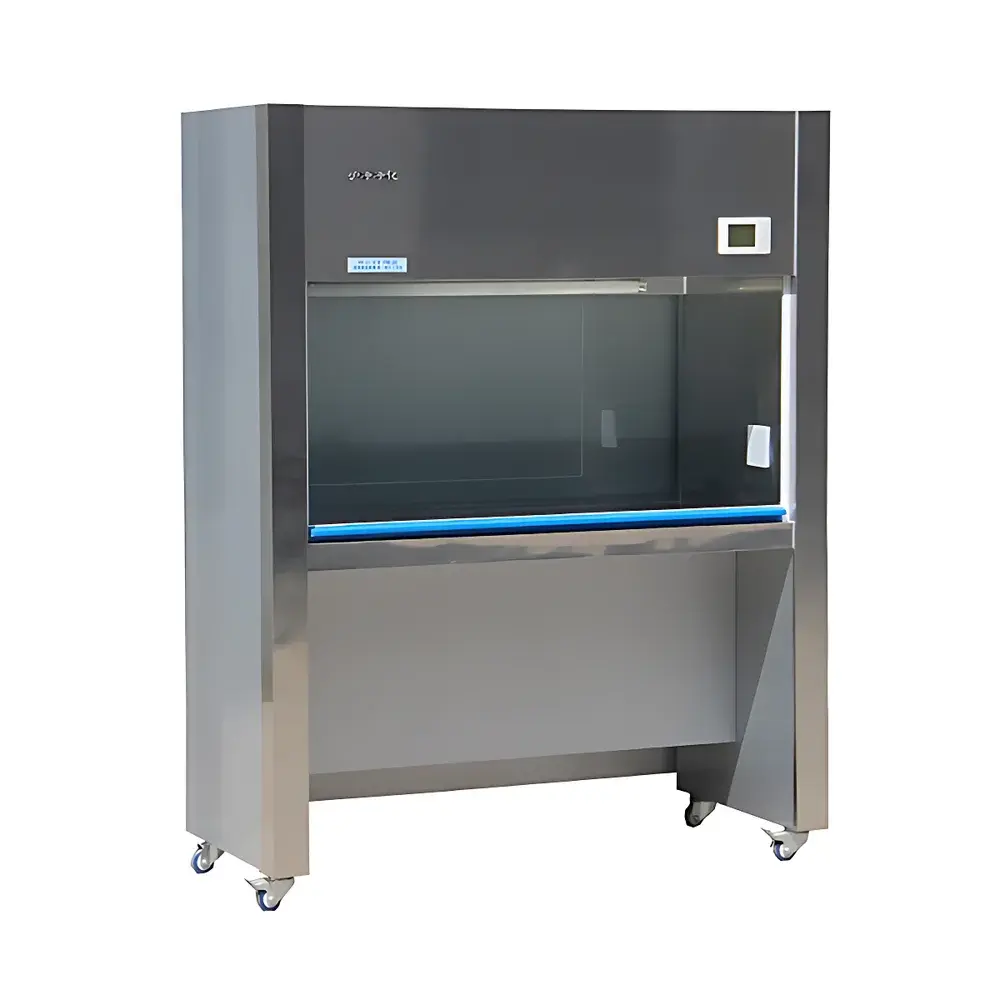
HJ SW-CJ-2D Dual-Operator Vertical Laminar Flow Clean Bench
| Brand | HJ |
|---|---|
| Origin | Shanghai, China |
| Manufacturer Type | Direct Manufacturer |
| Product Category | Domestic |
| Model | SW-CJ-2D |
| Instrument Type | Vertical Laminar Flow Clean Bench |
| Cleanliness Class | ISO Class 5 (100 @ ≥0.5 µm, Fed. Std. 209E) |
| Noise Level | ≤62 dB(A) |
| User Capacity | Dual-operator, single-front configuration |
| Airflow Pattern | Vertical downward laminar flow |
| Pre-filter | Integrated coarse particulate pre-filter |
| HEPA Filter | 1135 × 460 × 38 mm, single unit, ≥99.995% @ 0.3 µm |
| Average Face Velocity | 0.25–0.45 m/s |
| Vibration | ≤5 µm (peak-to-peak, XYZ axes) |
| Illumination | ≥300 lux |
| Power Supply | AC 220 V, 50 Hz |
| Max. Power Consumption | 600 W |
| Net Weight | 120 kg |
| Work Area Dimensions (W×D×H) | 1140 × 485 × 515 mm |
| Overall Dimensions (W×D×H) | 1300 × 550 × 1600 mm |
| Lighting | 30 W fluorescent lamp × 1 |
| UV Sterilization Lamp | 30 W × 1 |
| Control Interface | Digital LCD panel with interlocked safety logic |
Overview
The HJ SW-CJ-2D Dual-Operator Vertical Laminar Flow Clean Bench is an ISO Class 5-certified laboratory containment system engineered for routine aseptic procedures requiring unidirectional, particle-free airflow. Operating on the principle of vertical laminar flow, it draws ambient air through a pre-filter to capture coarse particulates, then forces it through a certified HEPA filter (≥99.995% efficiency at 0.3 µm) before delivering uniform, low-turbulence downward airflow across the work surface. This airflow profile establishes a protective downward velocity barrier—typically maintained between 0.25 and 0.45 m/s—that actively suppresses cross-contamination by preventing ingress of room air into the sterile work zone. Designed for dual-user operation in shared lab environments, the SW-CJ-2D complies with core performance benchmarks defined in Fed. Std. 209E and aligns with ISO 14644-1 requirements for cleanroom-grade air filtration and operational integrity.
Key Features
- Vertically oriented laminar airflow architecture with precisely calibrated face velocity control, ensuring consistent ISO Class 5 performance across the full 1140 mm work width.
- Integrated sash positioning system enabling smooth, frictionless vertical adjustment of the transparent front access window—optimized for ergonomic reach and variable workflow height requirements.
- Monocoque enclosure fabricated from pre-painted steel panels; work surface constructed from brushed 304 stainless steel (SUS304) for corrosion resistance, non-porosity, and compatibility with common disinfectants including 70% ethanol and sodium hypochlorite solutions.
- Dual-lamp system featuring a 30 W daylight-balanced fluorescent lamp for task illumination and a separate 30 W UV-C germicidal lamp (254 nm), both governed by hardware-enforced interlock logic that prevents simultaneous activation and ensures UV exposure only during unoccupied standby cycles.
- Microprocessor-based digital LCD controller providing real-time display of operational status, fan speed feedback, UV timer countdown, and fault diagnostics—including filter saturation alerts and airflow deviation warnings.
- Vertical quasi-enclosed work chamber design generating a stable downflow air curtain along all three lateral boundaries, minimizing turbulence-induced particle resuspension and enhancing protection against external environmental intrusion.
Sample Compatibility & Compliance
The SW-CJ-2D supports standard microbiological workflows involving Petri dishes (Φ90 mm), culture flasks, pipette racks, and small-scale tissue culture vessels. Its validated performance—≤0.5 colony-forming units per plate-hour under ISO 14698-1 bioaerosol challenge protocols—makes it suitable for applications governed by CLSI M22-A3, USP , and EU GMP Annex 1 (2022) guidance for non-sterile compounding and low-risk aseptic manipulations. While not classified as a biological safety cabinet (BSC), the unit meets IEC 61010-1 electrical safety standards and incorporates grounding continuity, overcurrent protection, and thermal cutoff mechanisms compliant with EN 61326-1 for laboratory measurement equipment.
Software & Data Management
This clean bench operates via embedded firmware without external software dependencies. All operational parameters—including UV cycle duration, fan runtime presets, and alarm thresholds—are configurable through the front-panel interface. Audit-ready event logging records timestamped entries for UV activation/deactivation, door position changes, and filter service intervals. Though not FDA 21 CFR Part 11-compliant out-of-the-box, the system’s deterministic behavior, hardware interlocks, and non-volatile memory retention support GLP-aligned documentation practices when integrated into site-specific SOPs.
Applications
- Routine inoculation and subculturing of bacterial and fungal isolates in clinical and academic microbiology laboratories.
- Preparation of media plates, reagent aliquoting, and sterile filtration setup prior to autoclaving or membrane filtration steps.
- Handling of non-hazardous cell lines in teaching labs and early-stage bioprocess development environments.
- Assembly and quality inspection of precision optical components where airborne particulate contamination must be minimized below 100 particles/ft³ (≥0.5 µm).
- Pharmaceutical stability testing sample preparation under controlled particulate conditions aligned with ICH Q5C guidelines.
FAQ
Does this unit provide personnel or environmental protection?
No. The SW-CJ-2D is a clean bench—not a biological safety cabinet—and provides product protection only. It does not exhaust air externally nor contain aerosols generated during manipulation.
What maintenance intervals are recommended for the HEPA filter?
HEPA filter replacement is typically required every 12–24 months depending on ambient particulate load and cumulative operating hours; pre-filter cleaning should occur biweekly to extend HEPA service life.
Can the UV lamp be used while the fan is running?
No. Hardware interlocks physically disable UV emission whenever the fan is active or the sash is open, preventing ozone generation and operator UV exposure.
Is calibration traceable to national standards?
Airflow velocity verification requires periodic anemometer calibration per ISO/IEC 17025-accredited protocols; HJ provides factory-verified baseline data but does not supply NIST-traceable certificates with standard delivery.
What power infrastructure is required for installation?
A dedicated 220 V, 50 Hz, 10 A grounded circuit is mandatory; voltage fluctuations exceeding ±10% may trigger thermal shutdown or inconsistent fan performance.



