
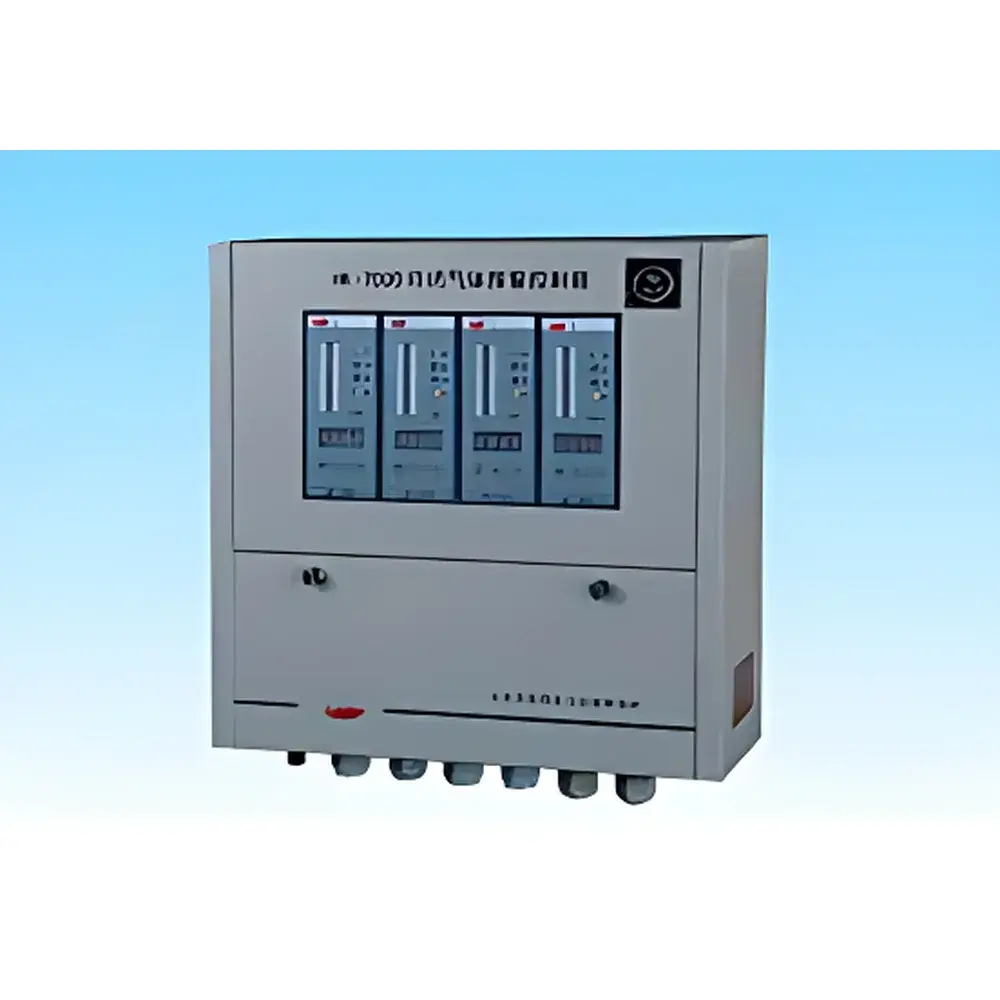
HK-7000 Combustible Gas Alarm Controller
| Brand | Huake Instrument |
|---|---|
| Origin | Beijing, China |
| Manufacturer Type | Authorized Distributor |
| Country of Origin | China |
| Model | HK-7000 |
| Pricing | Available Upon Request |
| Control Channels | 2 / 4 / 6 / 8 channels |
| Operating Temperature | 0–70 °C |
| Relative Humidity | ≤93% RH (non-condensing) |
| Input Signal | 4–20 mA (calibratable within 2–30 mA) |
| Display Range | 0–9999 (numeric), or time format (YYYY-MM-DD HH:MM:SS) |
| Analog Bar Graph | 0–100% FS |
| Communication Interface | RS-485 digital output |
| Alarm Relay Output | SPST dry contact, rated AC 220 V / 3 A or DC 24 V / 3 A |
| Alarm Functionality | Dual-stage audible/visual alarm with time-stamped event lockout |
| Data Retention | Non-volatile memory for operational history (power-on/off, alarm, fault, reset, calibration) |
| Local Calibration | Supported for connected transmitters |
| Compliance | GB 16808–1997 |
| Measurement Accuracy | ±1% FS |
| Display Resolution | 1 digit |
| Alarm Setpoint Range | 0–9999 (user-configurable) |
| Display Mode | Dual-channel — numeric LED + analog bar graph |
Overview
The HK-7000 Combustible Gas Alarm Controller is a DIN-rail mountable, microprocessor-based central monitoring unit engineered for continuous supervision of distributed gas detection systems in industrial, petrochemical, municipal, and commercial facilities. It operates on the principle of analog current loop signal processing, receiving standardized 4–20 mA output from certified combustible gas transmitters (e.g., catalytic bead or infrared sensors) and converting it into calibrated concentration readings, trend visualization, and actionable safety outputs. Designed to meet the structural, functional, and performance requirements of GB 16808–1997 (“Technical Requirements for Combustible Gas Alarm Controllers”), the HK-7000 serves as both a standalone alarm annunciator and a scalable node within larger safety instrumented systems (SIS) or building management systems (BMS). Its architecture supports deterministic response timing, non-volatile event logging, and fail-safe relay actuation—critical attributes for environments governed by process safety management (PSM) protocols.
Key Features
- Configurable channel capacity: Supports 2, 4, 6, or 8 independent 4–20 mA input loops—each assignable to discrete gas zones or multi-parameter transmitters (e.g., gas + temperature or gas + humidity).
- Dual-mode display: High-brightness 4-digit LED numeric display (0–9999) paired with a linear 100-segment LED bar graph for real-time analog trend indication—enabling rapid visual assessment of gas concentration dynamics.
- Time-synchronized operation: Integrated real-time clock (RTC) enables precise timestamping of all critical events (alarm activation, fault detection, power interruption, manual reset) with resolution down to the second.
- Dual-stage alarm logic: Programmable first-stage (pre-alarm) and second-stage (high-level alarm) thresholds, each triggering independent audible (piezoelectric buzzer) and visual (flashing LED) alerts with configurable latching behavior.
- Non-volatile “black box” memory: Stores ≥10,000 chronological records—including alarm onset/duration, sensor fault codes, power cycle timestamps, calibration logs, and operator-initiated actions—with retention guaranteed for >10 years without battery backup.
- Local transmitter calibration interface: Enables zero/span adjustment and span verification of connected 4–20 mA transmitters directly via front-panel keys—eliminating need for external handheld calibrators during routine maintenance.
- Fail-safe relay outputs: Four isolated SPST dry-contact relays (standard configuration), rated for AC 220 V / 3 A or DC 24 V / 3 A, supporting emergency shutdown, ventilation interlock, or fire panel integration per IEC 61511 SIL 1 guidelines.
Sample Compatibility & Compliance
The HK-7000 is compatible with any 4–20 mA output gas transmitter compliant with HART physical layer specifications and operating within the 2–30 mA calibration window. It accepts inputs from catalytic bead (LEL), infrared (IR), electrochemical (for toxic co-monitoring), and pressure-compensated flow/level/temperature transmitters—making it suitable for hybrid monitoring applications beyond gas-only use cases. The controller conforms to GB 16808–1997, which defines electromagnetic compatibility (EMC), environmental stress tolerance (operating at 0–70 °C, ≤93% RH non-condensing), mechanical robustness (vibration/shock resistance), and functional safety requirements for combustible gas alarm systems in China. While not CE-marked or UL-listed out-of-box, its electrical isolation, relay ratings, and signal conditioning design align with foundational principles of IEC 60079-0 (explosive atmospheres) and ISO 13849-1 (safety-related control systems) for integration into internationally certified installations.
Software & Data Management
The HK-7000 operates without external software dependency; all configuration, calibration, and historical data retrieval occur via intuitive front-panel navigation using membrane keys and LED feedback. Event logs are browsable in chronological order with filter options (alarm/fault/power/reset), and each entry includes timestamp, channel ID, measured value, and status flag. For system-level integration, the built-in RS-485 port supports Modbus RTU protocol (slave mode, address 1–247), enabling read-only access to real-time channel values, alarm states, relay positions, and memory index pointers—facilitating centralized SCADA logging or CMMS synchronization. Audit trails comply with basic GLP/GMP documentation expectations: no user-editable log entries, immutable timestamps, and clear distinction between automatic and manual events.
Applications
- Natural gas distribution stations and LNG terminals—monitoring for methane leakage at compressor skids, metering runs, and odorant injection points.
- Chemical storage warehouses and solvent handling areas—detecting hydrocarbon vapors (e.g., propane, butane, gasoline blends) near loading docks or drum-filling stations.
- Wastewater treatment plants—supervising biogas (CH₄/H₂S) accumulation in digesters, sludge dewatering halls, and enclosed pump stations.
- Industrial boiler rooms and HVAC mechanical rooms—verifying combustion air quality and detecting fuel gas leaks upstream of burners.
- Municipal infrastructure tunnels and underground parking garages—deployed alongside CO and NO₂ sensors for comprehensive ambient air hazard assessment.
- Multi-point indoor air quality (IAQ) monitoring—used in conjunction with thermal mass flow or differential pressure transmitters to cross-validate ventilation efficacy.
FAQ
Does the HK-7000 support HART communication with field transmitters?
No—the device receives only analog 4–20 mA signals and does not decode HART digital superimposed data. Configuration of HART-enabled transmitters must be performed separately using a HART communicator.
Can alarm setpoints be configured differently per channel?
Yes—each of the 2/4/6/8 input channels supports independent low-alarm (LA), high-alarm (HA), and fault thresholds, programmable via the front panel.
Is battery backup required to retain event logs during power loss?
No—non-volatile Flash memory ensures full retention of all logged events for over a decade without auxiliary power.
What is the maximum cable length supported for 4–20 mA signal transmission?
With standard 1.5 mm² twisted-pair shielded cable and 24 V DC loop supply, maximum recommended distance is 600 meters per channel (subject to voltage drop and noise immunity considerations).
Does the HK-7000 meet ATEX or IECEx certification requirements?
No—it is not intrinsically safe nor explosion-proof rated. It is intended for installation in safe-area control rooms or non-hazardous zones, interfacing with certified field devices installed in classified areas.







