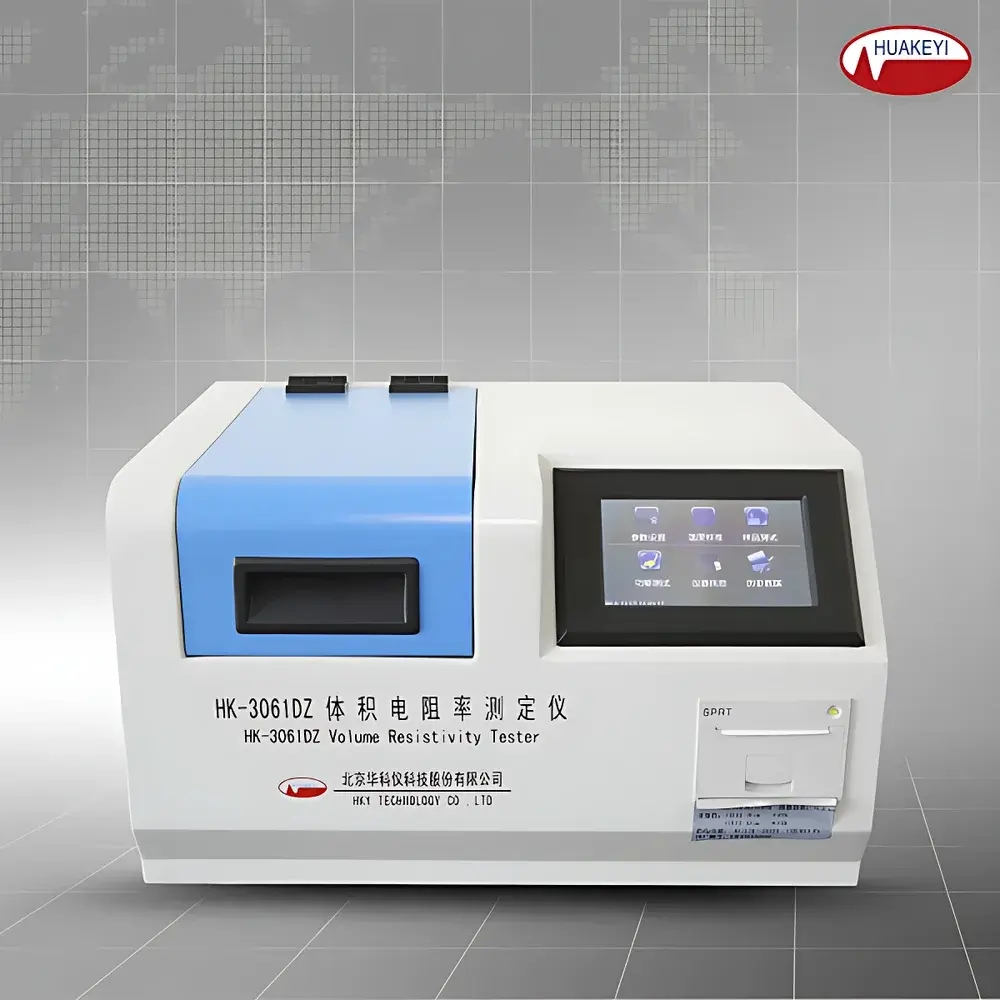
Huake HK-3061DZ Volume Resistivity Tester
| Brand | Huake |
|---|---|
| Model | HK-3061DZ |
| Power Supply | (198–264) VAC, 50/60 Hz |
| Test Voltage | DC 500 V |
| Resistivity Range | 1×10⁸ – 1×10¹⁶ Ω·cm |
| Repeatability | ≤15% |
| Reproducibility | ≤25% |
| Temperature Control Range | Low-temp bath (10–30) °C |
| Temperature Accuracy | ±0.2 °C |
| Electrode Cells | 4 (3 high-temp, 1 low-temp) |
| Data Storage | 500 test records with date-based retrieval |
| Interface | USB (standard), RJ-45 Ethernet (standard), RS-232 (optional) |
| Dimensions | 400 × 320 × 240 mm (L×W×H) |
| Weight | 15 kg |
| Operating Environment | 10–35 °C, ≤70% RH, non-corrosive, low EMI/EMF |
Overview
The Huake HK-3061DZ Volume Resistivity Tester is a precision laboratory instrument engineered for the quantitative determination of volume resistivity (Ω·cm) in insulating liquids—including mineral insulating oils, phosphate ester-based anti-wear hydraulic fluids (e.g., turbine control oil), and synthetic ester dielectric fluids—according to DL/T 421-1991, the Chinese power industry standard aligned with fundamental principles of IEEE Std 262 and IEC 60247. It operates on the direct-current (DC) two-electrode method: a stable 500 V DC bias is applied across a standardized cylindrical test cell containing the sample, and the resulting leakage current is measured under precisely controlled thermal conditions. Volume resistivity is calculated per ρ = R × A / d, where R is the measured resistance, A is the electrode area, and d is the gap between electrodes. The system integrates dual independent temperature baths (low-temperature: 10–30 °C; high-temperature: ambient to 100 °C), enabling compliance with test protocols requiring evaluation at multiple standardized temperatures (e.g., 20 °C, 40 °C, 70 °C, or 90 °C), critical for assessing aging behavior and oxidation stability in transformer and generator cooling systems.
Key Features
- High-resolution color TFT touchscreen interface with switchable English/Chinese menu navigation and context-sensitive prompts for intuitive operator guidance
- PID-based intelligent temperature regulation using PT1000 platinum resistance thermometers, delivering ±0.2 °C thermal stability across both low- and high-temperature zones
- Triple-sample automated measurement sequence: three high-temperature cells operate in rotation, minimizing manual intervention and enhancing throughput in routine QC labs
- Dual-bath architecture supports simultaneous conditioning of samples at distinct setpoints—essential for comparative analysis of insulation performance across service temperatures
- Integrated safety architecture including lid-open interlock, overtemperature cutoff, current limiting, and automatic post-test discharge sequencing to ensure operator and equipment protection
- Real-time display of raw resistance, calculated resistivity, temperature, elapsed time, and status flags—ensuring full traceability during active measurement
Sample Compatibility & Compliance
The HK-3061DZ is validated for use with hydrocarbon-based insulating oils (e.g., naphthenic and paraffinic mineral oils), silicone fluids, and phosphate ester anti-wear fluids meeting ASTM D6981 and IEC 60836 specifications. Its electrode cell geometry conforms to the dimensions and surface finish requirements defined in DL/T 421-1991 and referenced in ASTM D1169. All measurements are performed under controlled ambient conditions (10–35 °C, ≤70% RH, EMI/EMF-minimized environment) to meet GLP data integrity requirements. The instrument’s firmware implements audit-trail-capable event logging—including user ID, timestamp, parameter settings, and result values—to support regulatory readiness for ISO/IEC 17025-accredited laboratories and utilities operating under China’s State Grid Corporation technical supervision framework.
Software & Data Management
Data handling is governed by an embedded real-time operating system supporting secure local storage of up to 500 complete test records, each tagged with date/time stamp, operator ID (if configured), bath temperature, measured resistivity, and pass/fail flag relative to user-defined specification limits. Records are searchable by calendar date range and exportable via USB mass-storage mode in CSV format for integration into LIMS platforms. Standard RJ-45 Ethernet connectivity enables remote configuration, firmware updates, and scheduled data push to centralized databases—fully compatible with HL7 and ASTM E1384-compliant messaging protocols. Optional RS-232 serial interface provides legacy SCADA system integration. All stored data retain immutable timestamps and are write-protected against accidental overwrites.
Applications
- Routine quality control of new and reclaimed insulating oils prior to transformer filling
- Condition monitoring of in-service transformer oil to detect moisture ingress, oxidation byproducts, or conductive particle contamination
- Acceptance testing of phosphate ester fluids used in electro-hydraulic control systems of steam turbines
- Research-grade evaluation of novel biodegradable dielectric fluids under accelerated aging protocols
- Verification of cleaning efficacy following oil reclamation processes (e.g., vacuum dehydration, clay filtration)
- Supporting root-cause analysis during transformer failure investigations per IEEE C57.106 guidelines
FAQ
What standards does the HK-3061DZ comply with?
It is designed and verified to meet DL/T 421-1991 and incorporates measurement principles consistent with IEC 60247, ASTM D1169, and IEEE Std 262.
Can the instrument measure resistivity at non-standard temperatures?
Yes—the high-temperature bath is continuously adjustable from ambient to 100 °C in 0.1 °C increments, allowing custom test points beyond prescribed standards.
Is calibration traceable to national metrology institutes?
The system accepts certified reference resistors (e.g., 1 GΩ to 100 TΩ) for periodic verification; calibration certificates issued by CNAS-accredited providers are recommended annually.
How is data integrity ensured during network transmission?
RJ-45 communication uses TCP/IP with configurable authentication and TLS 1.2 encryption when interfaced with enterprise LIMS servers.
What maintenance is required for long-term accuracy?
Quarterly inspection of electrode cup surfaces for pitting or residue buildup, annual verification of PT1000 sensor drift, and biannual replacement of thermal bath fluid (silicone oil or ethylene glycol/water mix) per manufacturer guidelines.