
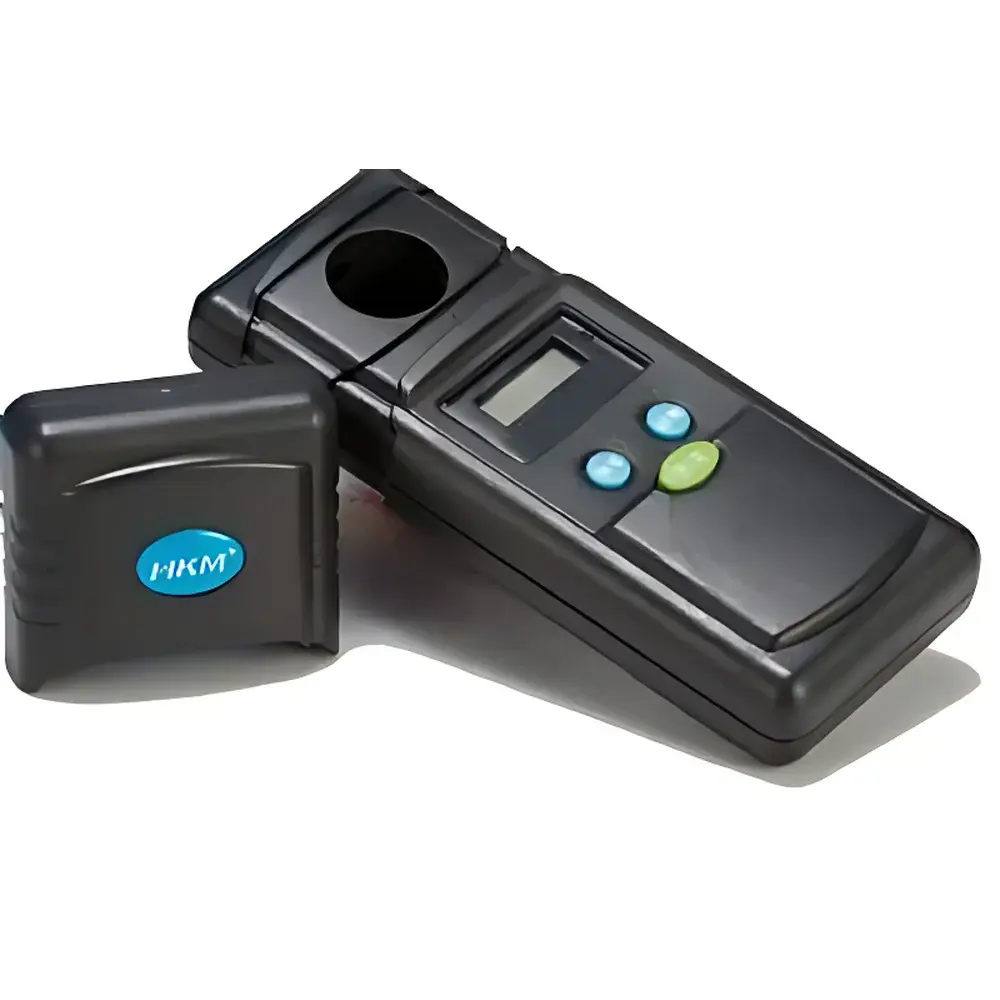
HKM S-107 HR Portable Chlorine Dioxide Colorimeter
| Brand | HKM |
|---|---|
| Origin | Guangdong, China |
| Model | S-107 |
| Measurement Range | 5–999 mg/L |
| Wavelength | 450 nm |
| Light Source | Blue LED |
| Accuracy | ±5% |
| Display | LCD (mg/L) |
| Operating Temperature | 0–40 °C |
| Relative Humidity | 0–90% RH (non-condensing) |
| Power | 1 × 9 V battery (≥40 h lifetime) |
| Dimensions | 170 × 70 × 30 mm |
| Weight | 200 g (with battery) |
| Includes | Instrument host, 2 matched cuvettes |
| Compliance | Aligned with GB 26366–2010 and methodology per 2002 Disinfection Technical Guidelines (Spectrophotometric Method) |
Overview
The HKM S-107 HR Portable Chlorine Dioxide Colorimeter is a dedicated photometric instrument engineered for rapid, on-site quantification of free chlorine dioxide (ClO₂) concentration in aqueous solutions. It operates on the principle of fixed-wavelength absorbance measurement at 450 nm, utilizing a stable blue light-emitting diode (LED) source and calibrated optical path geometry to detect the characteristic yellow-orange color intensity generated by the reaction between ClO₂ and a proprietary chromogenic reagent system. Unlike iodometric or titrimetric methods—such as the outdated丙二酸碘量法 (malonic acid–iodometric method) specified in GB/T 20783–2006—the S-107 HR employs a validated spectrophotometric approach aligned with the 2002 Chinese Disinfection Technical Guidelines. This ensures direct correlation with biologically active ClO₂ species, not precursor anions (e.g., chlorite, ClO₂⁻), thereby delivering operationally relevant data for disinfection process control. Its design targets real-time monitoring in municipal water treatment, food processing rinse lines, hospital sterilization systems, and HVAC cooling tower management—where accurate, unambiguous ClO₂ concentration informs dosing efficacy and regulatory compliance.
Key Features
- Direct-read LCD display showing ClO₂ concentration in mg/L without manual calculation or dilution
- Wide linear dynamic range: 5–999 mg/L—optimized for both low-level residual monitoring and high-concentration generator output verification
- Integrated 450 nm blue LED optical system with factory-calibrated photodetector, minimizing drift and wavelength dependency
- Compact handheld form factor (170 × 70 × 30 mm; 200 g with battery) suitable for field use, mobile labs, and point-of-use validation
- Low-power architecture enabling ≥40 hours of continuous operation on a single 9 V alkaline battery
- Self-contained measurement workflow: no external software, PC interface, or reagent preparation required
- Rugged ABS housing with IP54-rated ingress protection against dust and incidental moisture
Sample Compatibility & Compliance
The S-107 HR is validated for use with potable water, wastewater effluent, swimming pool recirculation streams, and industrial process water containing free ClO₂. It excludes interference from residual free chlorine (Cl₂), combined chlorine (chloramines), and low concentrations of nitrite (<5 mg/L) when used per protocol. The instrument’s methodology conforms to the spectrophotometric procedure outlined in the 2002 *Disinfection Technical Guidelines* (Ministry of Health, PRC), and its operational range directly supports the exposure concentration thresholds defined in GB 26366–2010 *Hygienic Standard for Chlorine Dioxide Disinfectants*. While not certified to ISO/IEC 17025, its performance characteristics—including ±5% accuracy across the full scale and repeatability <3% RSD (n=10)—meet routine QC requirements for GLP-aligned environmental and hygiene laboratories. It does not comply with FDA 21 CFR Part 11 due to absence of electronic audit trail or user authentication features.
Software & Data Management
The S-107 HR is a standalone, firmware-based instrument with no embedded microprocessor logging, USB connectivity, or cloud synchronization capability. All measurements are displayed in real time on the monochrome LCD; no data storage, export, or timestamping functions are implemented. Users must manually record results in lab notebooks or external LIMS systems. Firmware updates are not supported in-field; calibration constants are permanently stored in non-volatile memory during manufacturing. For laboratories requiring electronic records, integration is limited to visual transcription or optional third-party digital capture via smartphone imaging (not validated or endorsed by HKM).
Applications
- Verification of ClO₂ generator output concentration prior to injection into municipal distribution networks
- Monitoring residual ClO₂ in hospital endoscope reprocessing rinse water per GB 26366–2010 minimum efficacy thresholds (≥2 mg/L)
- Quality assurance of ClO₂-based sanitizers in dairy and beverage production lines
- Field assessment of ClO₂ stability in packaged disinfectant solutions during shelf-life studies
- Educational demonstration of oxidant-specific photometry principles in environmental engineering curricula
- Troubleshooting disinfection failures linked to inaccurate legacy iodometric assays
FAQ
Does the S-107 HR measure total chlorine or only free chlorine dioxide?
It measures only free, dissolved ClO₂ via selective chromogenic reaction. It does not respond to Cl₂, ClO₂⁻, ClO₃⁻, or NH₂Cl.
Can it be used for wastewater with high turbidity or suspended solids?
Samples must be filtered (≤0.45 µm) prior to analysis to avoid scattering artifacts; unfiltered high-turbidity matrices require centrifugation or clarification.
Is calibration traceable to NIST or national metrology institutes?
Calibration is performed using HKM-certified ClO₂ reference standards prepared gravimetrically against potassium iodate primary standard; NIST-traceable certificates are not supplied with standard units.
What maintenance is required beyond battery replacement?
Annual optical path cleaning with lint-free swabs and isopropyl alcohol is recommended; no user-serviceable internal components exist.
How does it differ from laboratory-grade UV-Vis spectrophotometers?
It sacrifices spectral flexibility and multi-analyte capability for portability, speed (<3 min/sample), and operator independence—making it a purpose-built tool for routine ClO₂ verification, not research-grade speciation.
Related Products







