
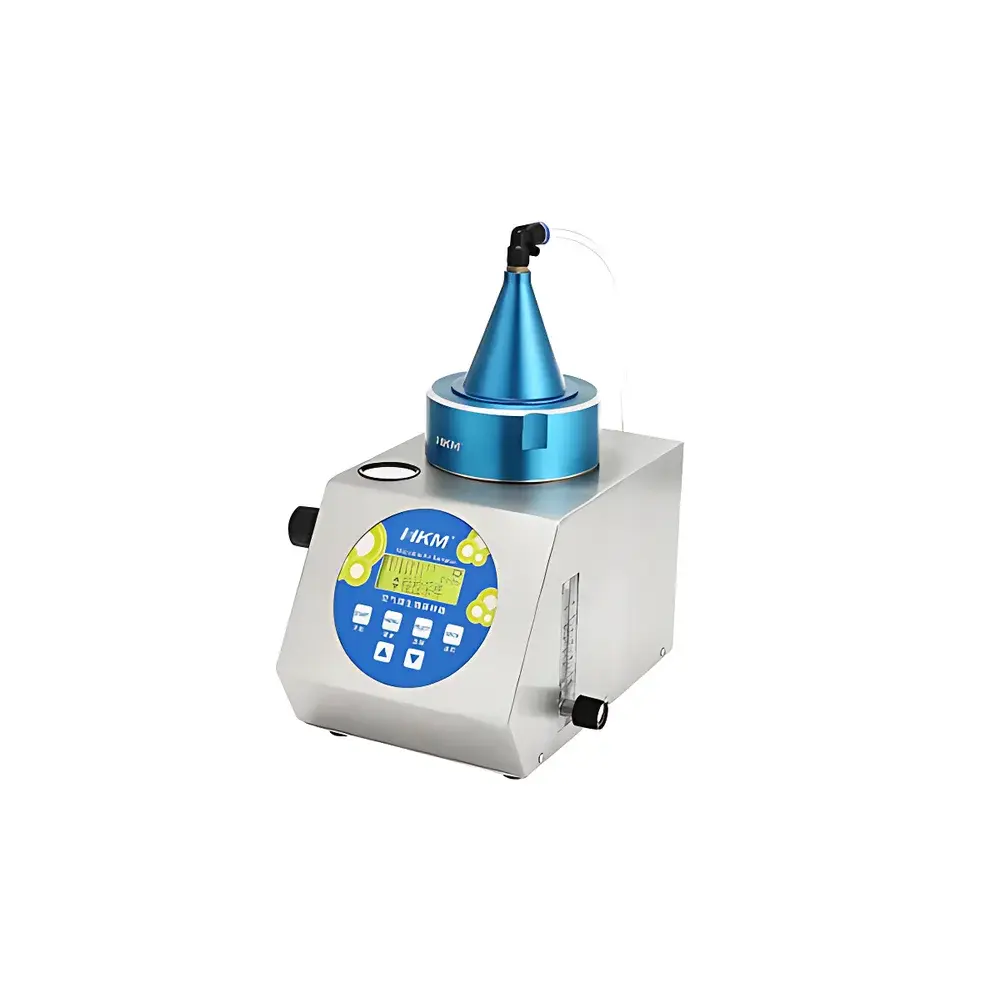
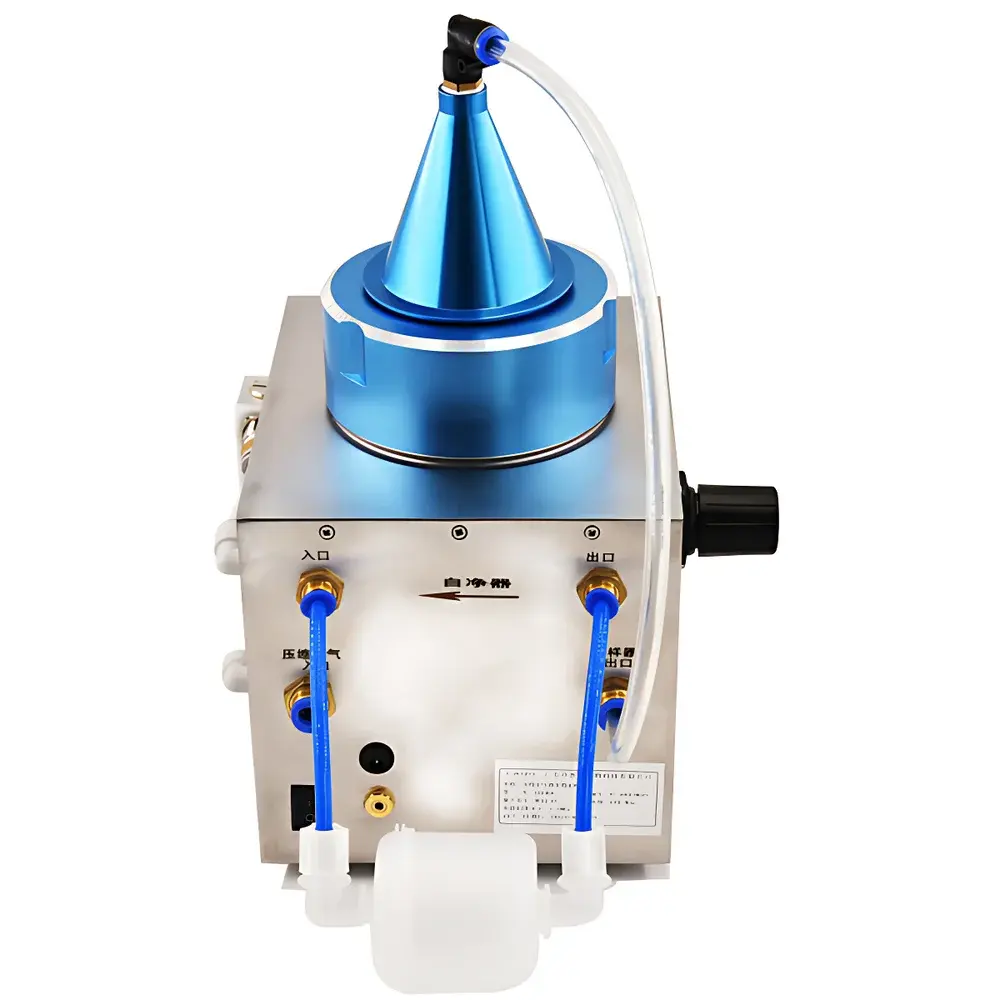
HKM CG100A Automated Compressed Air Microbial Sampler
| Brand | HKM |
|---|---|
| Model | CG100A |
| Sampling Principle | Anderson Impactor-Based Impaction |
| Flow Rate | 100 L/min (adjustable 10–100 L/min) |
| Pressure Range | 0–1 MPa |
| Sampling Volume Range | 10–6000 L |
| Sampling Duration | Up to 24 h per cycle |
| Data Storage Capacity | 8,000 records |
| Power Supply | DC 8.4 V / 6000 mAh Li-ion battery (24 h continuous operation) |
| Dimensions | 26.5 × 23.5 × 31.5 cm |
| Weight | 4.5 kg |
| Housing Material | Stainless steel main unit |
| Display | 122 × 32 LCD with bilingual (English/Chinese) interface |
| Input Voltage | 100–240 V AC, 50–60 Hz (via external adapter) |
Overview
The HKM CG100A Automated Compressed Air Microbial Sampler is a precision-engineered environmental monitoring instrument designed for quantitative assessment of viable airborne microorganisms in compressed gas systems. It operates on the well-established Anderson impactor principle—where compressed air, after regulated pressure reduction and flow stabilization, is directed through a multi-stage, multi-orifice sampling head. Under controlled impaction velocity, viable particles ≥0.65 µm are inertially deposited onto standard agar-filled Petri dishes. This physical separation mechanism ensures high collection efficiency for bacteria, yeasts, molds, and other culturable aerosols without reliance on filtration or liquid impingement. The device meets core functional requirements for ISO 8573-7:2019 (Compressed air — Part 7: Testing for viable particles), and supports compliance with pharmaceutical GMP Annex 1 (2022), USP , and EU GMP guidelines for compressed air quality validation in sterile manufacturing environments.
Key Features
- Fully automated sampling cycle: Programmable volume-based termination (10–6000 L), eliminating manual intervention and operator-induced variability.
- Integrated dual-sensor feedback loop: Real-time monitoring of inlet pressure (0–1 MPa) and volumetric flow rate (10–100 L/min) enables dynamic regulation to maintain consistent impaction velocity—critical for reproducible microbial recovery across variable supply pressures.
- Bilingual LCD interface (English/Chinese): 122 × 32 pixel display shows real-time parameters including elapsed time, cumulative volume, site code, date/time stamp, and battery status—facilitating multi-site deployment in multinational facilities.
- Open-plate compatibility: Accepts standard 90 mm Petri dishes with conventional microbiological media (e.g., TSA, SDA, Sabouraud Dextrose Agar); no proprietary consumables required.
- Optimized multi-orifice impactor head: 400 precisely aligned micro-nozzles minimize particle overlap and shadowing effects, reducing colony coalescence and improving count accuracy per ISO 14698-1.
- Robust data integrity architecture: Each sampling event auto-generates an immutable record—including timestamp, location ID, total volume, pressure reading, and battery level—stored locally in non-volatile memory (8,000-entry capacity).
- Field-deployable power system: High-capacity 7.4 V / 6000 mAh lithium-ion battery delivers uninterrupted 24-hour operation under nominal 100 L/min flow, with no memory effect and UL-certified safety circuitry.
Sample Compatibility & Compliance
The CG100A is validated for use with standard aerobic and selective culture media used in pharmaceutical, food, and healthcare settings. Its impactor geometry and calibrated flow path ensure adherence to ISO 8573-7’s recommended sampling conditions for Class 1–4 compressed air quality grading. Device firmware and data logging support ALCOA+ principles (Attributable, Legible, Contemporaneous, Original, Accurate, Complete, Consistent, Enduring, Available) required for FDA 21 CFR Part 11–aligned workflows. While not certified to IEC 61000-6-3 or ATEX, its stainless-steel housing and low-power electronics meet IP54 ingress protection standards for cleanroom-adjacent utility corridors and compressed air distribution rooms.
Software & Data Management
Data export is performed via USB 2.0 interface using HKM-provided PC software (Windows 10/11 compatible). Exported files are saved in CSV format with UTF-8 encoding, enabling direct import into LIMS platforms or statistical analysis tools (e.g., Minitab, JMP). Audit trail functionality logs all configuration changes, user logins, and calibration events with timestamps and operator IDs. Software supports batch report generation compliant with ISO/IEC 17025 documentation requirements, including uncertainty estimation for volume delivery based on factory-calibrated flow sensor drift specifications.
Applications
- Pharmaceutical manufacturing: Routine monitoring of compressed air used in fluid bed dryers, tablet coating pans, and aseptic filling lines per EU GMP Annex 1 Section 8.62.
- Biotechnology facilities: Validation of instrument air quality for bioreactor control systems and clean steam generators.
- Food & beverage processing: Verification of compressed air contact points in packaging machinery (e.g., pneumatic conveyors, bottle rinsing nozzles) per BRCGS Issue 9 Clause 4.10.2.
- Hospital central gas systems: Surveillance of medical-grade air supplied to surgical tools and dental units per ISO 8573-1:2010 Class 2 purity requirements.
- Third-party contract laboratories: Supporting ISO/IEC 17025-accredited testing services for compressed air certification reports.
FAQ
Does the CG100A require annual recalibration?
Yes—HKM recommends traceable flow and pressure sensor recalibration every 12 months using NIST-traceable standards, documented per ISO/IEC 17025 clause 6.5.
Can it sample gases other than compressed air?
It is validated for compressed air only; nitrogen or CO₂ may cause differential impaction efficiency due to altered gas density and viscosity—validation per ISO 14644-3 Annex B is required prior to use.
Is the data storage encrypted?
Local storage uses write-once memory architecture with CRC32 checksum validation; encryption is not applied, but exported CSV files may be secured externally per organizational IT policy.
What is the minimum detectable colony-forming unit (CFU) concentration?
Detection limit depends on sampling volume and plate incubation: at 6000 L volume and 48-h TSA incubation, theoretical LOD is ≤0.17 CFU/m³ assuming 100% recovery efficiency.
Does it comply with FDA 21 CFR Part 11?
The device itself does not provide electronic signature capability; however, its audit-trail-enabled software and immutable local records support Part 11 implementation when integrated within a validated enterprise system.
Related Products







