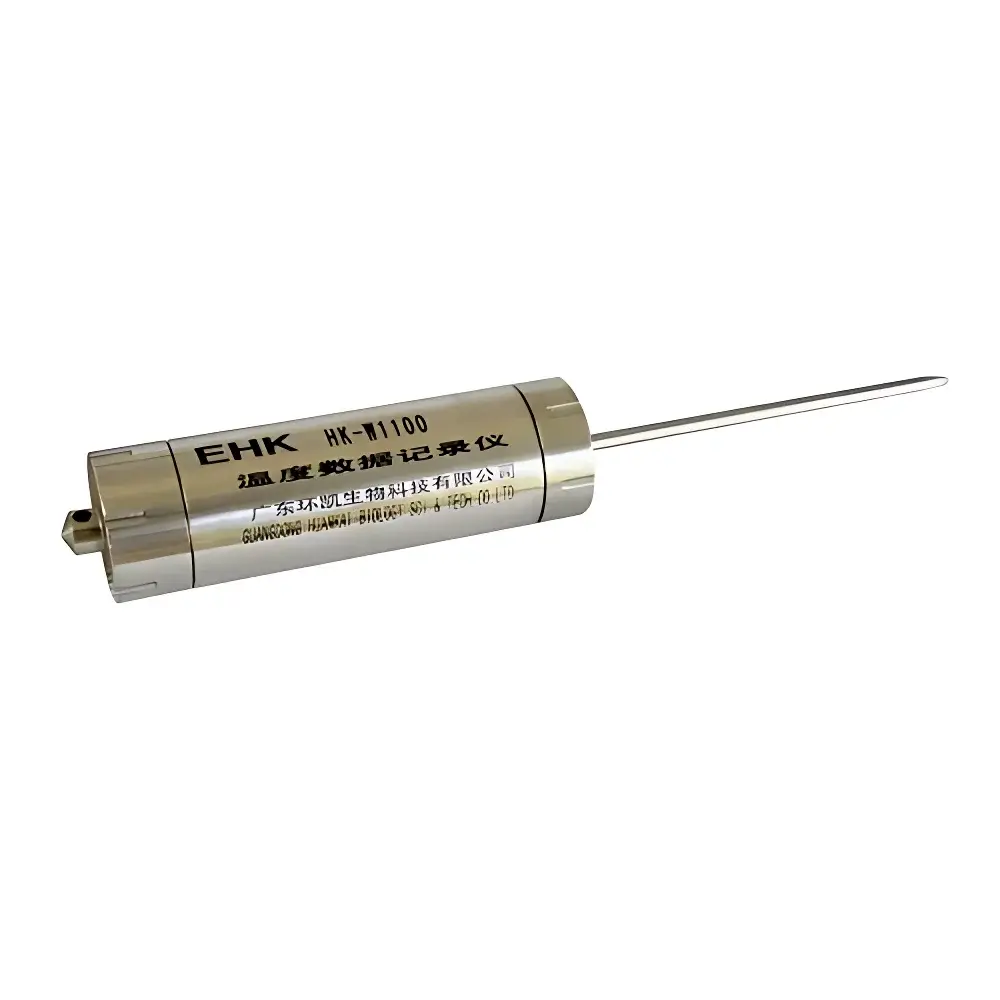
HKM HT-100 High-Temperature Steam Sterilizer Temperature Data Logger (Thermal Penetration Validation System)
| Brand | HKM |
|---|---|
| Model | HT-100 |
| Origin | Guangdong, China |
| Instrument Type | Single-Channel Temperature Data Logger |
| Measurement Range | −40 °C to +140 °C |
| Accuracy | ±(0.15 + 0.002T) °C |
| Resolution | 0.01 °C |
| Sensor | Class A Pt100 RTD |
| Max Continuous Exposure | 140 °C for 60 min or 135 °C for 90 min |
| Memory Capacity | 5700 data points |
| Logging Interval | Configurable in 1-minute increments |
| Power Source | 3.6 V high-temperature lithium battery (typical service life: ~12 months under standard validation duty cycle) |
| Probe Dimensions | Φ4 × 84 mm |
| Housing Material | Stainless steel |
| Ingress Protection | IP68 |
| Interface | USB 2.0 compliant |
| Compliance | Designed for thermal validation per ISO 17665-1, ISO 11134, EN 285, and FDA 21 CFR Part 11–ready software workflows |
Overview
The HKM HT-100 High-Temperature Steam Sterilizer Temperature Data Logger is a purpose-built thermal validation instrument engineered for precise, time-resolved temperature monitoring inside pressurized steam sterilization chambers—including autoclaves, retorts, jacketed reactors, and industrial ovens. Operating on the principle of resistance temperature detection (RTD) using a Class A Pt100 sensor, the HT-100 captures thermally stable, traceable temperature profiles under dynamic sterilization conditions. Its core function is to support thermal process validation by quantifying thermal penetration—the rate and extent to which lethal heat energy reaches the coldest point within a product load—and thermal distribution—the spatial uniformity of temperature across chamber zones. This dual capability enables users to generate objective evidence required for regulatory compliance with ISO 17665-1 (Moist Heat Sterilization), ISO 11134 (Sterilization of Health Care Products), EN 285 (Steam Sterilizers), and USP . The device is not a standalone controller but a validated data acquisition node designed for integration into quality management systems where auditability, reproducibility, and metrological traceability are mandatory.
Key Features
- High-accuracy Class A Pt100 RTD sensor with calibrated accuracy of ±(0.15 + 0.002T) °C across −40 °C to +140 °C, traceable to national standards.
- Rugged stainless-steel housing rated IP68—fully submersible and pressure-resistant—ensuring integrity during steam-saturated cycles up to 3 bar(g).
- Continuous operational capability at 140 °C for 60 minutes or 135 °C for 90 minutes, validated per IEC 60751 and manufacturer thermal stress testing protocols.
- Onboard memory stores up to 5700 timestamped temperature readings; data retention remains stable without power for ≥10 years post-recording.
- Integrated 3.6 V high-temperature lithium battery optimized for thermal stability—no voltage drift or premature cutoff under sustained elevated ambient conditions.
- USB 2.0 interface supports direct, driver-free connection to Windows-based PCs for rapid data offload and configuration via HKM Validation Suite software.
- Compact, wireless, and probe-integrated design eliminates wiring constraints—enabling placement at critical locations (e.g., cold spots, product cores, chamber corners) without modifying equipment geometry or compromising seal integrity.
Sample Compatibility & Compliance
The HT-100 is compatible with liquid-filled containers, sealed pouches, porous loads, and solid matrices commonly processed in pharmaceutical, biotech, food, and medical device sterilization. Its Φ4 × 84 mm stainless-steel probe allows insertion into simulated product loads (e.g., biological indicators, reference standards, or dummy vials) while maintaining mechanical robustness and thermal response fidelity. The system conforms to the physical and metrological requirements of thermal mapping and heat penetration studies as defined in ISO 17665-1 Annex C and PDA Technical Report No. 1. All recorded datasets include embedded timestamps, instrument ID, calibration status flags, and environmental metadata—supporting full ALCOA+ (Attributable, Legible, Contemporaneous, Original, Accurate, Complete, Consistent, Enduring, Available) data integrity principles. When used with HKM Validation Suite, audit trails, electronic signatures, and 21 CFR Part 11–compliant user access controls are fully implemented.
Software & Data Management
The HT-100 operates exclusively with HKM Validation Suite—a validated, installable desktop application supporting multi-instrument synchronization, automated report generation (PDF/CSV), and overlay comparison of up to 16 concurrent temperature profiles. The software implements configurable alarm thresholds, deviation flagging, and statistical summary tables (min/max/mean/delta-T). Raw binary logs are converted into ASCII-delimited files with ISO 8601 timestamps, enabling seamless import into LIMS, MES, or statistical process control platforms. Calibration certificates—including as-found/as-left data, uncertainty budgets, and reference standard traceability—are stored alongside each validation run. All software updates undergo version-controlled release testing and are documented per GAMP 5 guidelines.
Applications
- Validation of steam sterilization cycles (gravity, pre-vacuum, and dynamic-air-removal autoclaves) per EN 285 and ISO 17665.
- Thermal mapping of sterilizer chambers to identify cold/hot spots and verify zone uniformity.
- Heat penetration studies in terminally sterilized parenterals, IV bags, and lyophilized products.
- Process qualification of depyrogenation tunnels and dry-heat ovens used in component cleaning.
- Retort validation for low-acid canned foods under FDA 21 CFR Part 113 requirements.
- Supporting annual requalification, change control assessments, and root-cause analysis following sterilization failures.
FAQ
Is the HT-100 suitable for use inside vacuum-assisted sterilizers?
Yes—the IP68-rated housing and non-vented design prevent condensation ingress during vacuum phases, and its thermal mass ensures stable response during rapid pressure transitions.
Can the logging interval be adjusted in real time during a cycle?
No—interval settings must be pre-configured prior to deployment; the device operates autonomously once initiated to ensure deterministic timing and eliminate communication interference risks.
Does the HT-100 meet FDA 21 CFR Part 11 requirements?
The hardware itself is Part 11–neutral; compliance is achieved through HKM Validation Suite, which provides role-based access, electronic signatures, and immutable audit trails for all data handling events.
What is the recommended recalibration frequency?
Annual calibration is advised per ISO/IEC 17025 and internal quality procedures; field verification against a NIST-traceable reference thermometer is recommended before each critical validation run.
Can the probe be replaced or customized?
The probe is permanently welded and non-interchangeable to preserve calibration integrity; custom-length probes are available upon request with full recalibration and documentation.