
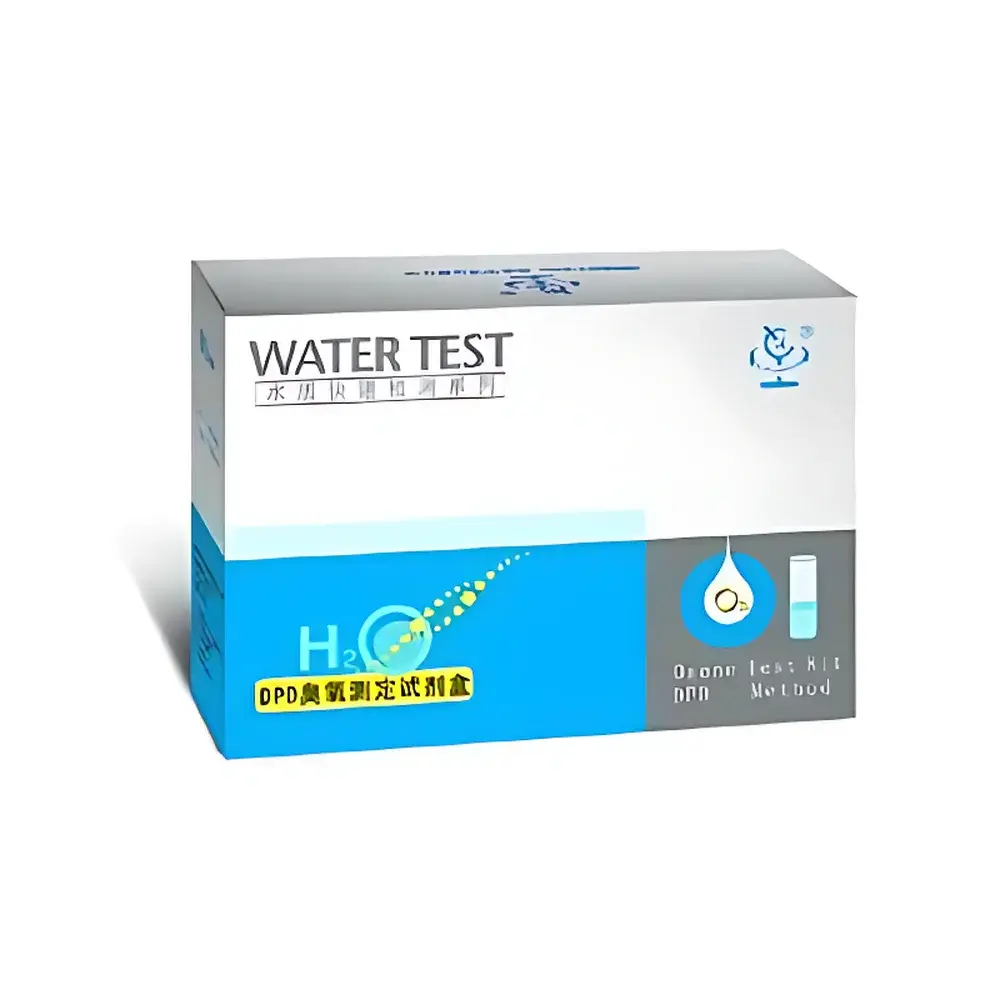
HKM Ozone Test Kit (DPD Method) – Model 090010
| Brand | HKM |
|---|---|
| Origin | Guangdong, China |
| Manufacturer Type | Authorized Distributor |
| Country of Origin | China |
| Model No. | 090010 |
| Detection Principle | DPD (N,N-Diethyl-p-phenylenediamine) Colorimetric Method |
| Measurement Range | 0.05–1.0 mg/L O₃ (8-point calibrated scale: 0.05 / 0.1 / 0.2 / 0.3 / 0.4 / 0.5 / 0.7 / 1.0 mg/L) |
| Format | Single-use tablet, individually foil-wrapped |
| Shelf Life | 24 months from manufacture date |
| Compliance | GB/T 5750.11–2023 (Standard Methods for Examination of Drinking Water – Disinfectants), ISO 6205:2021 (Water quality — Determination of ozone — DPD spectrophotometric method) |
Overview
The HKM Ozone Test Kit (Model 090010) is a field-deployable, standardized colorimetric reagent system engineered for the rapid, reliable quantification of dissolved ozone (O₃) in potable water, wastewater effluent, swimming pool circulation systems, and ozone-based disinfection validation points. It implements the internationally recognized DPD (N,N-Diethyl-p-phenylenediamine) oxidation method—where ozone selectively oxidizes DPD to a stable pink-colored quinoneimine dye, the intensity of which is directly proportional to ozone concentration. This principle is codified in GB/T 5750.11–2023 and aligned with ISO 6205:2021, ensuring metrological traceability and regulatory acceptability in routine environmental and public health monitoring workflows. Unlike legacy techniques such as the iodometric titration or carcinogenic o-tolidine assay, the DPD-based kit eliminates hazardous reagents, operator exposure risks, and laboratory dependency—enabling on-site analysis within 2 minutes without instrumentation beyond a calibrated visual comparator or portable photometer.
Key Features
- Pre-measured DPD tablets in individual aluminum foil pouches—ensuring reagent integrity, moisture resistance, and consistent dosing across field conditions.
- Eight-point calibrated concentration scale (0.05, 0.1, 0.2, 0.3, 0.4, 0.5, 0.7, and 1.0 mg/L O₃), optimized for high-resolution discrimination in the critical low-concentration range where ozone residual efficacy is most sensitive.
- 24-month shelf life under ambient storage (15–30°C, <60% RH), validated per ICH Q5C stability protocols; no refrigeration required.
- Minimal procedural steps: add tablet to 10 mL sample → mix → compare color after 90 seconds → read result; no pipetting, dilution, or timing devices needed.
- Interference mitigation: formulated to suppress common interferences including chlorine (<4 mg/L Cl₂), monochloramine (<1 mg/L NH₂Cl), and low-level manganese (<0.1 mg/L), per GB/T 5750.11–2023 Annex B.
- Traceable lot certification provided with each kit batch, including manufacturing date, expiry date, and reference to certified calibration standards (NIST-traceable ozone gas standards used during method validation).
Sample Compatibility & Compliance
The kit is validated for use with clear, non-turbid aqueous matrices including drinking water, filtered surface water, disinfected secondary effluent, and recirculated pool/spa water (turbidity 2 mg/L total suspended solids without prior filtration (0.45 µm membrane). All performance claims adhere to the precision requirements of ISO 6205:2021 (repeatability RSD ≤8% at 0.2 mg/L; reproducibility RSD ≤12% at 0.5 mg/L) and meet the accuracy criteria stipulated in US EPA Guidance Document 815-B-20-001 for field screening methods. The DPD chemistry conforms to WHO Guidelines for Drinking-water Quality (4th ed., 2017) Appendix 3.2 on disinfectant residual measurement and supports GLP-aligned recordkeeping when used with HKM’s optional LIMS-integrated logbook templates.
Software & Data Management
While the kit operates independently of electronic instrumentation, it integrates seamlessly into digital QA/QC workflows. Each foil packet carries a scannable 2D barcode linking to HKM’s Certificate of Analysis (CoA) portal—providing real-time access to lot-specific validation data, stability reports, and ISO/IEC 17025-accredited method verification summaries. For laboratories operating under 21 CFR Part 11 compliance, HKM offers an optional companion mobile application (iOS/Android) that captures geotagged test records—including time-stamped photos of comparator readings, operator ID, sample ID, and environmental notes—with encrypted cloud sync and audit trail generation. Raw data exports are compatible with CSV, PDF, and LIMS HL7 ADT interfaces.
Applications
- Verification of ozone contact chamber performance in municipal water treatment plants.
- Routine residual monitoring at point-of-application in bottled water production lines.
- Validation of ozone dosage in pharmaceutical-grade purified water (PW) and water-for-injection (WFI) distribution loops per USP .
- Emergency response testing following ozone generator maintenance or power interruption events.
- Educational use in environmental engineering labs for teaching redox-based disinfectant assay principles.
- Third-party certification audits requiring documented, repeatable field measurements compliant with ISO/IEC 17020 inspection schemes.
FAQ
Is this kit suitable for measuring ozone in seawater?
No. High chloride ion concentration (>500 mg/L Cl⁻) causes competitive oxidation of DPD and results in positive bias; alternative amperometric or UV-absorption methods are recommended for saline matrices.
Can results be correlated to instrumental ozone analyzers?
Yes—when performed by trained personnel following the kit’s SOP, correlation coefficients (r²) ≥0.985 have been demonstrated against UV photometric ozone analyzers (254 nm) across the 0.1–0.8 mg/L range in interlaboratory studies (HKM Technical Report TR-090010-2023-04).
What is the minimum detectable concentration?
The visual detection limit is 0.05 mg/L O₃ using the supplied comparator; when paired with a portable reflectance photometer (e.g., Hach DR390), the instrumental LOD improves to 0.02 mg/L (signal-to-noise ratio ≥3).
Does the kit require regulatory approval for use in drinking water compliance reporting?
It is accepted as a field screening method under China’s GB 5749–2022 and referenced in provincial drinking water surveillance guidelines; however, confirmatory lab analysis (e.g., iodometric titration per GB/T 5750.11–2023 Section 8.2) is required for official compliance documentation in regulated facilities.
Related Products







