
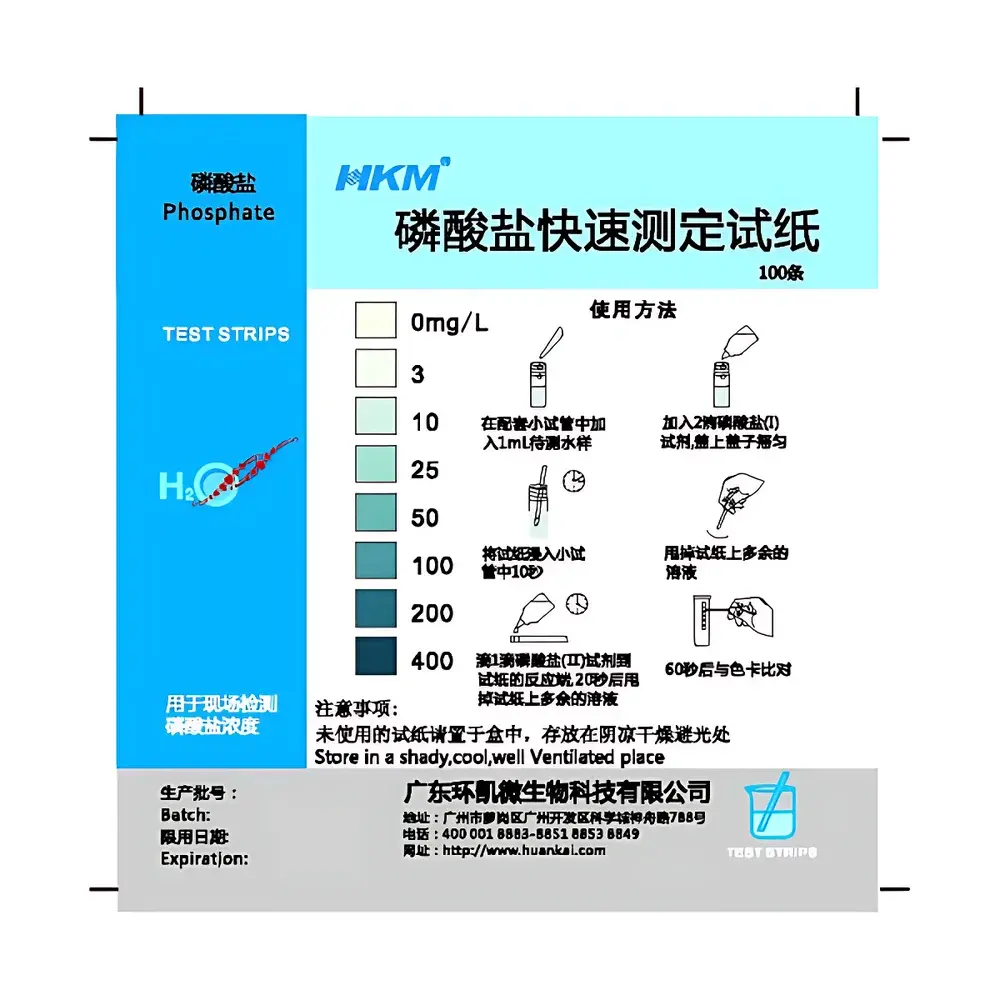
HKM Phosphate Test Strips (Model 090490)
| Brand | HKM |
|---|---|
| Origin | Guangdong, China |
| Manufacturer Type | Authorized Distributor |
| Product Category | Domestic |
| Model | 090490 |
| Price | USD 42 (approx.) |
| Detection Principle | Phosphomolybdenum Blue Colorimetric Method (for test strips) |
| Sample Matrix | Wastewater, Surface Water, Treated Effluent |
| Detection Range (Test Strips) | 0–3–10–25–50–100–200–400 mg/L PO₄³⁻ as P |
| Total Phosphorus Compatibility | Yes (requires acid persulfate or UV digestion prior to testing) |
| Calibration | Pre-calibrated visual color chart included |
| Shelf Life | 24 months from manufacture date when stored at 2–30 °C, protected from moisture and light |
| Compliance | Designed in alignment with ISO 6878:2004 (Water quality — Determination of phosphorus — Ammonium molybdate spectrophotometric method) and EPA Method 365.1 (Phosphorus, total, automated, persulfate digestion) |
Overview
The HKM Phosphate Test Strips (Model 090490) are rapid, field-deployable qualitative and semi-quantitative tools engineered for on-site screening of orthophosphate and total phosphorus concentrations in aqueous environmental samples. Based on the phosphomolybdenum blue colorimetric principle, these strips utilize a pre-immobilized reagent system that reacts selectively with soluble reactive phosphorus (SRP) under acidic conditions to form a stable blue-colored complex. The intensity of the developed color is directly proportional to phosphate concentration and is interpreted visually against an integrated, high-contrast reference chart calibrated in discrete concentration steps (0, 3, 10, 25, 50, 100, 200, and 400 mg/L as elemental phosphorus). Unlike laboratory-based spectrophotometers, this strip format eliminates the need for pipettes, cuvettes, or power sources—making it suitable for routine monitoring by field technicians, wastewater operators, and environmental educators where immediate decision support is required.
Key Features
- Rapid analysis: Results obtainable within 60–90 seconds after sample immersion
- No external instrumentation required: Fully self-contained visual readout with humidity-stable color chart
- Robust formulation: Reagent layer resistant to minor pH fluctuations (optimal range: pH 4.0–9.5) and common interfering ions (e.g., ≤500 mg/L Cl⁻, ≤100 mg/L NO₃⁻)
- Trace-level sensitivity for surface water screening: Lower detection step (3 mg/L) enables identification of elevated phosphorus loads before eutrophication thresholds are exceeded
- High thermal and shelf stability: Validated for 24-month storage at ambient temperatures up to 30 °C when sealed in original aluminum pouch
- Integrated quality control: Each batch includes lot-specific calibration verification data traceable to NIST-traceable phosphate standards
Sample Compatibility & Compliance
The HKM 090490 test strips are validated for use with raw wastewater, secondary effluent, stormwater runoff, agricultural drainage, and lake/reservoir surface water. For total phosphorus determination, samples must undergo standardized wet-chemical digestion using acid persulfate (per ISO 6878:2004) or UV-persulfate oxidation (per EPA Method 365.1) prior to strip application. The product design adheres to core principles of GLP-aligned field testing: each package includes batch-specific expiration dates, storage instructions, and interference guidance per ISO/IEC 17025:2017 Annex A.3 (field methods). While not intended for regulatory reporting without confirmatory lab validation, the strips meet performance criteria for Tier 1 screening under US EPA’s National Water Quality Monitoring Council (NWQMC) Field Screening Protocol.
Software & Data Management
This is a non-instrumented, analog test method; therefore, no proprietary software, drivers, or cloud connectivity are involved. However, the visual interpretation protocol is fully compatible with digital documentation workflows: users may capture strip images alongside metadata (time, location, operator ID, sample ID) using standard mobile devices. Image-based quantification via third-party color-analysis apps (e.g., Colorimeter Pro, SpectraCam) is feasible when calibrated against the supplied reference chart—enabling basic trend logging in Excel or LIMS-compatible CSV formats. All packaging labels include QR-coded access to HKM’s multilingual technical bulletin (EN/CN/ES), including interference tables, digestion protocols, and QA/QC checklists aligned with ISO 5725-2 repeatability guidelines.
Applications
- Pre-treatment assessment at municipal wastewater influent points
- Verification of phosphate removal efficiency across tertiary treatment stages (e.g., iron salt dosing, sand filtration)
- Stormwater BMP (Best Management Practice) performance evaluation in urban catchments
- Baseline phosphorus mapping in agricultural watersheds prior to fertilizer application seasons
- Educational demonstrations of nutrient cycling and eutrophication dynamics in university environmental science labs
- Emergency response screening during algal bloom events or suspected industrial discharge incidents
FAQ
Can these strips measure orthophosphate only, or total phosphorus?
Orthophosphate is measured directly. Total phosphorus requires prior digestion—full protocol included in the user manual.
What is the shelf life, and how should unused strips be stored?
24 months from manufacturing date when kept sealed in original pouch at 2–30 °C, away from direct sunlight and high humidity.
Do chlorinated disinfectants interfere with the test?
Free chlorine concentrations >2 mg/L may cause slight overestimation; dechlorination with sodium thiosulfate (1 drop of 10% solution per 10 mL sample) is recommended prior to testing.
Is there a certified reference material available for verification?
Yes—HKM supplies CRM-PO4-01 (certified phosphate standard, 100 mg/L as P, NIST-traceable), sold separately under catalog number CRM-PO4-01.
Are these strips compliant with ISO or EPA methods?
The underlying chemistry aligns with ISO 6878:2004 and EPA Method 365.1; however, the strip format itself is classified as a field screening tool—not a definitive compliance method—per EPA Guidance Document OW-4000-12 (2021).







