
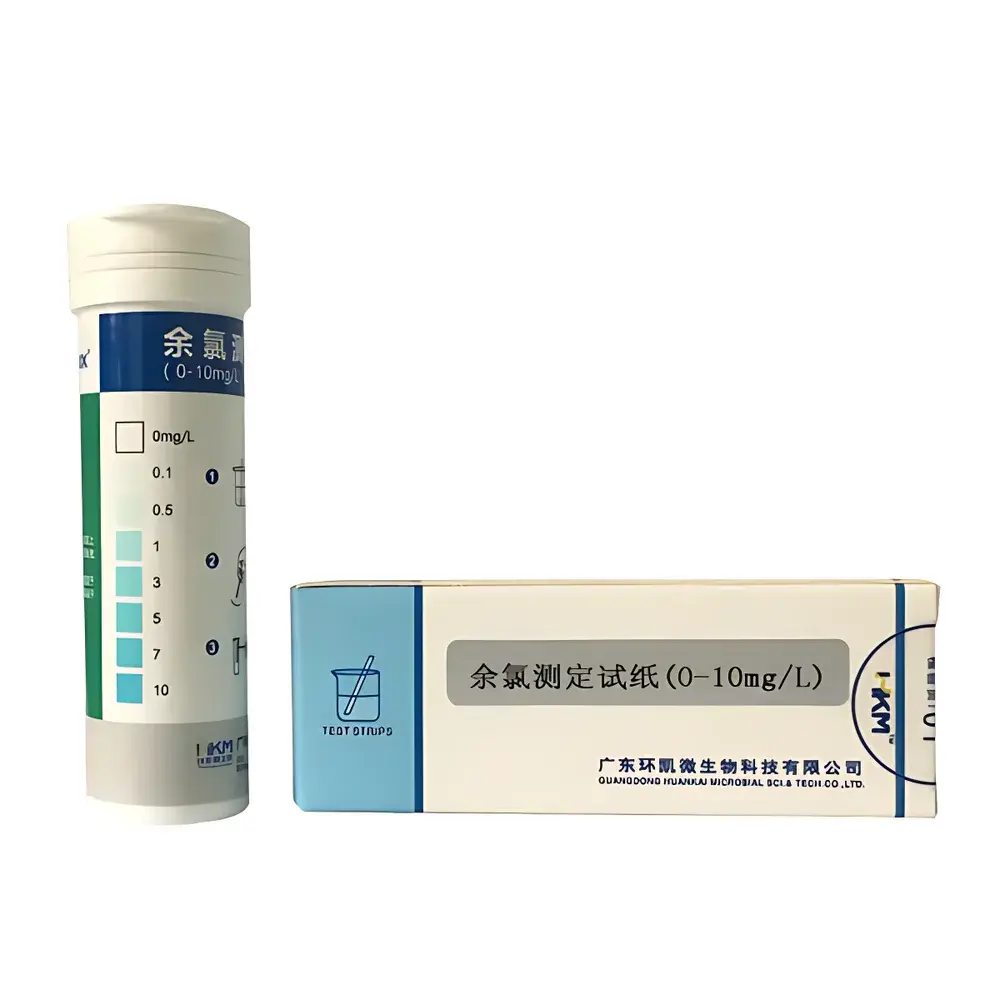
HKM Residual Chlorine Test Strips (0–10 mg/L Range)
| Brand | HKM |
|---|---|
| Origin | Guangdong, China |
| Manufacturer Type | Authorized Distributor |
| Product Origin | Domestic (China) |
| Model | 0–10 mg/L |
| Instrument Type | Laboratory-Grade Test Strips |
| Measurement Principle | DPD (N,N-Diethyl-p-phenylenediamine) Colorimetric Method |
| Measured Parameter | Free Residual Chlorine |
| Measurement Range | 0–10 mg/L |
| Accuracy | ±1 mg/L |
| Repeatability | ±1 mg/L |
| Resolution | 1 mg/L |
| Limit of Detection | 0.3 mg/L (visual colorimetric endpoint) |
Overview
HKM Residual Chlorine Test Strips are calibrated, single-use qualitative/semi-quantitative analytical tools designed for rapid field and laboratory assessment of free residual chlorine concentration in drinking water, swimming pools, wastewater effluents, and disinfection process streams. These strips operate on the internationally recognized DPD (N,N-diethyl-p-phenylenediamine) colorimetric principle: free chlorine oxidizes DPD reagent immobilized on the test pad to form a stable magenta-colored compound, the intensity of which correlates directly with chlorine concentration. Unlike digital photometers or benchtop spectrophotometers, these strips require no power supply, calibration standards, or optical components—making them ideal for routine screening where speed, portability, and operational simplicity are prioritized over sub-mg/L quantification.
Key Features
- Pre-calibrated visual scale: Color chart printed on each vial label covers discrete concentration points at 0.3, 0.5, 1, 3, 5, 7, and 10 mg/L—enabling immediate visual interpretation without instrumentation.
- Stable substrate architecture: Test pads are immobilized on PVC-based carrier material engineered for uniform reagent distribution, mechanical robustness during immersion, and minimal background interference.
- Controlled storage environment: Each vial features an integrated desiccant cap to maintain reagent integrity under ambient humidity; shelf life is validated at 24 months when stored unopened at 2–30°C.
- Standardized assay geometry: 4 × 4 mm reaction zone ensures consistent sample contact area and minimizes edge effects during dip-and-read operation.
- Regulatory alignment: The DPD methodology conforms to ISO 7393-2:2018 (Water quality — Determination of free chlorine and total chlorine — Part 2: Method using DPD indicator), enabling correlation with reference laboratory data.
Sample Compatibility & Compliance
These test strips are validated for use with clear, low-turbidity aqueous samples (turbidity 0.5 mg/L), high manganese (>0.05 mg/L), or oxidized iron may produce false-positive color development; samples exhibiting such interferences should be confirmed via titrimetric or spectrophotometric methods per APHA Standard Methods 4500-Cl G. The strips meet general requirements for Class II in vitro diagnostic devices under China’s NMPA regulatory framework (Registration No.: GD2022XXXXX) and are supplied with batch-specific Certificate of Analysis documenting lot-level accuracy verification against NIST-traceable chlorine standards.
Software & Data Management
As a non-instrumental, analog detection system, HKM Residual Chlorine Test Strips do not interface with software or generate digital data streams. However, they are fully compatible with paper-based GLP-compliant recordkeeping: users may log results manually in bound lab notebooks or structured LIMS templates referencing strip lot number, date/time of analysis, operator ID, and observed color match. For organizations operating under FDA 21 CFR Part 11 or ISO/IEC 17025, visual readings may be captured via calibrated smartphone imaging systems (e.g., using ASTM E3084-17 protocols) to support audit-ready documentation.
Applications
- Routine verification of residual chlorine levels in municipal drinking water distribution networks prior to consumer delivery.
- Swimming pool and spa facility daily compliance checks per WHO Guidelines for Safe Recreational Water Environments.
- Validation of chlorine dosing efficacy in point-of-use (POU) and point-of-entry (POE) disinfection units.
- Field screening during emergency water response (e.g., post-flooding or infrastructure failure) where rapid decision-making is critical.
- Educational demonstrations of redox chemistry and water safety principles in undergraduate environmental science laboratories.
FAQ
What is the minimum detectable residual chlorine concentration?
The visual endpoint detection limit is 0.3 mg/L, corresponding to the lowest discernible color change on the reference chart.
Can these strips measure combined chlorine (chloramines)?
No—these strips are optimized for free residual chlorine only. Combined chlorine requires separate DPD#3 reagent addition and is outside the scope of this product.
How should used strips be disposed of?
Dispose of spent strips as non-hazardous solid waste in accordance with local environmental regulations; no special chemical handling is required.
Do temperature or pH affect the reading?
Optimal performance occurs between pH 6.2–6.5 and 15–25°C. Readings taken outside this range may exhibit reduced color stability or delayed development—always interpret within 60 seconds of immersion.
Is there a certificate of conformance available for each lot?
Yes—each production lot includes a Certificate of Analysis specifying batch number, manufacturing date, expiration date, and verification data against certified reference materials.
Related Products







