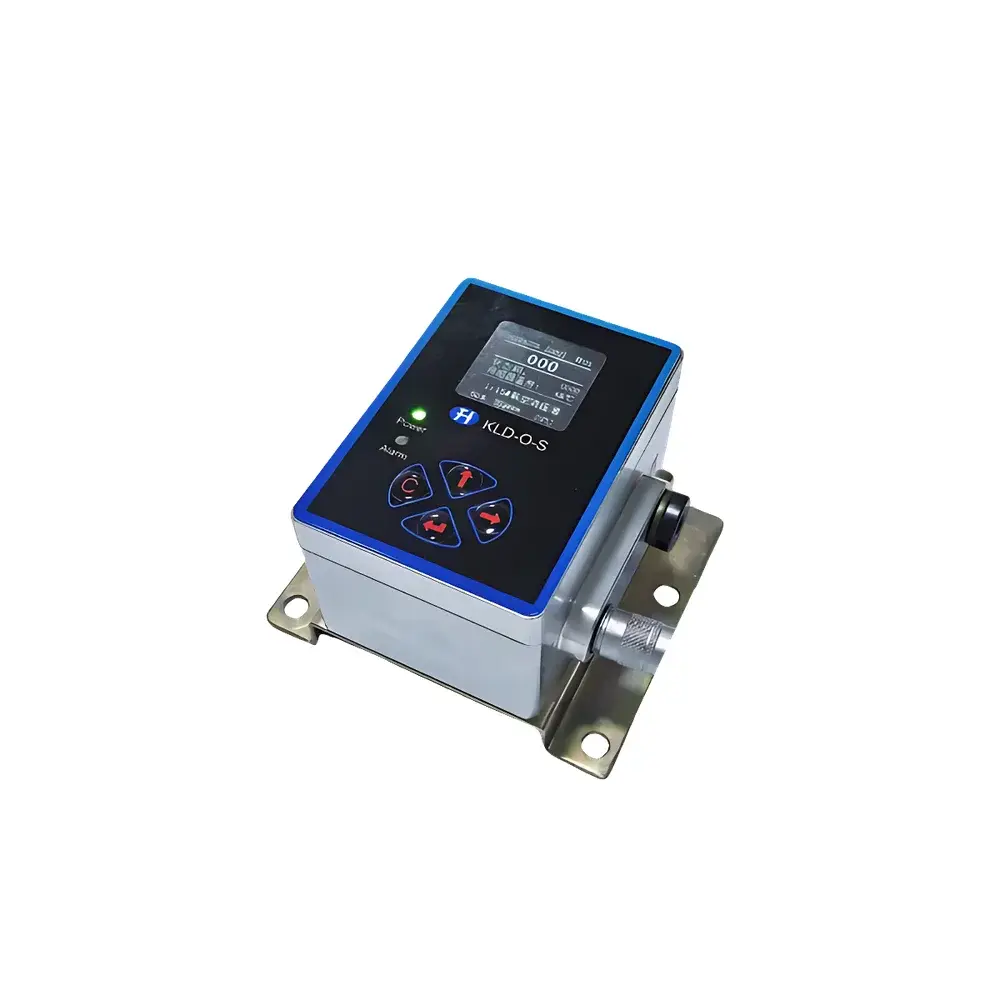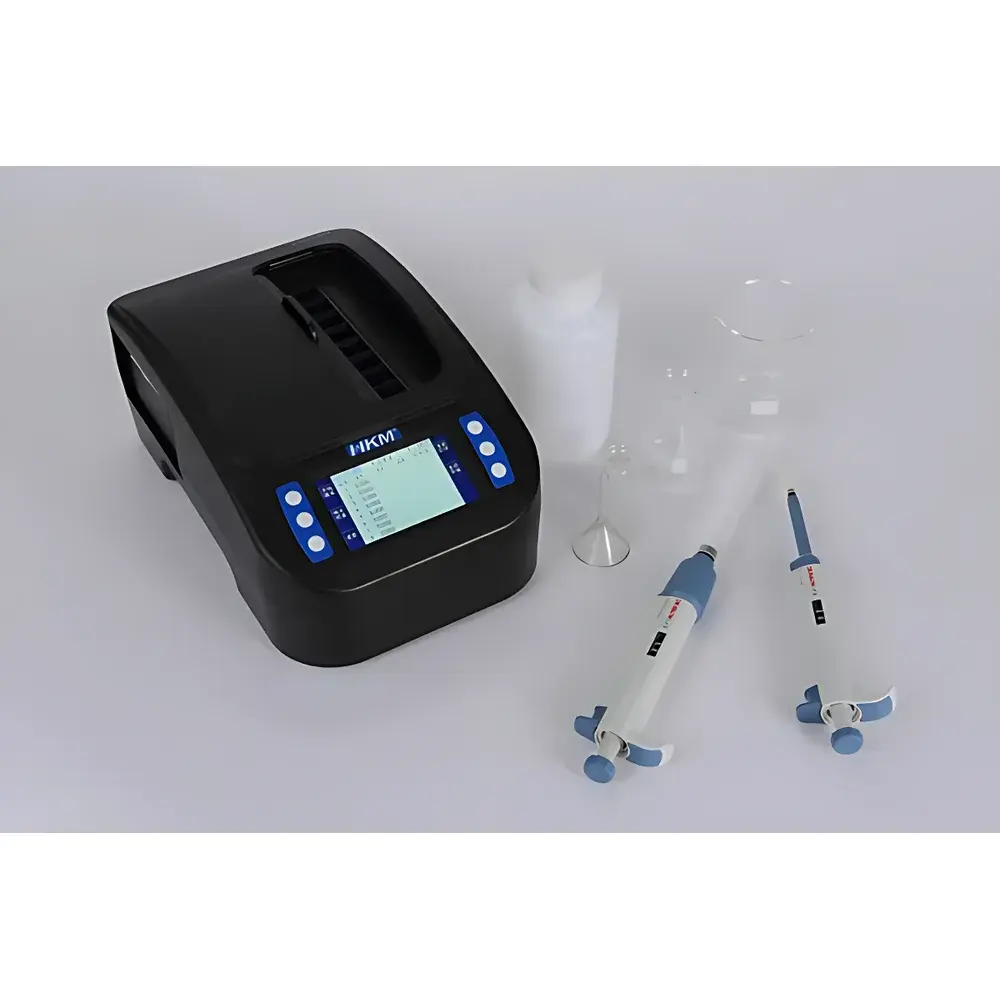
HKM SAJ Series Multi-Parameter Food Safety Rapid Analyzer
| Brand | HKM (Guangdong Huankai Microbial Technology Co., Ltd.) |
|---|---|
| Origin | Guangdong, China |
| Model | SAJ Series |
| Detection Principle | Enzyme Inhibition + Photometric Colorimetry |
| Detection Channels | 8 or 16 independent optical units |
| Measurement Range | Inhibition Rate 0–100% |
| Absorbance Range | 0–3.0 AU |
| Absorbance Accuracy | ±0.01 (410 nm, 0–2.0 AU), ±0.02 (512 nm & 555 nm, 0–1.0 AU) |
| Repeatability | ±0.5% (transmittance repeatability) |
| Zero Drift | ≤0.1%/3 min |
| Photocurrent Drift | ≤0.1%/3 min |
| Detection Time | 15 s – 30 min per assay |
| Display | 4.3″ color TFT-LCD (480×272 resolution) |
| Data Storage Capacity | Up to 780,000 test records |
| Power Supply | 6400 mAh rechargeable Li-ion battery (≥24 h continuous operation) |
| Dimensions | 300 × 200 × 130 mm |
| Compliance | GB/T 5009.199–2003, GB 5009.33–2010, GB/T 5750.10–2006, NY/T 448–2001 |
Overview
The HKM SAJ Series Multi-Parameter Food Safety Rapid Analyzer is a benchtop and field-deployable photometric detection platform engineered for quantitative and semi-quantitative screening of critical food contaminants. It operates on two complementary analytical principles: enzyme inhibition kinetics for organophosphate and carbamate pesticide residues, and standardized photometric colorimetry for analytes including nitrite, nitrate, formaldehyde, chlorine dioxide, borax, hydrogen peroxide, lead, protein, peroxide value, amino nitrogen, and more. Designed in accordance with Chinese national standards (GB series) and agricultural industry norms (NY/T), the instrument delivers laboratory-grade reliability in non-laboratory environments—enabling rapid decision-making at points of production, distribution, retail, and regulatory inspection. Its dual-mode architecture eliminates reliance on external calibration standards for routine assays, while built-in optical stabilization ensures measurement integrity across ambient temperature fluctuations and extended operational cycles.
Key Features
- 16-channel or 8-channel parallel detection architecture, with fully independent optical paths—including dedicated LED light sources (imported semiconductor), sample cuvette holders, and Fairchild photodiode sensors—ensuring true channel-to-channel isolation and eliminating cross-talk.
- Closed-loop automatic light source calibration system continuously monitors and adjusts LED intensity to maintain optimal signal-to-noise ratio, mitigating drift caused by thermal aging or environmental variation.
- Self-calibrating photometric engine performs automatic 0% and 100% transmittance reference correction without manual intervention, reducing operator dependency and procedural error.
- Integrated diagnostic firmware performs real-time hardware self-checks; fault codes are displayed directly on the 4.3″ high-resolution color LCD with contextual guidance for maintenance or troubleshooting.
- Onboard thermal printer enables immediate hard-copy documentation of results, compliant with GLP traceability requirements for field audits and chain-of-custody reporting.
- USB 2.0 interface supports bidirectional communication with Windows-based desktop software for method configuration, batch data import/export, statistical analysis (mean, SD, CV%), report generation, and secure upload to centralized food safety surveillance platforms (e.g., traceability networks).
- Robust ABS polymer chassis with piano-black finish provides IP54-rated ingress protection against dust and incidental splashes, suitable for mobile labs, market stalls, and agro-processing facilities.
Sample Compatibility & Compliance
The SAJ analyzer accepts liquid extracts, homogenized suspensions, and clarified filtrates from diverse matrices—including fresh produce, cereals, tea leaves, potable water, soil leachates, and processed foods—without requiring solvent extraction or derivatization. Each assay utilizes pre-formulated, lyophilized enzyme reagents with validated thermal stability (retained activity after 30 days at 37 °C), enabling unrefrigerated logistics in tropical climates. All detection protocols align with mandatory Chinese food safety standards: pesticide residue screening per GB/T 5009.199–2003 and NY/T 448–2001; nitrite/nitrate quantification per GB 5009.33–2010; formaldehyde detection per GB/T 5750.10–2006. While not FDA 21 CFR Part 11–certified out-of-the-box, audit trails, user-access logs, and immutable result timestamps support alignment with GMP/GLP documentation frameworks when deployed within controlled quality systems.
Software & Data Management
The embedded firmware supports hierarchical user authentication (administrator/operator modes), time-stamped data logging with sample ID, operator ID, and location metadata. Local storage retains up to 780,000 complete assay records with full spectral absorbance traces where applicable. PC software (Windows 10/11 compatible) provides advanced functionality: customizable report templates (PDF/Excel), statistical process control charts (X-bar/R), outlier detection via Grubbs’ test, and encrypted export to LIMS or national food monitoring databases. Data synchronization is performed via USB mass-storage mode or optional Wi-Fi dongle (not included), with SHA-256 checksum verification ensuring data integrity during transfer.
Applications
This analyzer serves as a frontline screening tool across the food supply chain: rapid verification of pesticide clearance in farm-gate vegetable lots; on-site validation of nitrite levels in cured meats and pickled vegetables; formaldehyde adulteration checks in aquatic products and tofu; borax detection in rice noodles and dumpling wrappers; and peroxide value assessment in edible oils prior to bottling. Regulatory agencies deploy it in mobile food safety laboratories (equipped with 12 V DC automotive adapters), while school cafeterias and hospital kitchens use it for daily raw material verification. Its portability, battery endurance (>24 h), and minimal reagent consumption (<100 µL per test) make it especially suited for decentralized testing in resource-constrained settings.
FAQ
What regulatory standards does the SAJ Series comply with?
It conforms to GB/T 5009.199–2003 (pesticides), GB 5009.33–2010 (nitrite/nitrate), GB/T 5750.10–2006 (formaldehyde), and NY/T 448–2001 (field pesticide screening).
Can the instrument be used for quantitative analysis or only qualitative screening?
It supports both semi-quantitative inhibition rate calculation and calibrated photometric quantification using built-in standard curves; quantitative accuracy meets stated ±0.5% repeatability specifications.
Is external calibration required before each use?
No—automatic zero/blank referencing and closed-loop optical stabilization eliminate routine manual calibration; only periodic verification with certified reference materials is recommended per QA protocols.
How is data security handled during USB transfer to a computer?
Files are written in read-only mode with embedded digital signatures; the PC software validates checksums upon import to prevent tampering or corruption.
Does the device support multi-language UI beyond Chinese?
The current firmware version features native Chinese interface only; English language packs are available upon request for international procurement contracts.