
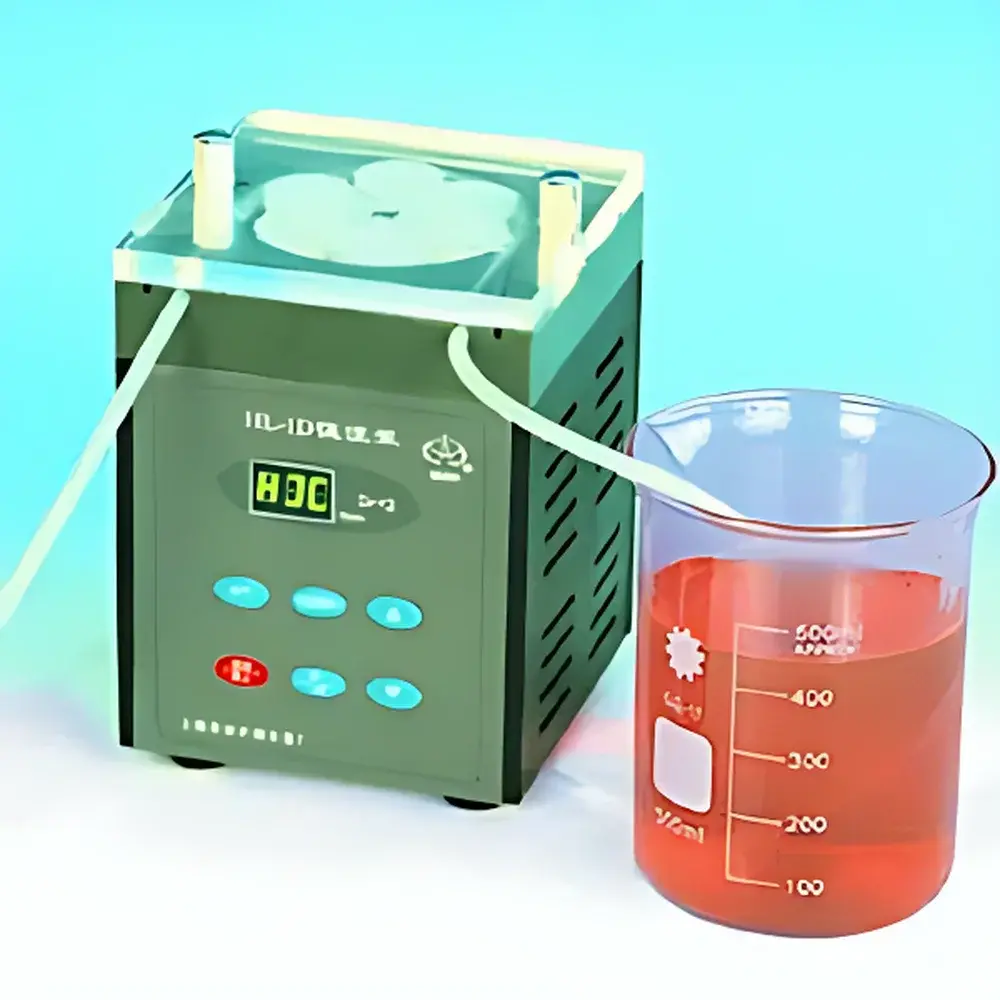
HL-1B Single-Channel Digital Display Peristaltic Pump / Constant Flow Pump
| Origin | Shanghai, China |
|---|---|
| Manufacturer Type | Distributor |
| Product Origin | Domestic (China) |
| Model | HL-1B |
| Price | USD 280 (approx.) |
| Dimensions | 120 × 120 × 180 mm |
| Channel Count | Single |
| Flow Rate Range | 0.5–600 mL/h |
| Maximum Back Pressure | ≥3 kg/cm² (≈294 kPa) |
| Speed Range | 0–50 rpm (digital display, stepless speed control) |
Overview
The HL-1B Single-Channel Digital Display Peristaltic Pump is a compact, benchtop constant-flow delivery system engineered for precision fluid handling in analytical, preparative, and process-support laboratory workflows. Operating on the principle of peristaltic displacement—where rollers compress flexible tubing to generate positive displacement—the HL-1B delivers pulse-free, contamination-free flow without requiring valves, seals, or wetted pump components beyond the tubing itself. This design ensures full chemical isolation between the drive mechanism and the fluid path, making it suitable for sterile, corrosive, viscous, or particulate-laden solutions. Its digital speed interface enables real-time rpm monitoring and reproducible flow calibration across the 0.5–600 mL/h range, with mechanical stability maintained at back pressures up to ≥294 kPa (3 kg/cm²), supporting applications from low-flow reagent dosing to continuous sample transfer in HPLC auxiliary lines or environmental sampling systems.
Key Features
- Digital LED display showing real-time rotational speed (0–50 rpm) with ±1 rpm resolution, enabling precise manual calibration against volumetric standards.
- Stepless (infinitely variable) mechanical speed control via precision potentiometer—no gear shifts or discrete settings, ensuring smooth flow transitions during method development.
- Robust aluminum alloy housing (120 × 120 × 180 mm) with integrated heat-dissipating fins; designed for continuous operation under ambient lab conditions (15–35 °C, <80% RH).
- Single-channel head compatible with standard silicone or Tygon® L/S 14–24 tubing (ID 1.6–3.2 mm); tubing retention force optimized to prevent slippage at maximum pressure load.
- Self-contained power supply (AC 100–240 V, 50/60 Hz); CE-compliant internal circuitry with overcurrent and thermal shutdown protection.
Sample Compatibility & Compliance
The HL-1B supports a broad spectrum of liquid media—including aqueous buffers, organic solvents (when paired with fluoropolymer-compatible tubing such as PharMed® BPT), cell culture media, and mildly abrasive suspensions—provided tubing selection aligns with chemical resistance requirements. While the base configuration uses standard silicone tubing (suitable for pH 2–12, non-oxidizing environments), optional tubing adapters accommodate chemically inert materials for GLP-aligned workflows. The device complies with IEC 61010-1:2010 for electrical safety in laboratory equipment and meets EMC directive 2014/30/EU. It is not certified for use in explosion-proof (ATEX) or intrinsically safe environments, nor is it validated per FDA 21 CFR Part 11 for electronic records; however, its analog control architecture allows integration into auditable systems when paired with external data loggers meeting ALCOA+ principles.
Software & Data Management
The HL-1B operates as a standalone instrument with no embedded firmware, cloud connectivity, or proprietary software dependency. Flow rate is determined solely by calibrated rpm-to-volume conversion using gravimetric or volumetric validation methods per ISO 8599 or ASTM D3123. Users may document operational parameters (e.g., setpoint rpm, duration, tubing type/lot number) in paper-based or LIMS-integrated electronic notebooks. For automated protocol execution, the pump features a 0–5 V analog input port (optional accessory) enabling external TTL or PLC-triggered start/stop and speed modulation—facilitating synchronization with spectrophotometers, fraction collectors, or reactor control systems without closed-loop feedback.
Applications
- Continuous infusion in microbiological assays and enzyme kinetics studies where consistent nutrient or inhibitor delivery is critical.
- Mobile phase delivery in low-pressure gradient HPLC or ion chromatography setups requiring stable, low-pulsation flow below 1 mL/min.
- Automated water quality monitoring—feeding samples to online analyzers (e.g., UV-Vis, conductivity sensors) in municipal or industrial effluent streams.
- Cell culture bioreactor feed-and-bleed loops, especially where sterility and tubing changeover flexibility are prioritized over high-pressure capability.
- Calibration solution delivery in atomic absorption spectroscopy (AAS) and inductively coupled plasma (ICP) sample introduction systems.
FAQ
What tubing sizes are compatible with the HL-1B pump head?
Standard compatibility includes inner diameters of 1.6 mm to 3.2 mm (e.g., L/S 14, 16, 24 per Cole-Parmer nomenclature); tubing wall thickness must be 0.8–1.6 mm for optimal occlusion and roller engagement.
Can the HL-1B maintain accurate flow under variable back pressure?
Yes—within its specified pressure limit (≥294 kPa), flow deviation remains ≤±3% across the full 0.5–600 mL/h range when calibrated with identical tubing batches and ambient temperature stabilized to ±2 °C.
Is the HL-1B suitable for GMP-regulated pharmaceutical manufacturing?
It may be deployed in non-critical utility roles (e.g., buffer transfer in prep-scale purification), but lacks 21 CFR Part 11 audit trail functionality and formal IQ/OQ documentation support; users must establish in-house qualification protocols.
Does the pump include tubing or require separate purchase?
Tubing is not included; users must select chemically appropriate tubing based on application—silicone (general purpose), Viton® (halogenated solvents), or C-Flex® (high-flex fatigue life).
How often should the pump tubing be replaced for optimal accuracy?
Under continuous operation at 30 rpm and room temperature, silicone tubing typically requires replacement every 100–150 hours to maintain flow consistency within ±5%; lifetime varies significantly with solvent exposure and pressure cycling.



