
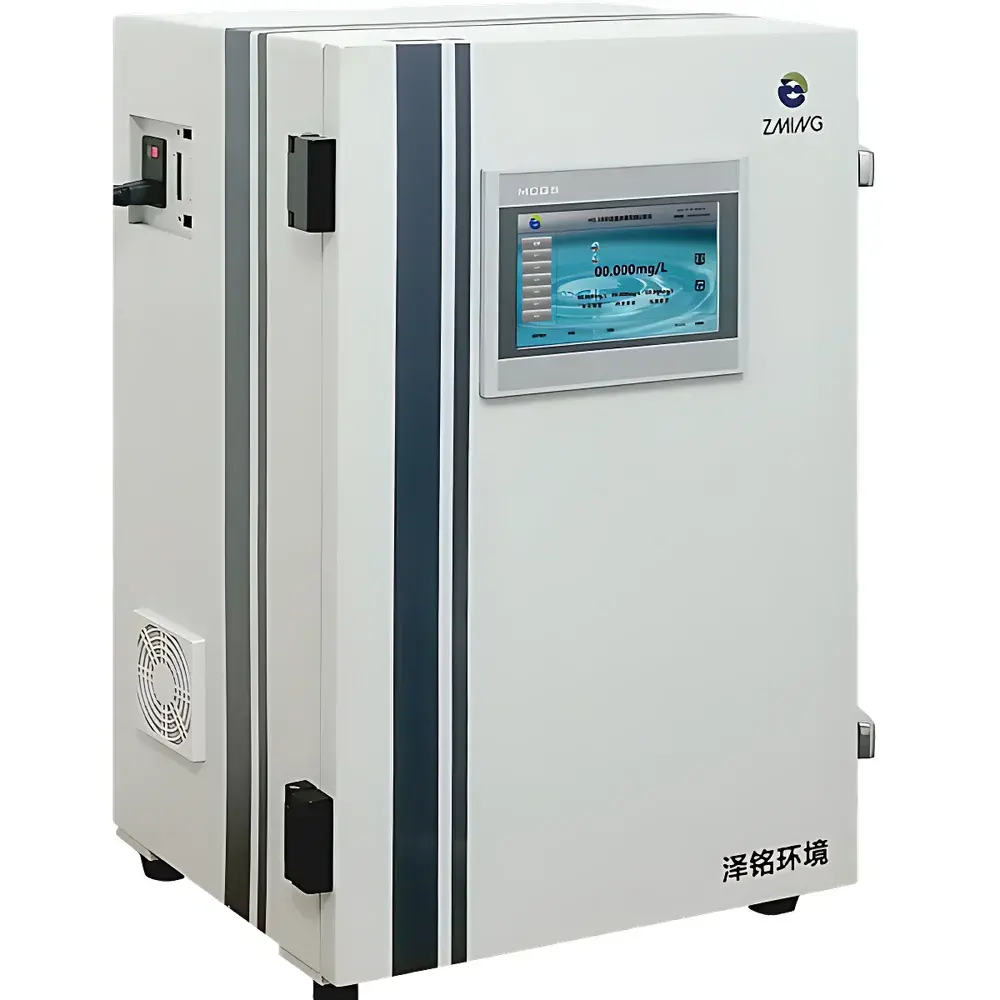
Zming Environmental HQ-3200(PO4) Online Phosphate Analyzer
| Brand | Zming Environmental Technology Co., Ltd. |
|---|---|
| Origin | Jiangsu, China |
| Manufacturer Type | Authorized Distributor |
| Country of Origin | China |
| Model | HQ-3200(PO4) |
| Measurement Parameter | Total Phosphorus (as PO₄³⁻) |
| Instrument Type | Online Analyzer |
| Measurement Principle | Ammonium Molybdate Spectrophotometry (GB/T 11893–1989) |
| Measurement Range | 0–2 mg/L PO₄ (extendable) |
| Resolution | 0.001 mg/L |
Overview
The Zming Environmental HQ-3200(PO4) Online Phosphate Analyzer is an industrial-grade, fully automated water quality monitoring system engineered for continuous, unattended determination of orthophosphate and total phosphorus (expressed as PO₄³⁻) in aqueous matrices. It implements the standardized ammonium molybdate spectrophotometric method per China’s national standard GB/T 11893–1989 — a widely accepted variant of the classical Murphy–Riley assay. This method relies on acid-catalyzed reaction between phosphate ions and ammonium molybdate under controlled temperature and pH, forming a heteropoly blue complex measurable at 700 nm. The analyzer integrates sample aspiration, reagent dosing, digestion (where required for total phosphorus), colorimetric reaction, optical detection, and data reporting into a single robust architecture. Designed for deployment in fixed-site environmental monitoring networks, it delivers high reproducibility in dynamic flow environments including rivers, estuaries, drinking water intakes, wastewater treatment plant effluents, and irrigation canals.
Key Features
- Integrated turbidity and chromaticity compensation algorithm — dynamically corrects absorbance interference from suspended solids and natural organic colorants, enabling reliable operation in high-turbidity surface waters (up to 500 NTU) without manual filtration or dilution.
- Digital PID-controlled heating module with adjustable setpoint (30–120 °C) — ensures precise thermal management during persulfate digestion for total phosphorus conversion, minimizing inter-batch variability and meeting QA/QC requirements for regulatory compliance.
- Capacitive volumetric metering system — eliminates mechanical wear and fluidic hysteresis associated with peristaltic pumps; achieves ±0.5% volumetric accuracy for both sample and reagent delivery, supporting long-term repeatability (RSD < 1.2% over 30-day operation).
- Onboard multi-level quality control — supports automatic blank correction, standard calibration verification (daily/weekly), spike recovery checks, and duplicate sample analysis — all traceable and timestamped for GLP-aligned data integrity.
- Modular wet-end design — corrosion-resistant PFA and quartz flow cells, chemically inert solenoid valves, and self-cleaning aspiration lines reduce maintenance frequency and extend service intervals beyond 90 days under typical municipal wastewater conditions.
Sample Compatibility & Compliance
The HQ-3200(PO4) is validated for use with raw and treated water samples across diverse physicochemical profiles: freshwater (pH 6.0–9.0), seawater (salinity up to 35 psu), low-DOC industrial discharges, and nutrient-rich urban runoff. It complies with GB/T 11893–1989 for total phosphorus determination and aligns with methodological equivalency principles referenced in ISO 15681-1:2003 (Water quality — Determination of phosphorus — Part 1: Orthophosphate). While not certified to EPA Method 365.4 or ASTM D515-89, its analytical performance meets the precision and detection limit criteria outlined in US EPA OWQMC Guidance for Phosphorus Monitoring in Surface Waters (2018). All operational logs, calibration records, and QC events are stored with immutable timestamps to support audit readiness under local environmental agency reporting frameworks.
Software & Data Management
The embedded Linux-based controller runs Zming’s proprietary AquaView™ firmware (v4.2+), providing web-accessible configuration, real-time trend visualization, and alarm-triggered email/SMS notifications via Modbus TCP or 4–20 mA analog output. Data export supports CSV and XML formats compatible with SCADA systems (e.g., Ignition, Siemens Desigo) and national environmental monitoring platforms (e.g., China’s National Ecological Environment Monitoring Platform). Audit trails include user login history, method parameter changes, and instrument status flags — satisfying basic 21 CFR Part 11 read-only record retention requirements when deployed in municipal utility settings. Remote firmware updates and diagnostic telemetry are supported via secure HTTPS tunneling.
Applications
- Real-time phosphorus load tracking at riverine gauging stations and estuarine transects for eutrophication modeling.
- Compliance monitoring of phosphorus discharge limits at municipal wastewater treatment plants (WWTPs) and industrial pretreatment facilities.
- Early-warning detection of nutrient spikes in drinking water source protection zones (e.g., reservoirs, karst aquifers).
- Performance evaluation of constructed wetlands and tertiary phosphorus removal units (e.g., iron-enhanced sand filters, lanthanum-modified bentonite dosing).
- Long-term trend analysis in ecological restoration projects, including post-dredging sediment release monitoring and dam-release nutrient pulse quantification.
FAQ
What sample pretreatment is required prior to analysis?
No filtration or centrifugation is required for most applications due to integrated turbidity compensation. However, samples with >1000 mg/L total suspended solids (TSS) or visible particulates >100 µm should be pre-screened using a 100-µm mesh filter to prevent flow cell clogging.
Can the instrument measure both orthophosphate and total phosphorus in the same cycle?
No — the HQ-3200(PO4) is configured for total phosphorus measurement by default, requiring onboard persulfate digestion. A separate orthophosphate-only configuration (without digestion module) is available upon request.
How frequently must calibration standards be prepared?
Calibration verification standards (0.1 and 1.0 mg/L PO₄) should be prepared fresh daily from certified stock solutions (NIST-traceable, 1000 mg/L PO₄ in HCl); long-term stability of working standards is limited to 24 hours at 4 °C.
Is remote diagnostics supported?
Yes — the unit supports SSH-enabled command-line access and HTTP-based health monitoring (CPU load, memory usage, reagent levels, flow rate, temperature deviation) through a dedicated service port.
What is the minimum sample flow rate required for stable operation?
A sustained inlet pressure of ≥0.1 MPa and volumetric flow ≥50 mL/min are recommended to ensure consistent aspiration and avoid air bubble formation in the reaction manifold.







