

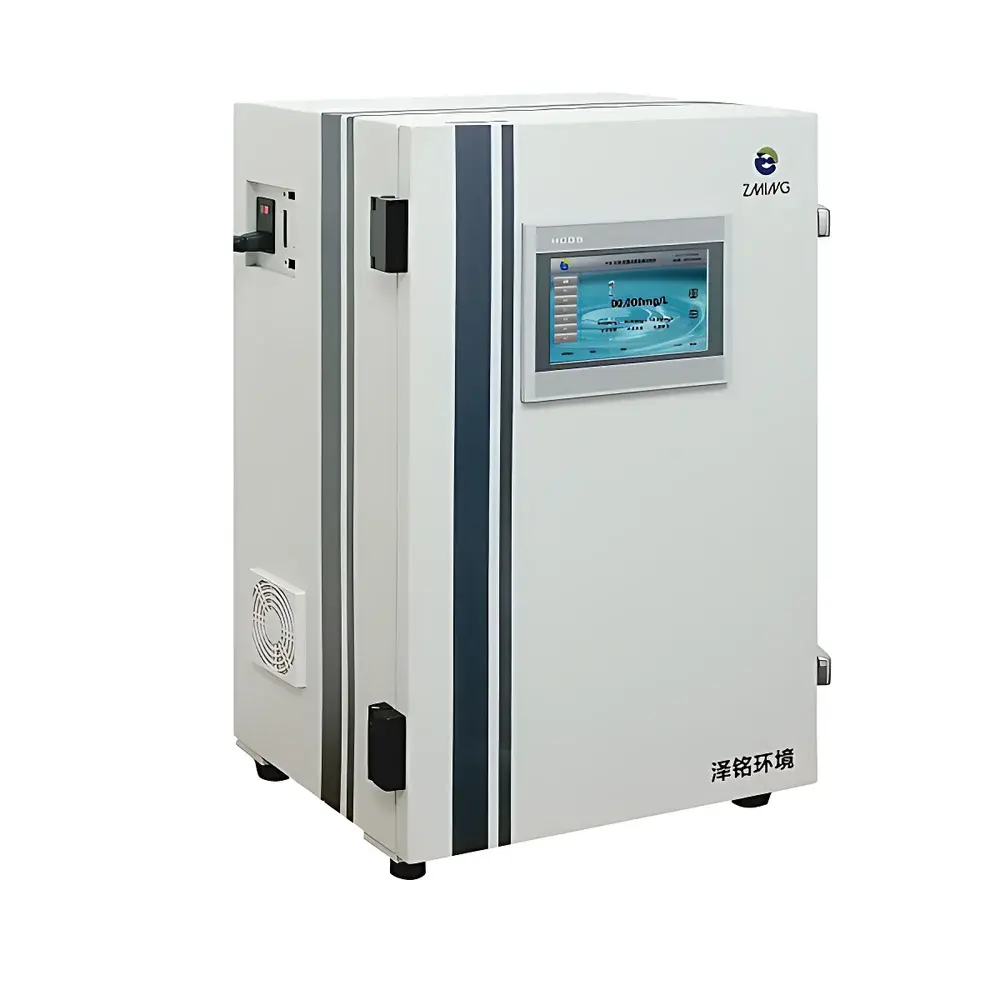
Zming Environmental HQ-3300 Online Chemical Oxygen Demand (CODCr) Analyzer
| Brand | Zming Environmental Technology Co., Ltd. |
|---|---|
| Origin | Jiangsu, China |
| Model | HQ-3300 |
| Instrument Type | Online Analyzer |
| Measurement Principle | Potassium Dichromate Digestion Method (Online) |
| Measurement Range | 15–500 mg/L (extendable up to 25,000 mg/L, user-configurable) |
| Analysis Cycle Time | 40 minutes |
| Chloride Interference Tolerance | ≤75,000 mg/L |
| Detection Limit | Low (optimized for complex wastewater matrices) |
| Optical System | Dual-beam photometry with automatic turbidity and color compensation |
| Sample Delivery | Capacitive volumetric metering |
| Operating Mode | Unattended, long-term remote monitoring |
Overview
The Zming Environmental HQ-3300 is an online, fully automated Chemical Oxygen Demand (CODCr) analyzer engineered for continuous, regulatory-compliant water quality monitoring in demanding environmental and industrial settings. It implements the standardized potassium dichromate digestion method—aligned with ISO 6060, HJ 399–2007 (China), and equivalent national protocols—for oxidation of organic matter under high-temperature, high-pressure acidic conditions. Unlike laboratory-based batch analyzers, the HQ-3300 integrates digestion, colorimetric detection, and data reporting into a single robust platform designed for unattended operation over extended periods. Its architecture supports real-time CODCr quantification in flowing water streams, making it suitable for integration into SCADA networks, centralized environmental monitoring centers, and effluent compliance systems where traceability, repeatability, and minimal operator intervention are critical.
Key Features
- High-efficiency digestion module operating at elevated temperature and pressure, achieving >95% oxidation efficiency for refractory organics within the defined 40-minute cycle time.
- Dual-beam optical system with matched reference and sample channels, actively compensating for lamp drift, power fluctuations, and ambient electromagnetic interference—ensuring measurement stability across variable site conditions.
- Integrated turbidity and chromaticity compensation algorithm, enabling accurate absorbance correction for highly colored or suspended-solids-laden samples (e.g., municipal wastewater, river sediments, estuarine inflows).
- Capacitive volumetric metering technology for precise, pulse-free delivery of sample and reagents—eliminating mechanical wear, bubble formation, and cross-contamination risks associated with peristaltic or syringe pumps.
- Extended chloride tolerance (≤75,000 mg/L Cl−), achieved through optimized digestion chemistry and matrix-matched calibration protocols—supporting reliable operation in coastal discharge points, landfill leachate, and saline industrial effluents.
- Modular design with front-access service panels, tool-free consumables replacement, and self-diagnostic routines—including digestion temperature validation, photometric zero/span verification, and fluidic path integrity checks.
Sample Compatibility & Compliance
The HQ-3300 accommodates raw influent, treated effluent, surface water, estuarine mixtures, and high-TSS industrial discharges without pre-filtration—provided inlet particulates remain below 1 mm nominal diameter. It meets functional requirements outlined in EPA Method 410.4 (COD by dichromate) and supports audit-ready data generation compliant with ISO/IEC 17025 quality management principles. All measurement events—including calibration, QC checks, maintenance logs, and error flags—are timestamped and stored locally with optional encrypted transmission to central servers. The system architecture permits configuration for GLP/GMP-aligned environments, including user-level access control, electronic signature support, and full 21 CFR Part 11 audit trail capability when deployed with validated software modules.
Software & Data Management
The embedded firmware provides local HMI navigation via a 7-inch resistive touchscreen with multilingual interface (English, Chinese, Spanish). Remote access is enabled via Modbus TCP, OPC UA, or MQTT protocols for integration into third-party SCADA, DCS, or cloud-based IoT platforms. Data export formats include CSV, XML, and JSON; all reports conform to EN 14181 QAL1/QAL2 requirements for automated monitoring systems. Built-in QC functions include daily blank verification, multi-point standard calibration, and spiked recovery tests—with pass/fail criteria configurable per site-specific QA/QC plans. Historical data retention exceeds 18 months at 15-minute resolution on internal 16 GB eMMC storage.
Applications
- Continuous monitoring of municipal wastewater treatment plant (WWTP) influent and effluent streams for regulatory discharge reporting.
- Real-time assessment of river health at upstream/downstream transects, including tidal estuaries and nutrient-sensitive receiving waters.
- Performance evaluation of constructed wetlands, stormwater retention basins, and river restoration projects.
- Compliance tracking for industrial pretreatment systems subject to local environmental authority limits (e.g., textile, food processing, pharmaceutical sectors).
- Early-warning detection of accidental spills or process upsets in drinking water intake protection zones and inter-basin water transfer corridors.
- Long-term trend analysis in national surface water surveillance networks requiring ISO-certified, low-maintenance instrumentation.
FAQ
What regulatory standards does the HQ-3300 comply with for CODCr measurement?
It follows the core methodology of ISO 6060 and HJ 399–2007, and its operational performance aligns with EN 14181 requirements for automated water analyzers.
Can the instrument operate reliably in high-salinity coastal wastewater?
Yes—its chloride interference threshold of ≤75,000 mg/L enables stable operation in brackish influents, desalination plant reject streams, and marine aquaculture discharge monitoring.
Is remote diagnostics and firmware update supported?
Yes—via secure HTTPS web interface or TLS-encrypted MQTT; all updates undergo cryptographic signature verification prior to installation.
How is calibration traceability maintained?
Certified KHP (potassium hydrogen phthalate) standards traceable to NIST or CNAS-accredited reference materials are used; calibration certificates and raw absorbance logs are retained in device memory.
What maintenance intervals are recommended for unattended operation?
Reagent replacement every 30 days (standard configuration); quartz digestion cell cleaning every 90 days; full system verification quarterly—documented in built-in maintenance scheduler.







