
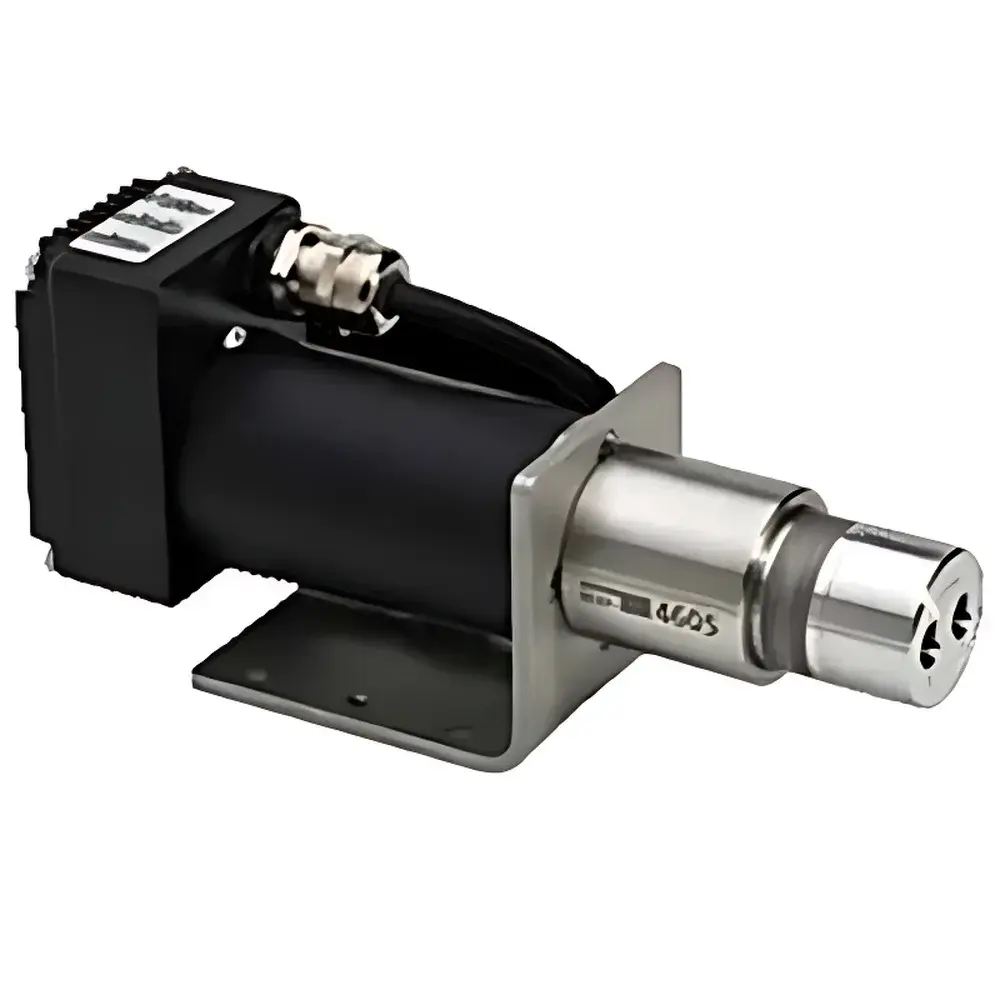
HNP MZR-4605 High-Precision Micro-Dosing Peristaltic Pump
| Brand | HNP |
|---|---|
| Origin | Germany |
| Model | MZR-4605 |
| Flow Rate | 0.012–72 mL/min (min. 10 µL/h) |
| Viscosity Range | 0.3–50,000 mPa·s |
| Precision (CV) | < 1% |
| Speed Range | 1–6000 rpm |
| Fluid Connections | 1/4"–28 UNF (frontal) |
| Wetted Materials | SS 316L (1.4404 / 1.4435), tungsten carbide–nickel matrix |
| Shaft Seal | graphite-reinforced PTFE + SS 316L |
| static seal | FPM (optional EPDM, FFPM) |
| Motor | 24 V DC servo motor, 44 W |
| Controller | integrated 16-bit microcontroller |
| Interfaces | 0–10 V analog, RS-232, 1 digital I/O |
| Dimensions | 143 × 45 × 65 mm (L×W×H) |
| Weight | ~800 g |
| Differential Pressure Range | 0–10 bar (water, 1 mPa·s) |
| Max Inlet Pressure | 5 bar (10–40 bar*) |
| Operating Temperature | −5 to +60 °C (−20 to +150 °C*) |
| Displacement Volume | 12 µL |
| Minimum Dose | 2 µL |
Overview
The HNP MZR-4605 is a high-precision, digitally controlled micro-dosing peristaltic pump engineered for repeatable, low-volume fluid handling in demanding laboratory and industrial environments. Unlike conventional diaphragm or piston pumps, the MZR-4605 employs a precision-engineered rotor with dual-roller geometry that compresses a chemically resistant tubing segment against a fixed track—ensuring zero fluid contact with mechanical components and eliminating cross-contamination risks. Its core measurement principle relies on volumetric displacement per revolution, calibrated via integrated encoder feedback and real-time speed control. This architecture delivers true linear flow proportionality across its full dynamic range, making it suitable for applications requiring trace-level dosing accuracy under variable backpressure and viscosity conditions. Designed and manufactured in Germany, the pump complies with CE directives and meets functional safety requirements for integration into ISO 9001-certified production lines and GLP-compliant analytical workflows.
Key Features
- Integrated 16-bit microcontroller enabling closed-loop speed regulation, pulse-width modulation (PWM) motor control, and real-time error detection (e.g., tubing occlusion, stall, or dry-run)
- DC servo motor (24 V, 44 W) delivering high torque at low speeds and stable operation down to 1 rpm—critical for ultra-slow dispensing (as low as 10 µL/h)
- Robust wetted path constructed from ASTM A276 Grade 316L stainless steel (1.4404 / 1.4435) and tungsten carbide–nickel composite surfaces, ensuring compatibility with aggressive solvents, acids, bases, and abrasive suspensions
- Graphite-reinforced PTFE shaft seals and FPM (FKM) static seals rated for continuous operation up to +60 °C; optional EPDM and FFPM variants support extended thermal or ozone-exposed environments
- Modular interface architecture supporting analog 0–10 V control, RS-232 serial communication (ASCII protocol), and configurable digital I/O for PLC synchronization or external trigger events
- Compact footprint (143 × 45 × 65 mm) and lightweight design (~800 g) optimized for OEM integration into analytical instruments, automated coating systems, and benchtop synthesis platforms
Sample Compatibility & Compliance
The MZR-4605 accommodates fluids spanning three orders of magnitude in dynamic viscosity—from low-viscosity solvents (e.g., methanol, acetone, water) to highly viscous media including adhesives, gels, greases, and filled polymer dispersions (up to 50,000 mPa·s). Its pressure capability scales with fluid rheology: rated for differential pressures up to 10 bar with aqueous solutions (1 mPa·s) and up to 50 bar with medium-viscosity oils (16 mPa·s), while maintaining inlet pressure limits of 5 bar (extendable to 40 bar with optional pressure-rated tubing and fittings). All wetted materials conform to USP Class VI and FDA 21 CFR 177.2600 standards for indirect food contact. The pump supports audit-ready operation when paired with compliant SCADA or LIMS systems, offering timestamped event logging, parameter change history, and user-access-level controls aligned with 21 CFR Part 11 electronic record requirements.
Software & Data Management
The embedded controller supports deterministic command-response communication over RS-232 using ASCII-based protocol (e.g., “SPEED=3200”, “START”, “STOP”). Third-party software integration—including LabVIEW, MATLAB, Python (pySerial), and Beckhoff TwinCAT—is facilitated via documented register maps and status flag definitions. Optional firmware upgrades enable programmable multi-step dosing profiles (e.g., ramp-up, dwell, ramp-down), batch volume tracking, and automatic calibration compensation based on tubing wear models. Data export functions generate CSV-formatted logs containing timestamps, setpoints, actual speed, current draw, and fault codes—enabling post-process statistical process control (SPC) analysis per ISO 22514-2.
Applications
- Chemical process development: precise reagent addition in flow chemistry reactors and catalytic screening platforms
- Pharmaceutical manufacturing: excipient metering in hot-melt extrusion, solvent-based granulation, and sterile fill-finish auxiliary systems
- Industrial coating & dispensing: controlled application of UV-curable inks, conductive pastes, and two-component adhesives in electronics assembly
- Materials science labs: sequential deposition of nanocomposite precursors during thin-film fabrication or 3D bioprinting support baths
- Vacuum-compatible dosing: inert gas-purged feed lines for moisture-sensitive monomers in glovebox-integrated synthesis workstations
- Environmental testing: calibrated delivery of standard reference solutions in automated water quality analyzers and corrosion coupon exposure rigs
FAQ
What tubing materials are recommended for use with the MZR-4605?
Pharmed® BPT, Norprene® LFL, and Viton®-lined silicone tubing are validated for long-term use; selection depends on chemical resistance, pressure rating, and temperature stability per ISO 8036. Tubing ID must match the pump head specification (typically 0.5–1.6 mm).
Can the pump operate continuously at minimum flow rates (e.g., 10 µL/h)?
Yes—its servo-controlled motor maintains positional accuracy and torque consistency even below 10 rpm, provided appropriate tubing elasticity and drive roller preload are maintained per manufacturer guidelines.
Is remote calibration supported without physical access?
No—calibration requires volumetric gravimetric verification using certified balances and timed collection. However, stored calibration coefficients can be updated remotely via RS-232 commands after validation.
Does the MZR-4605 meet ATEX or IECEx requirements for explosive atmospheres?
Not by default; however, explosion-proof enclosures and intrinsically safe barrier modules (e.g., Pepperl+Fuchs KFD2-UT2-EX1) may be integrated externally to achieve Zone 2/22 compliance.
How is tubing lifetime monitored?
The controller does not auto-detect tubing wear; users must schedule preventive replacement based on total revolutions logged or observed flow deviation (>±1.5% from baseline). Recommended service intervals range from 200–1000 hours depending on operating pressure and fluid abrasivity.
Related Products



