
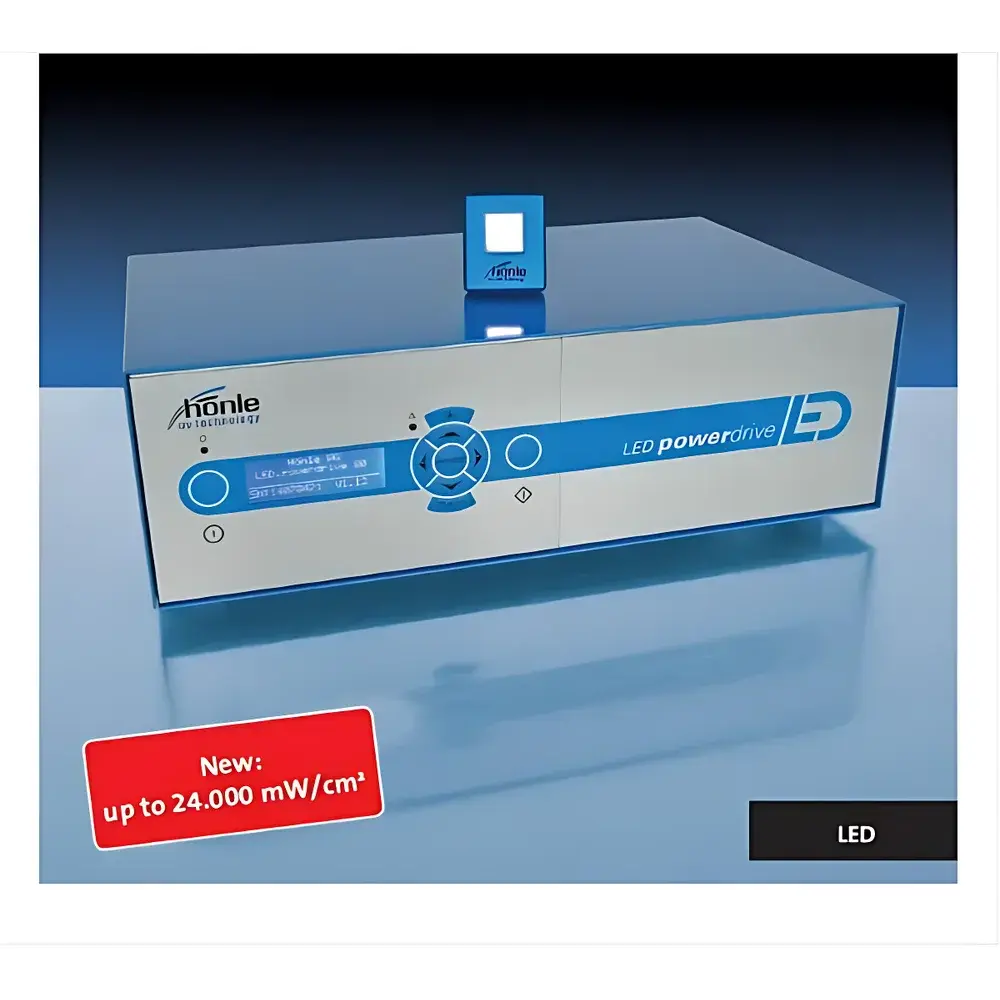
Hoenle LED Spot Light Source with Integrated LED Power Driver
| Brand | Hoenle |
|---|---|
| Origin | Germany |
| Manufacturer Type | Authorized Distributor |
| Origin Category | Imported |
| Model | LED Spot Light Source with Integrated LED Power Driver |
| Wavelength Options | 365 nm, 385 nm, 395 nm, 405 nm, 460 nm (±10 nm) |
| Emission Aperture | 20 mm × 20 mm (square) |
| Pulse Control Resolution | Down to 100 µs |
| Irradiation Time Range | 0.01–99.99 s (fine mode), 0.1–999.9 s (standard mode), 1–9999 s (extended mode), or continuous operation |
| Intensity Adjustment | 2–100% in 1% increments |
| Operating Lifetime | >20,000 h (typical LED lifetime) |
| Cooling | External water cooling |
| Compliance | Suitable for ISO Class 5 (Class 100) cleanroom environments |
Overview
The Hoenle LED Spot Light Source with Integrated LED Power Driver is a high-intensity, precision-engineered UV and visible light irradiation system designed for industrial photopolymerization, fluorescence excitation, and controlled photochemical processing in packaging, electronics assembly, medical device manufacturing, and pharmaceutical R&D. Unlike conventional mercury arc or broad-spectrum UV lamps, this system employs solid-state LED technology operating at discrete, narrow-band wavelengths—365 nm, 385 nm, 395 nm, 405 nm, or 460 nm (±10 nm)—enabling selective activation of photoinitiators and fluorophores with minimal thermal load. Its compact, fanless lamp head—enabled by external water cooling—is engineered for integration into space-constrained automation cells and ISO Class 5 cleanrooms. The system’s core architecture couples a thermally stabilized LED emitter array with a digitally programmable power driver, supporting microsecond-level temporal control, precise radiometric output regulation, and full auditability of operational parameters.
Key Features
- Compact, fanless lamp head (20 mm × 20 mm square emission aperture) compatible with cleanroom environments per ISO 14644-1 Class 5 specifications.
- External water-cooling interface ensures stable thermal management and sustained peak irradiance without air turbulence or particulate generation.
- Sub-millisecond pulse control: adjustable irradiation duration from 0.01 s (10 ms) down to 100 µs via front-panel or external TTL/PLC trigger.
- Intensity modulation from 2% to 100% in 1% increments, calibrated against NIST-traceable reference detectors for process repeatability.
- Integrated real-time monitoring of LED junction temperature, cumulative operating hours, and fault status—accessible via service menu and front-panel display.
- Multi-channel capability: single PowerDrive controller supports up to three independent LED Spot units with synchronized or asynchronous operation.
Sample Compatibility & Compliance
The LED Spot Light Source is compatible with substrates ranging from silicon wafers and polymer films to glass vials and sterile medical packaging components. Its narrow spectral output minimizes unwanted photodegradation while maximizing quantum efficiency in acrylate-, epoxy-, and thiol-based formulations. The system complies with IEC 62471 (Photobiological Safety) for UV-A and visible LED sources and meets mechanical safety requirements per EN 60204-1. When deployed in regulated environments—including GMP-compliant pharmaceutical packaging lines—the PowerDrive controller supports configurable audit trails, user access levels, and timestamped event logging aligned with FDA 21 CFR Part 11 principles. No warm-up or cooldown phase is required, eliminating process downtime and enabling true on-demand illumination.
Software & Data Management
While the LED Spot operates autonomously via its embedded controller, it provides native integration pathways for factory automation systems. Analog input (0.2–10 V) enables analog intensity setpoint modulation; digital I/O includes dedicated PLC inputs (LED Enable, LED On) and outputs (LED Active, Error, Warning) with dry-contact relay options for interlocking with conveyors or safety gates. All operational parameters—including elapsed irradiation time, thermal history, and error codes—are stored non-volatilely and retrievable through the LCD interface. For traceability-critical applications, optional RS-485 or Ethernet modules (sold separately) support Modbus RTU/TCP communication, allowing centralized logging into MES or LIMS platforms. Firmware updates are performed via USB, ensuring long-term compliance with evolving industry standards.
Applications
- UV-curing of adhesives, coatings, and encapsulants in electronics assembly (e.g., camera module bonding, optical fiber potting).
- Fluorescence stimulation for quality inspection—such as ink verification on blister packs or seal integrity testing via fluorescent tracer imaging.
- Photochemical crosslinking of hydrogels and biomaterials in sterile packaging validation studies.
- Accelerated aging and stability testing of UV-sensitive packaging polymers under controlled spectral exposure.
- High-speed label lamination and foil stamping where cycle time reduction depends on sub-second irradiation precision.
FAQ
What wavelengths are available, and how is spectral selection determined?
Standard configurations include 365 nm, 385 nm, 395 nm, 405 nm, and 460 nm, each with ±10 nm bandwidth. Selection is based on photoinitiator absorption profiles—e.g., 365 nm for conventional benzophenone systems, 395–405 nm for amine-free acylphosphine oxides.
Can the LED Spot be integrated into an existing PLC-controlled packaging line?
Yes—via isolated digital I/O (24 VDC), analog intensity control (0.2–10 V), and dry-contact relays for external cooling or safety interlocks. Timing synchronization is supported down to 100 µs using external TTL triggers.
Is calibration documentation provided with the system?
Each unit ships with a factory irradiance calibration certificate referenced to a NIST-traceable spectroradiometer, covering the specified wavelength and aperture geometry. Recalibration services are available annually per ISO/IEC 17025-accredited protocols.
How is thermal stability maintained during extended operation?
The lamp head relies exclusively on external water cooling (recommended flow rate: ≥1.5 L/min at 15–25 °C inlet temperature). Internal temperature sensors feed back to the PowerDrive controller, which reduces output if thermal thresholds are approached—ensuring consistent radiometric performance over >20,000 h lifetime.
Related Products





