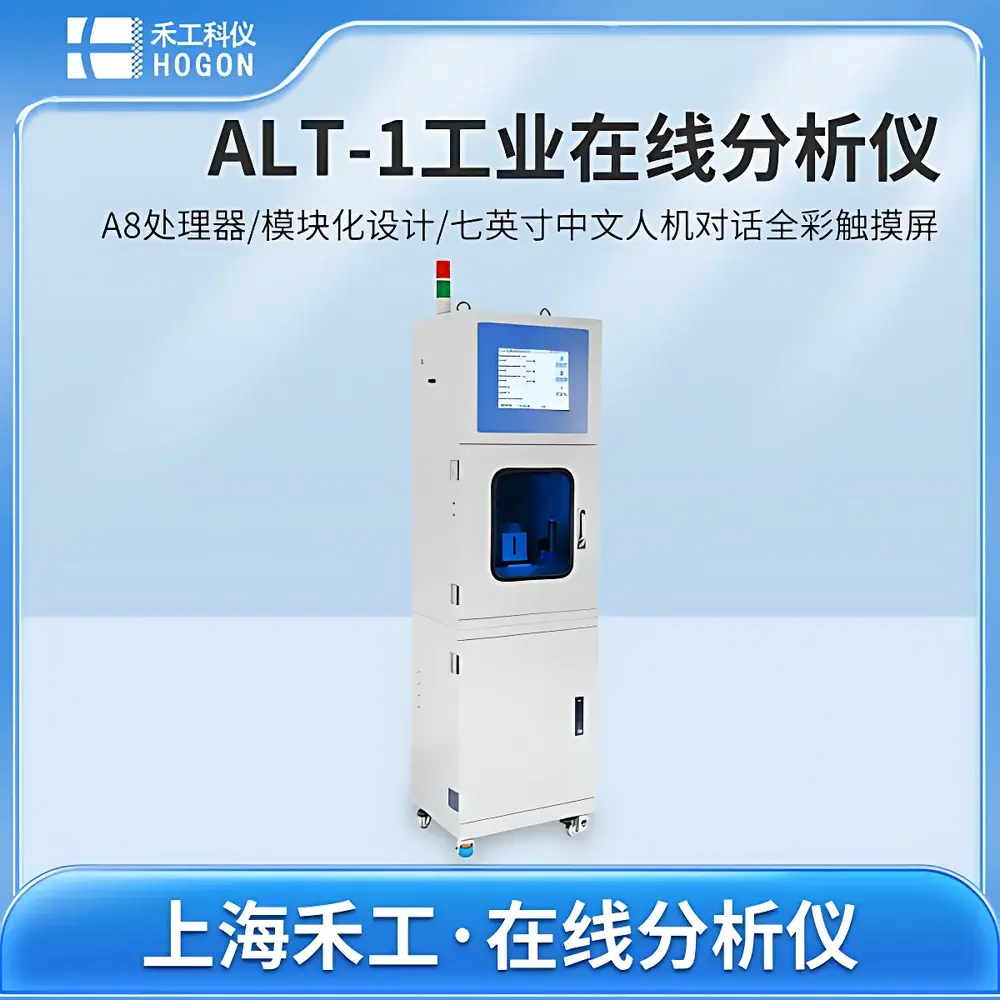
HOGON ALT-1 Online NaOH Concentration Analyzer for Photoresist Stripping Tanks
| Brand | HOGON |
|---|---|
| Origin | Shanghai, China |
| Manufacturer Type | Direct Manufacturer |
| Product Category | Domestic |
| Model | ALT-1 Online NaOH Concentration Analyzer |
| Pricing | Upon Request |
| Output Signals | Modbus TCP, RS-232/485, CAN, 4–20 mA |
| Operating Environment | ≤90% RH, 10°C minimum (non-condensing) |
| Resolution | Potentiometric: 0.1 mV (−2000 to +2000 mV) |
| pH | 0.001 pH (0–20 pH) |
| Photometric | 0.003 Abs (0–1 Abs) |
| Ingress Protection | IP55/IP65 (when door is closed and latched) |
| Titration Accuracy | ±1 µL (with 20 mL burette) |
Overview
The HOGON ALT-1 Online NaOH Concentration Analyzer is a purpose-engineered process analytical instrument designed for continuous, real-time quantification of sodium hydroxide (NaOH) concentration in photoresist stripping tanks used in semiconductor fabrication, PCB manufacturing, and advanced microelectronics production. It operates on the principle of automated potentiometric acid-base titration—leveraging high-precision dosing mechanics, a calibrated pH composite electrode, and endpoint detection via first-derivative analysis of the titration curve. Unlike optical or conductivity-based proxies, this method delivers direct, stoichiometrically traceable measurement of active NaOH content (expressed in mol/L or g/L), independent of ionic strength variations, temperature drift, or interfering species commonly present in spent stripping baths (e.g., dissolved organics, metal ions, or surfactants). The analyzer integrates seamlessly into existing wet bench control architectures and is engineered for unattended operation in Class 1000 cleanroom-adjacent environments with minimal maintenance intervals.
Key Features
- Automated sample handling: Integrated peristaltic sampling pump with programmable volume (default 10 mL), dilution module (up to 1:5), and waste evacuation circuit—ensuring representative, contamination-free analysis without operator intervention.
- High-fidelity titration system: Dual-syringe burette assembly with 1 µL volumetric resolution and repeatability <±0.2% RSD over 20 mL range; compatible with standardized HCl titrants (0.05–0.2 mol/L).
- Robust electrochemical sensing: Temperature-compensated pH composite electrode (Ag/AgCl reference, glass membrane) with automatic calibration validation prior to each analysis cycle.
- Multi-protocol industrial connectivity: Native support for Modbus TCP (Ethernet), RS-485 (4-wire), RS-232 (for local diagnostics), and CAN bus; analog 4–20 mA output configurable for primary NaOH concentration or secondary diagnostic parameters (e.g., endpoint pH, titrant consumed).
- Environmental resilience: Enclosure rated IP55/IP65 when latched; optional NEMA 4X or ATEX-compliant variants available for harsh chemical exposure zones.
Sample Compatibility & Compliance
The ALT-1 is validated for use with aqueous alkaline stripping solutions containing NaOH concentrations ranging from 0.5 to 5.0 mol/L—covering standard industry formulations for positive-tone photoresist removal. It tolerates suspended particulates ≤50 µm and total organic carbon (TOC) levels up to 2000 ppm without filter clogging, thanks to its self-cleaning fluid path design. All wetted materials (PFA tubing, borosilicate glass cell, EPDM seals) comply with USP Class VI and FDA 21 CFR 177.2600 requirements. Data integrity conforms to ALCOA+ principles: audit trails record operator actions, method changes, calibration events, and raw titration curves with timestamp and user ID. The system supports configuration for GLP/GMP environments, including electronic signatures and 21 CFR Part 11-compliant data archiving when paired with validated HOGON DataHub software.
Software & Data Management
Embedded firmware provides onboard method storage (up to 16 user-defined protocols), real-time trend visualization (NaOH concentration vs. time), and configurable alarm thresholds (high/low limits, rate-of-change alerts). Raw data—including mV vs. volume plots, derivative curves, and calculated concentration values—is exportable via CSV or OPC UA. Remote access is enabled through secure HTTPS interface with role-based authentication (admin, operator, viewer). Optional cloud integration allows synchronization with MES platforms (e.g., Siemens Opcenter, Rockwell FactoryTalk) and predictive analytics modules for bath life estimation based on titration drift patterns and cumulative reagent consumption.
Applications
- Semiconductor front-end manufacturing: Monitoring NaOH concentration in wafer-level resist strip baths to maintain etch uniformity and prevent substrate undercut or surface roughening.
- PCB fabrication lines: Ensuring consistent copper foil exposure during solder mask or dry film removal—critical for fine-pitch HDI board yield.
- Display panel production: Controlling alkaline cleaning baths in TFT-LCD and OLED substrate processing where residual alkali must be tightly bounded to avoid ITO corrosion.
- Chemical recycling facilities: Quantifying caustic strength in solvent recovery loops handling spent photoresist strippers.
FAQ
How frequently can the ALT-1 perform measurements?
Standard cycle time is 12–15 minutes per analysis (including sampling, dilution, titration, and system rinse); configurable down to 8 minutes with optimized method parameters.
Does the analyzer require daily calibration?
No—electrode calibration is performed automatically before each analysis using two-point buffer verification (pH 4.01 and 7.00); full system performance checks are scheduled weekly via certified reference standards.
Can it operate in high-temperature stripping tanks (>50°C)?
Yes—the sampling line includes PTFE-insulated thermal barrier; inlet fluid is actively cooled to ≤40°C prior to introduction into the analyzer chamber.
Is offline validation against lab titration possible?
Yes—each analysis generates a complete digital titration curve and raw mV data, enabling direct cross-validation against ASTM E2087-20 or ISO 8655-6 reference methods.
What maintenance is required?
Quarterly replacement of consumables (electrode, syringe tips, tubing); annual verification of burette accuracy using gravimetric dispensing check; no optical alignment or sensor recalibration needed.
Related Products