
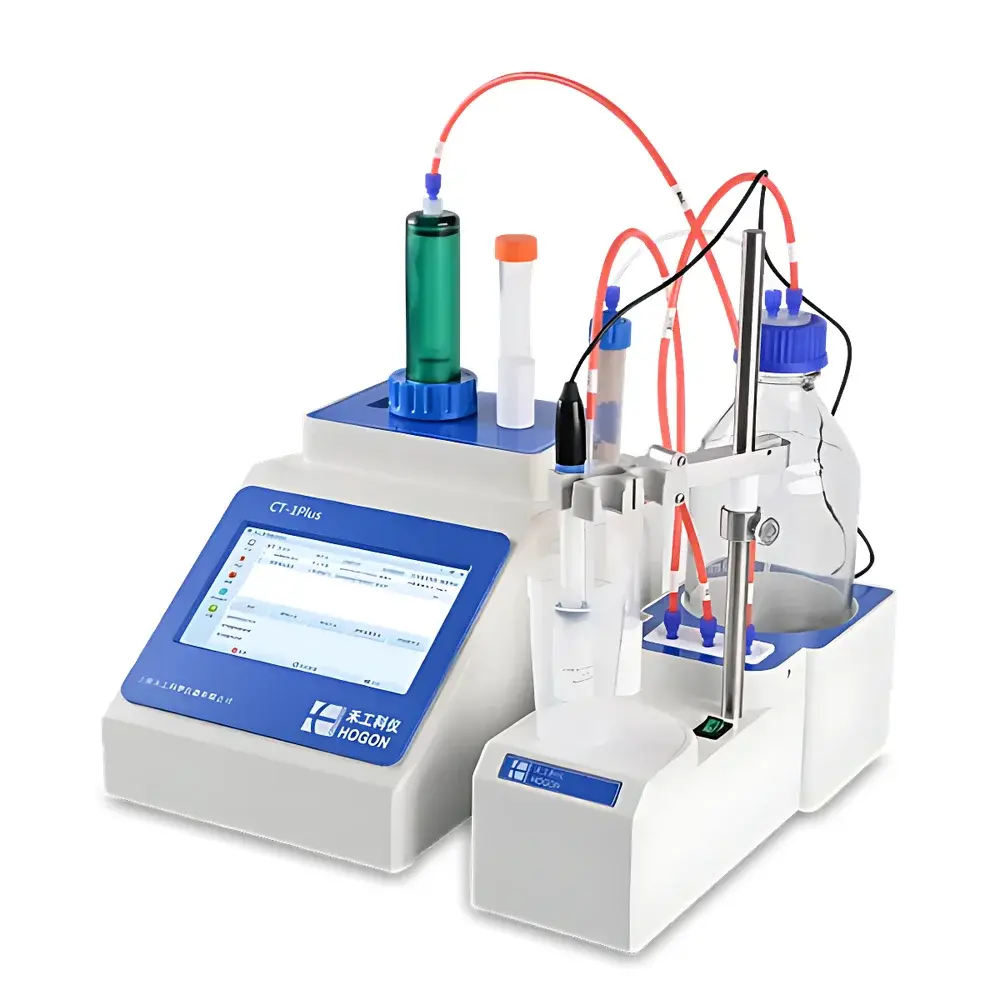
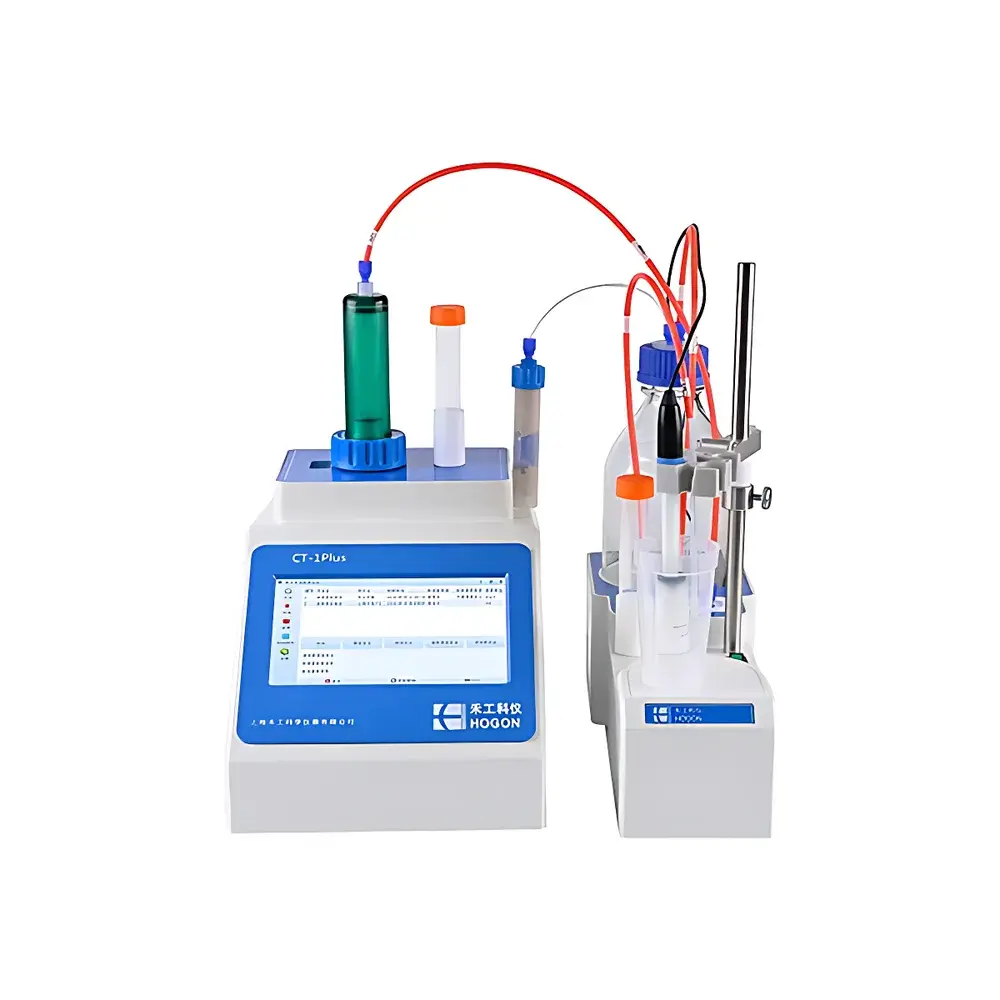
HOGON CT-1Plus Automatic Potentiometric Titrator for Chloride Ion Analysis in Copper Plating Baths
| Brand | HOGON |
|---|---|
| Origin | Shanghai, China |
| Manufacturer Type | Direct Manufacturer |
| Product Category | Domestic |
| Model | CT-1Plus |
| Instrument Type | General-Purpose Automatic Potentiometric Titrator |
| Application Scope | Universal |
| pH Measurement Range | 1–14 |
| Potential Meter Accuracy | ±0.2 mV |
| Potential Meter Resolution | 0.1 mV (Range: ±2000 mV) |
| Titration Precision | 0.001 mL (20 mL burette, standard) |
| Titration Resolution | 0.0005 mL (10 mL burette, optional) |
Overview
The HOGON CT-1Plus Automatic Potentiometric Titrator is a dedicated analytical platform engineered for precise, trace-level chloride ion (Cl⁻) quantification in acidic copper electroplating electrolytes. It operates on the principle of potentiometric titration using silver nitrate (AgNO₃) as the titrant and a silver/silver chloride (Ag/AgCl) indicator electrode paired with a double-junction reference electrode (R-101D). The system detects the inflection point in the potential curve — corresponding to the stoichiometric endpoint of the Ag⁺ + Cl⁻ → AgCl(s) precipitation reaction — via first-derivative (dE/dV) analysis. This electrochemical methodology eliminates visual endpoint interpretation errors inherent in manual argentometric titrations, delivering objective, operator-independent results essential for process control in high-reliability PCB and semiconductor interconnect manufacturing environments.
Key Features
- High-resolution potentiometric measurement: 0.1 mV resolution over ±2000 mV range, with certified accuracy of ±0.2 mV — critical for resolving subtle potential shifts near the equivalence point in low-conductivity plating baths.
- Micro-dispensing precision: Standard 20 mL glass burette delivers titrant with 0.001 mL repeatability; optional 10 mL burette achieves 0.0005 mL resolution for sub-ppm Cl⁻ quantification in highly concentrated or diluted samples.
- Intelligent endpoint detection: First-derivative (dE/dV) algorithm automatically identifies the maximum slope point, eliminating subjective color-based endpoint judgment and minimizing inter-operator variability (typical RSD < 0.5% for triplicate analyses at ~60 ppm Cl⁻).
- Dedicated electrode configuration: Ag-101 indicator electrode and R-101D double-junction reference electrode optimized for stability and selectivity in aggressive, high-metal-ion matrices (e.g., Cu²⁺ > 60 g/L, H₂SO₄ ~180 g/L), minimizing junction potential drift and coating interference.
- Process-integrated workflow: Full sequence automation — from sample aspiration and dilution (via external pipetting module integration) to titration, calculation, and report generation — reduces hands-on time to under 3 minutes per sample.
Sample Compatibility & Compliance
The CT-1Plus is validated for direct analysis of undiluted and diluted acidic copper sulfate plating baths, including acid copper, high-speed copper, and micro-throwing power formulations. Sample preparation requires only gravimetric transfer (e.g., 10.00 g bath sample) followed by dilution with deionized water (typically 1:5 to 1:10 v/v) to ensure optimal conductivity and minimize matrix effects. The instrument complies with ASTM B769 (Standard Test Method for Chloride Ion in Electroplating Solutions) and supports GLP/GMP data integrity requirements through secure user authentication, full audit trail logging (including parameter changes, calibration events, and result modifications), and electronic signature capability. All data files are timestamped, non-editable, and exportable in CSV and PDF formats for regulatory submission.
Software & Data Management
The proprietary HOGON TitrSoft software provides a compliant, intuitive interface for method development, sequence programming, real-time titration monitoring, and post-run evaluation. Users define critical parameters — stirring speed (e.g., 200 rpm), drop interval (e.g., 1200 ms), derivative threshold (e.g., 200 mV/mL), and blank correction — within validated method templates. Raw potential vs. volume curves, derivative plots, and statistical summaries (mean, SD, RSD, confidence intervals) are stored with metadata (operator ID, date/time, sample ID, instrument serial number). Data export adheres to 21 CFR Part 11 requirements when configured with role-based access controls and digital signature modules. Backups are automated to network drives or encrypted local storage.
Applications
- Real-time monitoring of Cl⁻ concentration in production copper plating baths to maintain optimal range (typically 30–100 ppm) for brightener synergy and deposit uniformity.
- Root cause analysis of dullness, pitting, or poor ductility linked to chloride depletion or accumulation.
- Validation of bath replenishment protocols and additive dosing accuracy.
- Quality assurance testing of incoming anolyte or make-up chemicals for chloride contamination.
- Supporting DOE studies on chloride–brightener–carrier interactions in next-generation high-speed plating chemistries.
FAQ
What electrode combination is recommended for chloride analysis in copper plating baths?
The Ag-101 silver indicator electrode paired with the R-101D double-junction reference electrode is specifically calibrated for this application, ensuring stable response in high-Cu²⁺, low-pH environments.
Can the CT-1Plus be integrated into a laboratory information management system (LIMS)?
Yes — via configurable ASCII or CSV file export with fixed-field delimiters and timestamped naming conventions, enabling seamless ingestion into common LIMS platforms.
Is calibration verification required before each batch of samples?
A single-point standard verification using a certified 50 ppm Cl⁻ standard is recommended per shift; full two-point calibration (e.g., 20 ppm and 80 ppm) is performed daily or after electrode replacement.
How does the system handle high-sulfate or high-copper matrix interference?
The dE/dV endpoint algorithm and electrode design minimize interference; matrix-matched calibration standards and blank subtraction further correct for background conductivity and redox-active species.
Does the instrument support remote operation or unattended overnight runs?
Yes — the system supports scheduled sequences with automatic shutdown and error logging, and can be accessed remotely via secure VNC or RDP connections when deployed on a lab intranet.





