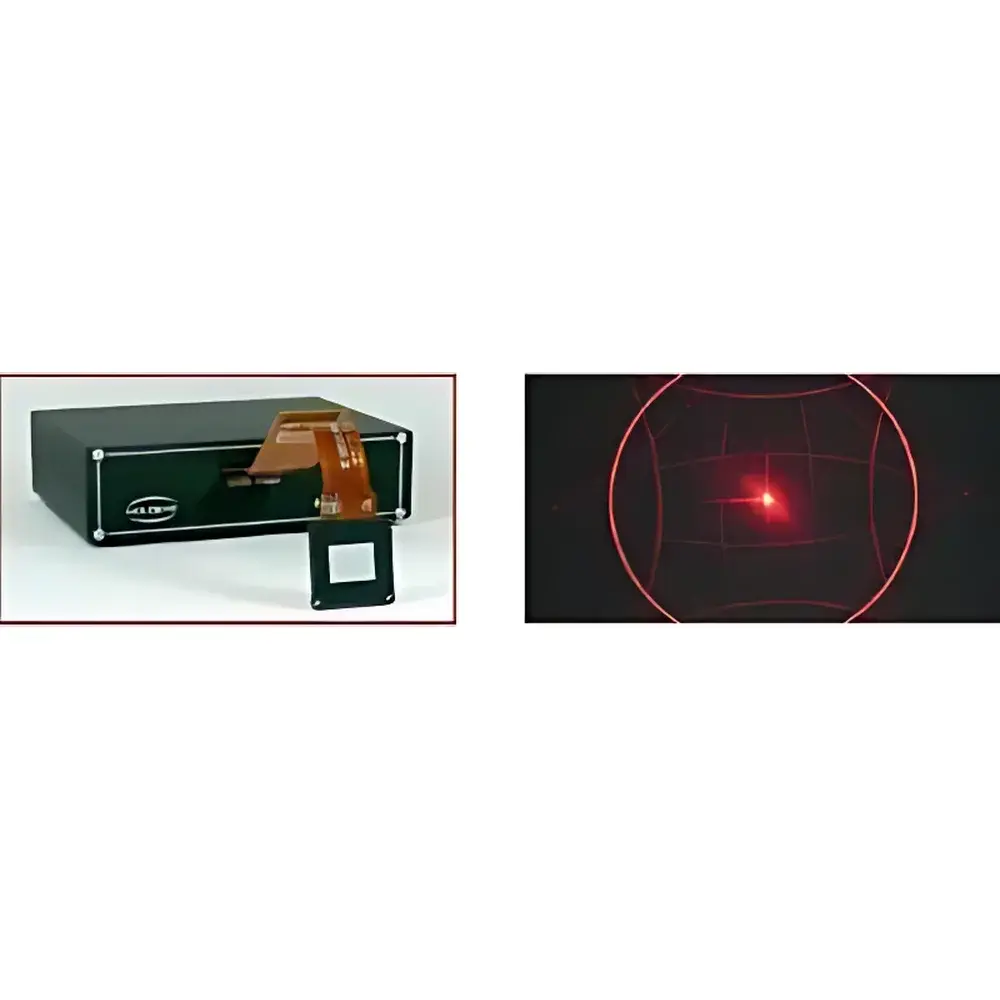
Holoeye LC-R Series Reflective Liquid Crystal on Silicon (LCoS) Spatial Light Modulator
| Brand | Holoeye |
|---|---|
| Origin | Germany |
| Model | LC-R Series (LC-R-2500 / LC-R-768 / LC-R-720 / LC-R-1080) |
| Modulation Type | Amplitude and Phase |
| Pixel Count | 1024×768 to 1920×1200 |
| Pixel Pitch | 8.1 µm to 19 µm |
| Aperture Ratio | 90–93% |
| Contrast Ratio | 1000:1 to 5000:1 (wavelength-dependent) |
| Phase Modulation Depth | >1π to >1.2π across visible spectrum (400–700 nm) |
| Frame Rate | 60 Hz to 180 Hz |
| Diffraction Efficiency | ≥60% |
| Spectral Range | 400–700 nm |
| Bit Depth | 8-bit |
| Interface | DVI, optional USB |
| Display Technology | Reflective LCoS microdisplay |
Overview
The Holoeye LC-R Series is a family of high-performance reflective Liquid Crystal on Silicon (LCoS) spatial light modulators engineered for precision wavefront control in coherent optical systems. Operating on the principle of electrically addressed phase and/or amplitude modulation of incident laser light, these devices enable dynamic, pixel-level manipulation of optical fields—critical for applications such as holographic beam shaping, adaptive optics, optical trapping, digital holography, and diffractive optical element (DOE) emulation. Each LC-R variant integrates a monolithic silicon backplane with nematic liquid crystal layers optimized for low-voltage drive, high fill factor, and stable birefringence response across the visible spectrum (400–700 nm). The reflective architecture ensures minimal thermal load and high optical throughput, while the high aperture ratio (>90%) and calibrated gamma response support quantitative phase reconstruction with high fidelity.
Key Features
- Multi-model platform: Four standardized configurations—LC-R-2500 (1024×768), LC-R-768 (1280×768), LC-R-720 (1280×768), and LC-R-1080 (1920×1200)—optimized for resolution, speed, or active area trade-offs.
- Dual modulation capability: Simultaneous or independent amplitude and phase modulation modes supported via polarization-sensitive illumination and voltage-controlled birefringence.
- High optical efficiency: ≥60% diffraction efficiency in first-order patterns; contrast ratios up to 5000:1 at 633 nm ensure clean zero-order suppression in interferometric setups.
- Fast temporal response: Frame rates up to 180 Hz (LC-R-720, <3 ms rise time) enable real-time closed-loop wavefront correction and dynamic hologram sequencing.
- Industrial-grade interface: Standard DVI input for direct GPU-driven pattern streaming; optional USB control for parameter configuration and firmware updates.
- Calibrated software suite: Includes factory-characterized gamma tables, pixel uniformity correction maps, and built-in DOE synthesis tools for common optical functions (Fresnel lenses, vortex beams, grating structures, slit arrays).
Sample Compatibility & Compliance
The LC-R Series is compatible with standard collimated free-space optical paths using TEM00 laser sources (CW or pulsed) within the 400–700 nm range. Mounting follows ANSI/ISO standard kinematic interfaces (e.g., SM1-threaded housings), facilitating integration into commercial optical benches and OEM subsystems. While not certified to specific regulatory standards (e.g., IEC 61000, FDA 21 CFR Part 11), the device architecture adheres to fundamental metrological principles required for traceable optical testing—including stable thermal management (<0.5 °C drift over 2 h at ambient), repeatable electro-optic response (±0.5% RMS intensity variation over 104 frames), and documented calibration uncertainty for phase modulation depth (±0.05π). It is widely deployed in laboratories operating under GLP-compliant protocols for optical metrology, particularly where reproducibility of structured illumination patterns is essential.
Software & Data Management
Holoeye provides the proprietary SLM Display Software, a Windows-based application supporting real-time pattern generation, hardware synchronization (via external TTL trigger input), and batch sequence scripting. All models include factory-measured gamma correction profiles per wavelength and pixel-wise nonuniformity compensation matrices. For integration into custom environments, a comprehensive SDK (C/C++, Python, MATLAB APIs) enables low-latency frame loading, dynamic parameter adjustment (e.g., bias voltage, refresh timing), and readback of internal status registers. Audit trails for pattern uploads and configuration changes are logged locally in CSV format—supporting basic traceability requirements in academic and industrial R&D settings. No cloud connectivity or remote telemetry is implemented; data remains fully under user control.
Applications
- Optical Metrology: Generation of programmable fringe patterns for digital holographic interferometry, speckle correlation, and 3D surface profilometry.
- Adaptive Optics: Wavefront correction in microscopy (e.g., multiphoton, STED) and astronomy testbeds using iterative optimization algorithms.
- Quantum Optics: Spatial mode sorting (e.g., OAM decomposition), entanglement engineering, and single-photon state shaping.
- Biophotonics: Dynamic optical tweezers, structured illumination microscopy (SIM), and optogenetic pattern stimulation.
- OEM Instrumentation: Embedded beam steering and focus control in portable OCT systems, laser material processing heads, and lidar prototype platforms.
- Defense & Aerospace: Countermeasure simulation, synthetic aperture generation, and real-time atmospheric turbulence emulation.
FAQ
What industries commonly deploy Holoeye LC-R SLMs?
The LC-R Series is routinely used in academic research labs, national metrology institutes, defense contractors, aerospace OEMs, and medical device developers—particularly where programmable, high-fidelity wavefront control is required without custom ASIC development.
Is phase calibration provided with each unit?
Yes. Each shipped LC-R module includes a wavelength-specific phase calibration report (measured via interferometry), along with corresponding lookup tables for linearized phase addressing across the full 0–2π range.
Can the LC-R operate with femtosecond lasers?
It is compatible with low-repetition-rate (<1 kHz) fs pulses in the visible band when average power remains below 50 mW/cm² at the active area; users must implement appropriate dispersion compensation and pulse stretching to avoid nonlinear effects in the LC layer.
Are custom resolutions or spectral ranges available?
Holoeye offers limited customization (e.g., AR coatings for 355 nm or 1064 nm) through its engineering services group; however, native resolution and pixel pitch are fixed per model and cannot be modified post-manufacture.