
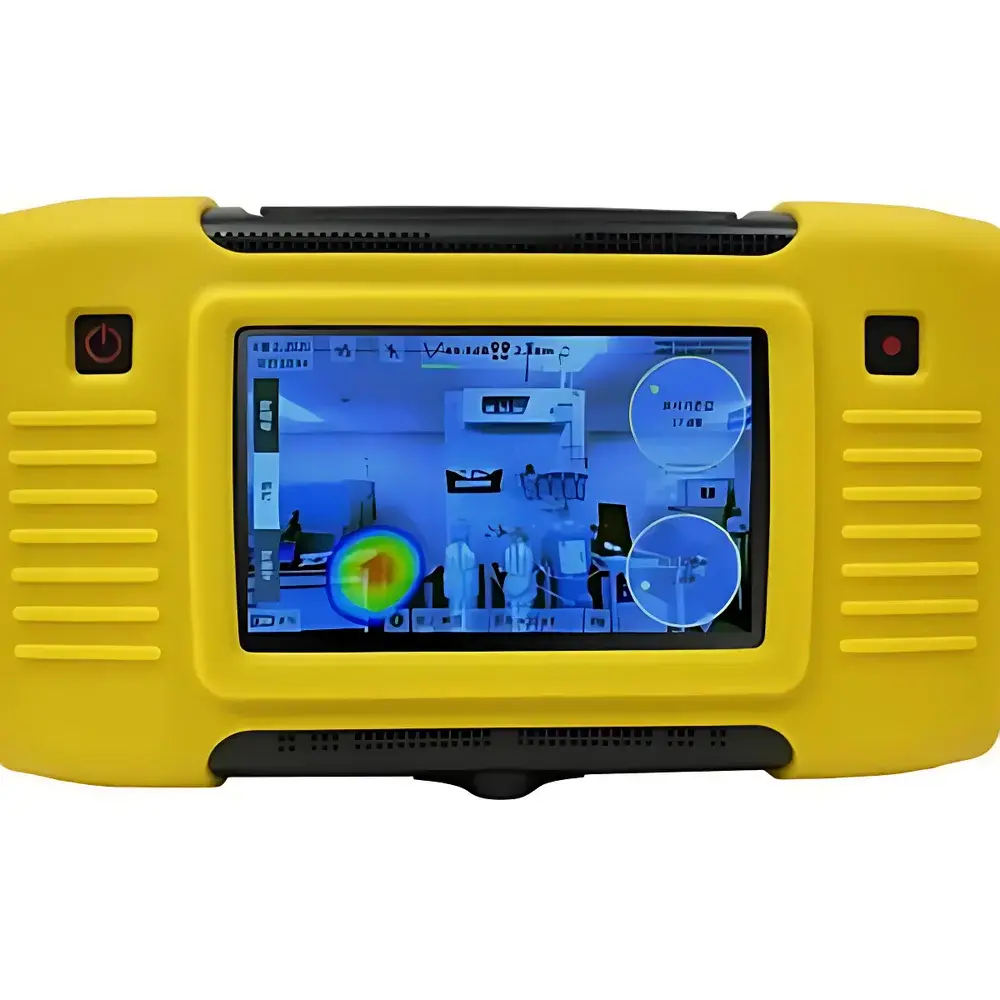
Honeywell SearchSonic Imager Acoustic Gas Leak & Electrical Corona Detection Camera
| Brand | Honeywell |
|---|---|
| Origin | USA |
| Model | SearchSonic Imager |
| Type | Handheld Acoustic Imaging Camera |
| Detection Principle | Ultrasonic Time-of-Flight Beamforming Array |
| Frequency Range | 20–100 kHz (adjustable bandwidth) |
| Operating Distance | 1 m to 50 m (dependent on leak size, pressure differential, and background noise) |
| Weight | <1.2 kg |
| Battery Life | ≥4 hours continuous operation |
| Display | 5.5″ OLED touchscreen (1920×1080) |
| Data Output | MP4 video + WAV audio + CSV metadata |
| Compliance | CE, UKCA, ATEX Zone 2/22, IECEx Zone 2/22, IP54 |
Overview
The Honeywell SearchSonic Imager is a handheld acoustic imaging camera engineered for non-contact, real-time visualization of ultrasonic emissions associated with pressurized gas leaks and electrical corona discharge. Unlike conventional point-sensor detectors or infrared thermography, the SearchSonic Imager employs a 128-element phased-array microphone system coupled with real-time beamforming algorithms to localize and spatially map high-frequency sound sources (20–100 kHz) onto a visible-light video feed. This enables technicians to *see* the exact origin, direction, and relative intensity of leaks—even in acoustically cluttered industrial environments—without physical contact or process interruption. The device operates on the principle that turbulent gas flow through orifices (e.g., faulty flanges, valve packing, or cracked welds) and partial discharges in energized insulation generate broadband ultrasonic energy. By isolating these frequencies from ambient noise via digital signal processing and adaptive thresholding, the imager delivers quantitative localization accuracy within ±1° angular resolution at 10 m distance—supporting predictive maintenance, energy loss quantification, and arc-flash risk mitigation per NFPA 70E and IEEE 1584 guidelines.
Key Features
- Real-time acoustic overlay: Synchronizes ultrasonic source mapping with HD optical video for intuitive leak/corona identification.
- Adaptive noise suppression: Configurable frequency band selection and dynamic threshold adjustment minimize false positives in noisy plants (e.g., near compressors, turbines, or switchgear rooms).
- Quantitative estimation mode: Estimates approximate leak rate (standard cubic feet per minute, scfm) for common gases (air, nitrogen, natural gas) based on measured sound pressure level (SPL), distance, and known pressure differentials—enabling ROI calculation for repair prioritization.
- Ergonomic one-handed operation: Weighing under 1.2 kg with balanced center-of-gravity design; optimized for extended use during plant walkdowns or confined-space inspections.
- On-device analytics: Embedded spectral analysis, time-domain waveform display, and snapshot annotation support immediate field reporting without external software.
- ATEX/IECEx-certified housing: Intrinsically safe design rated for Zone 2 (gas) and Zone 22 (dust) hazardous locations—certified to EN 60079-0 and EN 60079-15 standards.
Sample Compatibility & Compliance
The SearchSonic Imager detects ultrasonic emissions generated by turbulent flow across pressure boundaries and dielectric breakdown in air—making it compatible with all compressed gases (including air, N₂, CO₂, CH₄, SF₆) and steam systems operating above 3 bar(g). It also identifies corona, tracking, and arcing phenomena on exposed medium-voltage (1–35 kV) components—including insulators, bushings, disconnect switches, and cable terminations—without requiring de-energization. The instrument complies with ISO 55001 asset management frameworks, supports GLP/GMP audit trails when integrated with Honeywell’s Enterprise Asset Performance Management (APM) platform, and meets data integrity requirements per FDA 21 CFR Part 11 when used with validated reporting workflows.
Software & Data Management
Recorded inspections are saved as synchronized MP4 video files embedded with calibrated WAV audio streams and timestamped CSV metadata (including GPS coordinates, operator ID, ambient temperature/humidity, and measurement parameters). The proprietary Honeywell Acoustic Insight desktop software enables post-processing: spectral signature comparison, SPL trend analysis over time, automated report generation (PDF/Excel), and integration with CMMS platforms (e.g., IBM Maximo, SAP PM) via RESTful API. All stored data includes immutable audit logs showing user actions, parameter changes, and export events—ensuring traceability for regulatory review.
Applications
- Energy conservation: Quantifying compressed air and steam leaks in manufacturing facilities to prioritize repairs with highest kWh or thermal energy savings potential.
- Electrical reliability: Early detection of corona activity preceding insulation failure in substations, wind turbine switchyards, and data center UPS systems.
- Process safety: Screening for fugitive emissions in petrochemical, pharmaceutical, and food-grade facilities to meet EPA LDAR (Leak Detection and Repair) program requirements (40 CFR Part 60, Subpart VV).
- Preventive maintenance: Monitoring aging infrastructure—including boiler tubes, heat exchanger bundles, and pneumatic control systems—for progressive degradation trends.
- Commissioning verification: Validating seal integrity after piping hydrotests or electrical equipment installation before startup.
FAQ
Does the SearchSonic Imager require calibration before each use?
No—factory calibration is traceable to NIST standards and remains valid for 12 months under normal operating conditions. Annual recalibration is recommended and supported by Honeywell-certified service centers.
Can it detect helium or hydrogen leaks?
Yes—while sensitivity varies with molecular weight and pressure drop, the imager reliably detects turbulent flow signatures of helium and hydrogen when leak rates exceed ~0.1 scfh at distances ≤15 m.
Is training required to interpret results accurately?
Basic operation requires ≤2 hours of certified field training; advanced spectral interpretation and leak quantification are covered in Honeywell’s Level II Acoustic Imaging Certification course (8 hours, ANSI/ISO/IEC 17024-compliant).
How does it perform in outdoor or windy environments?
Wind speeds >15 mph attenuate high-frequency signals; use of the included windscreen accessory and directional scanning techniques maintain detection capability up to 25 mph.
Does it integrate with Honeywell Forge or third-party IIoT platforms?
Yes—via MQTT or OPC UA protocols, enabling real-time alarm forwarding, dashboard visualization, and predictive analytics using historical acoustic event data.






