
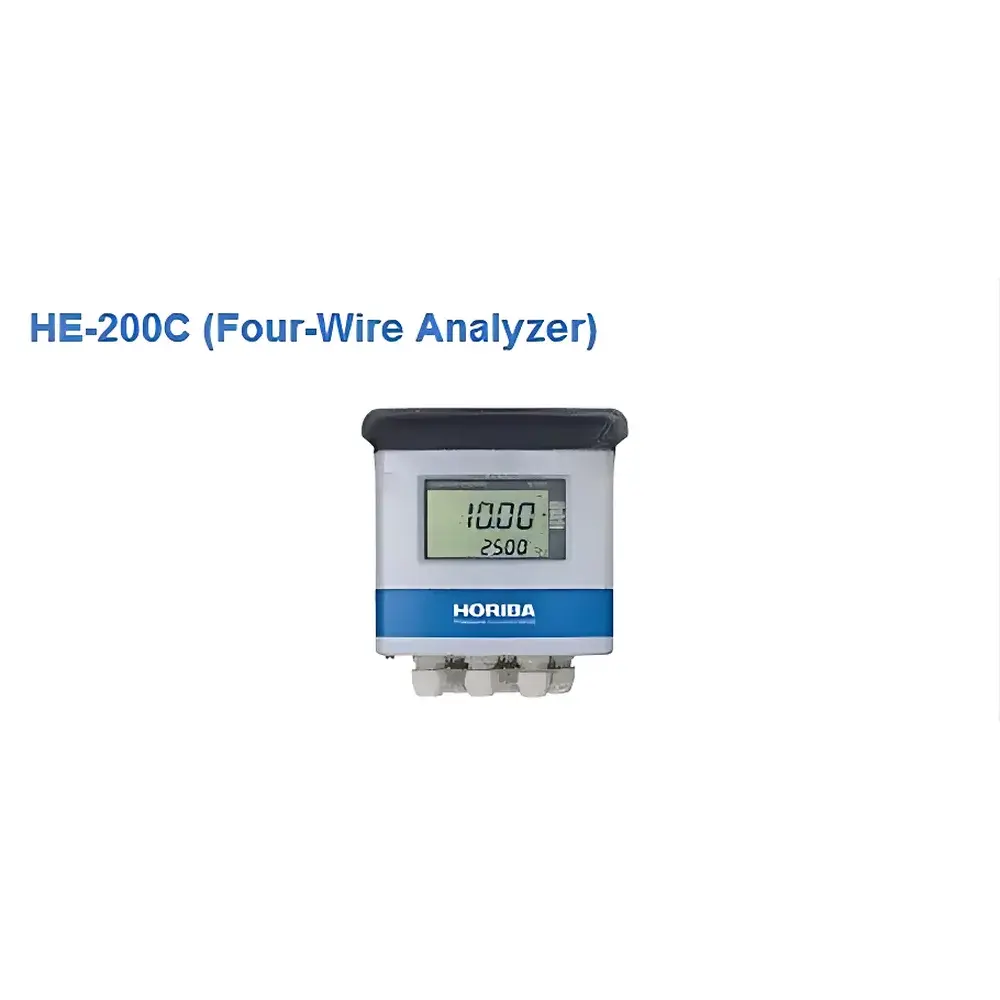
HORIBA HE-200C Industrial Online Conductivity Monitor
| Brand | HORIBA |
|---|---|
| Origin | Japan |
| Model | HE-200C |
| Enclosure Rating | IP65 |
| Power Supply | 90–264 V AC, 50/60 Hz |
| Output | Three isolated 4–20 mA analog outputs (configurable per parameter) |
| Relay Outputs | Three SPDT dry-contact relays (R1–R3, user-assignable for high/low alarms, USP qualification, or fault indication) |
| Communication | RS-485 (2-wire, galvanically isolated input/output circuitry) |
| Temperature Compensation | Pt1000 sensor (0 °C reference), 0–100 °C range |
| Measurement Parameters | Conductivity (0.000 µS/cm to 200.0 mS/cm, selectable cell constant: 0.01, 0.1, or 1.0 cm⁻¹), TDS (0.00–2000 mg/L, user-defined conversion factor 0.30–1.00), and temperature (0–100 °C, ±0.1 °C accuracy at reference point) |
| Accuracy | Conductivity ±0.5% FS (max), TDS ±1.5% FS (max), temperature ±0.5 °C linearity error |
| Repeatability | Conductivity ±0.5% FS (max), TDS ±1.5% FS (max) |
| Environmental Rating | Outdoor-rated aluminum housing, CE/FCC/WEEE/RoHS compliant |
| Mounting | Pole-mounted (50A pipe) or wall-mounted |
| Weight | ~4.5 kg |
Overview
The HORIBA HE-200C is an industrial-grade, outdoor-deployable online conductivity monitor engineered for continuous, unattended operation in demanding water quality monitoring applications. Based on the proven H-1 series platform, it employs two-electrode conductometric measurement principles compliant with ISO 7888 and ASTM D1125 standards for electrical conductivity determination in aqueous solutions. Unlike benchtop analyzers, the HE-200C integrates a ruggedized signal processing architecture with real-time temperature compensation (via integrated Pt1000 sensor) and automatic linearization across six decades of conductivity range — from ultrapure water (0.000 µS/cm) to high-salinity industrial effluents (200.0 mS/cm). Its dual-purpose design supports both environmental compliance monitoring (e.g., discharge permit verification per EPA Method 120.1) and process-critical control loops in pharmaceutical water systems (PW, WFI), semiconductor ultrapure water (UPW), and chemical manufacturing. The instrument operates independently of external controllers, delivering traceable, GLP-aligned data without requiring host SCADA integration for basic functionality.
Key Features
- Rugged IP65-rated aluminum enclosure certified to CE and FCC electromagnetic compatibility directives — suitable for direct outdoor installation without additional weatherproof enclosures.
- Triple independent 4–20 mA analog outputs, each configurable for conductivity, temperature, or TDS — supporting redundant transmission to DCS, PLC, or data loggers with galvanic isolation up to 500 VDC.
- Three programmable SPDT relay outputs (R1–R3) assignable to upper/lower limit alarms, USP Pharmaceutical Water qualification criteria (e.g., conductivity limits per USP <645>), or system fault conditions including electrode degradation detection.
- RS-485 Modbus RTU interface with optically isolated circuitry enables daisy-chained multi-instrument networks — ideal for distributed wastewater treatment plant monitoring or multi-point process water loops.
- Onboard electrode diagnostics continuously evaluate sensor integrity, detecting open-circuit, short-circuit, or coating-related drift — triggering maintenance alerts before measurement uncertainty exceeds ±0.5% FS.
- Large backlit LCD display (128 × 64 pixels) shows primary parameter, temperature, calibration history timestamp, and real-time self-diagnostic status — eliminating need for handheld configurators during routine checks.
Sample Compatibility & Compliance
The HE-200C is validated for use with standard two-electrode conductivity cells having cell constants of 0.01 cm⁻¹ (for ultrapure water), 0.1 cm⁻¹ (for potable and process water), and 1.0 cm⁻¹ (for wastewater and brines). It meets IEC 61000-6-2 (immunity) and IEC 61000-6-4 (emission) requirements, ensuring stable performance in electrically noisy industrial environments. All firmware and calibration logic adhere to FDA 21 CFR Part 11 principles: audit trails record every calibration event (date/time, operator ID, electrode constant entered, TDS factor applied), and configuration changes are digitally signed and time-stamped. The device complies with RoHS Directive 2011/65/EU and WEEE Directive 2012/19/EU, and its mechanical construction conforms to EN 60529 (IP65) and EN 60068-2 environmental stress testing protocols.
Software & Data Management
No proprietary PC software is required for commissioning or routine operation; all configuration is performed via intuitive front-panel navigation. However, optional HORIBA Link™ configuration utility (Windows-based) enables batch parameter export/import, firmware updates, and generation of PDF-formatted calibration reports compliant with ISO/IEC 17025 documentation requirements. The HE-200C stores the last five calibration records internally, including date, temperature at calibration, reference standard used (e.g., KCl 0.01 mol/L at 25 °C), and deviation from nominal value. All analog and relay outputs support configurable hysteresis and delay timers to prevent nuisance tripping in turbulent flow conditions. Data retention remains intact during power interruption thanks to non-volatile memory with >10-year data integrity rating.
Applications
- Continuous conductivity monitoring in pharmaceutical purified water (PW) and water for injection (WFI) distribution loops — verifying compliance with USP <645> and EU Ph. Eur. 2.2.38.
- Effluent discharge monitoring at municipal and industrial wastewater treatment plants — meeting regulatory thresholds under NPDES permits and local environmental ordinances.
- Real-time salinity tracking in desalination pre-treatment and reverse osmosis feedwater streams to optimize antiscalant dosing and membrane protection.
- In-line quality assurance for electronics-grade ultrapure water (UPW) in semiconductor fabrication — detecting ionic contamination events down to sub-ppb Na⁺ equivalent levels.
- Process water conductivity control in food & beverage production lines, particularly dairy and brewing applications where mineral balance affects product consistency.
FAQ
Can the HE-200C measure both conductivity and TDS simultaneously?
No — conductivity and TDS are mutually exclusive measurement modes. When TDS is selected, the instrument applies a user-defined conversion factor (0.30–1.00) to the raw conductivity reading; no simultaneous dual-parameter output is supported.
Is temperature compensation mandatory, or can it be disabled?
Temperature compensation is always active and cannot be disabled; the Pt1000 sensor is integral to measurement integrity. However, the algorithm supports both linear (standard) and non-linear (NaCl curve) compensation models selectable via configuration menu.
What is the maximum cable length between the HE-200C transmitter and the conductivity sensor?
For standard shielded twisted-pair cable (AWG 22, 100 pF/m), maximum recommended distance is 30 meters. For longer runs, use low-capacitance instrumentation cable (<50 pF/m) and verify signal integrity with oscilloscope testing prior to commissioning.
Does the HE-200C support HART communication protocol?
No — it features RS-485 Modbus RTU only. HART capability is available in HORIBA’s higher-tier LAQUA series but not implemented in the H-1 platform.
How often does the instrument require calibration verification?
Per ISO/IEC 17025 and ASTM D1125, field calibration verification should occur at intervals determined by risk assessment — typically every 7 to 30 days for critical pharmaceutical applications, or quarterly for non-regulated industrial effluent monitoring. Automatic diagnostic logs assist in establishing statistically valid calibration intervals.
Related Products







