
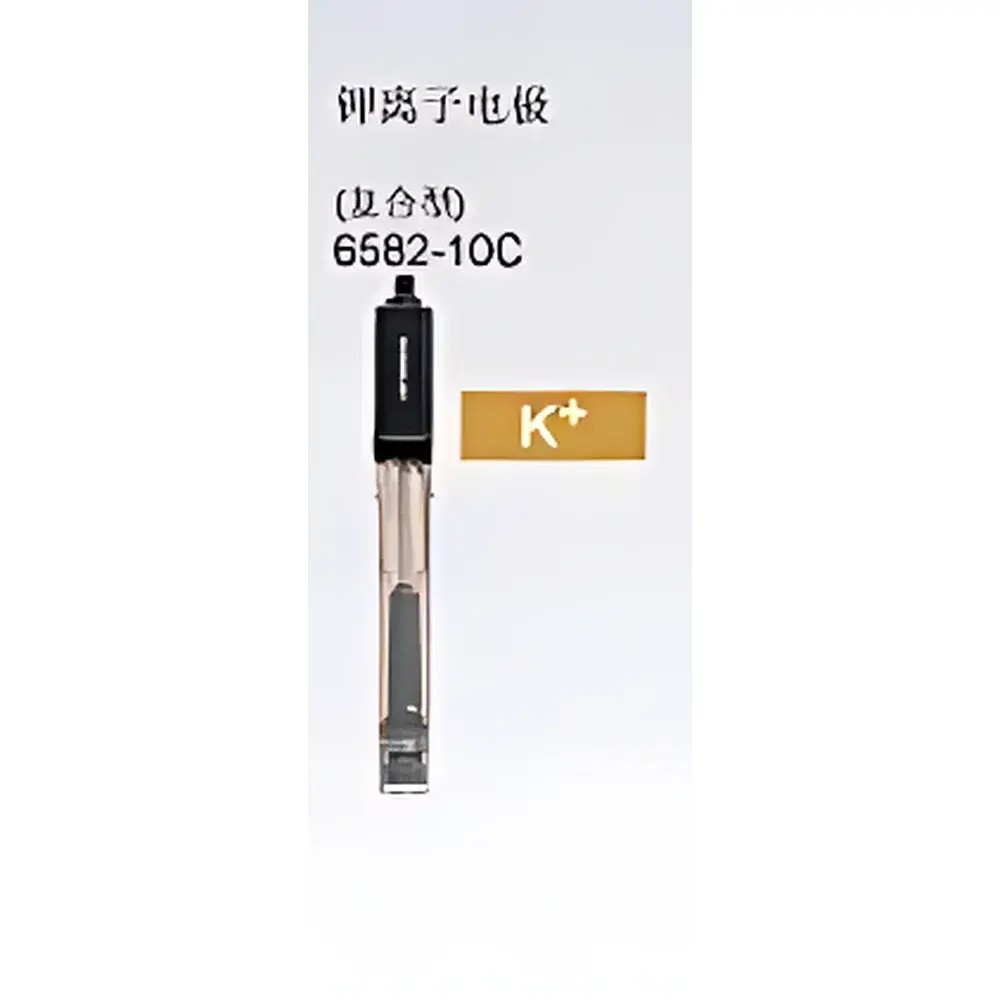
HORIBA 6582-10C Potassium Ion-Selective Electrode (Composite Type)
| Brand | HORIBA |
|---|---|
| Origin | Japan |
| Model | 6582-10C |
| Measurement Range | 0.04–39,000 ppm K⁺ |
| Electrode Type | Composite (Integrated Reference) |
| Compatible Meters | HORIBA F-72 / F-73 / F-74 / F-74BW (benchtop), D-53 (portable) |
| Reference System | Built-in double-junction Ag/AgCl reference |
| Operating pH Range | 2.5–10.5 (K⁺-specific membrane unaffected by common interferents within this range) |
| Response Time | <30 seconds (t₉₀ in standard calibration solutions) |
| Temperature Range | 0–50 °C |
| Storage Solution | 0.1 M KCl or manufacturer-recommended storage buffer |
Overview
The HORIBA 6582-10C is a composite-type potassium ion-selective electrode (ISE) engineered for high-precision, direct potentiometric measurement of potassium activity in aqueous environmental and process water samples. It operates on the principle of selective ion exchange across a valinomycin-doped polyvinyl chloride (PVC) membrane, which exhibits exceptional selectivity for K⁺ over Na⁺ (log KK,Napot ≈ −2.8) and other monovalent cations. Unlike conventional two-electrode setups requiring external reference electrodes, the 6582-10C integrates a stable, low-drift double-junction Ag/AgCl reference system within a single robust body—minimizing liquid junction potential variability and eliminating setup complexity. Designed specifically for integration with HORIBA’s F-series benchtop analyzers (F-72, F-73, F-74, F-74BW) and D-53 portable meters, it delivers reproducible mV outputs conforming to the Nernst equation (59.2 mV/decade at 25 °C), enabling quantitative determination across a wide dynamic range from 1.0 × 10⁻⁶ M to 1.0 × 10⁻² M K⁺ (equivalent to 0.04–39,000 ppm as elemental potassium).
Key Features
- Composite design eliminates need for separate reference electrode—reduces measurement drift and cross-contamination risk
- Valinomycin-based sensing membrane optimized for selectivity against sodium, ammonium, and hydrogen ions under controlled pH conditions (pH 2.5–10.5)
- Double-junction reference system filled with saturated KCl and KNO₃ outer electrolyte—minimizes cation interference from sample matrices
- Chemically resistant PVC body and epoxy-sealed junction compatible with field deployment and laboratory use
- Calibration-ready output signal compliant with ASTM D1293-22 (Standard Test Method for Electrical Conductivity and pH of Water) and ISO 10523:2008 (Water quality — Determination of pH)
- Interchangeable with HORIBA’s modular electrode platform—supports rapid sensor replacement without recalibrating the host analyzer
Sample Compatibility & Compliance
The 6582-10C is validated for use in natural waters (surface, groundwater, wastewater effluent), drinking water distribution systems, agricultural runoff, and industrial process streams. It tolerates moderate turbidity (<50 NTU) and suspended solids when used with appropriate filtration (e.g., 0.45 µm membrane pre-filtration). Performance remains stable in samples containing up to 500 mg/L total dissolved solids (TDS), provided ionic strength is compensated via standard addition or ionic strength adjuster (ISA) protocols. The electrode complies with GLP documentation requirements when paired with HORIBA F-series instruments equipped with audit-trail-enabled firmware (v3.2+), supporting 21 CFR Part 11–compliant data integrity workflows where electronic records are maintained. It is not intended for non-aqueous, highly viscous, or protein-rich biological fluids without matrix-matched calibration.
Software & Data Management
When connected to HORIBA F-72/F-73/F-74/F-74BW analyzers, the 6582-10C interfaces natively with HORIBA LabSolutions™ software (v2.10+), enabling automated calibration curve generation (single-point, two-point, or multi-point), real-time slope monitoring (ideal Nernstian response: 57–60 mV/decade), and automatic temperature compensation (ATC) using integrated Pt1000 thermistor input. All measurement events—including calibration timestamps, electrode ID, slope values, and raw mV readings—are logged with user-defined metadata and exported in CSV or PDF report formats compliant with ISO/IEC 17025:2017 clause 7.7 (Results reporting). For D-53 portable operation, onboard memory stores up to 500 data points with GPS-tagged geolocation (when enabled), and synchronization with HORIBA MobileLink™ app facilitates cloud-based QA/QC review.
Applications
- Regulatory monitoring of potassium in drinking water per WHO Guidelines for Drinking-water Quality (4th ed.) and EPA Method 300.1 (Ion Chromatography – Revision 2.1, used for ISE validation)
- Wastewater treatment plant effluent compliance tracking under EU Urban Wastewater Treatment Directive (91/271/EEC) annex parameters
- Soil leachate analysis in agricultural environmental impact assessments (ASTM D4373-21)
- Quality control of nutrient solutions in hydroponic and aquaponic systems
- Validation of ion-exchange resin performance in demineralization units
- Field screening of potassium enrichment in surface waters impacted by fertilizer runoff or mining discharge
FAQ
What is the recommended storage solution for the 6582-10C electrode?
Store vertically in 0.1 M KCl solution or HORIBA-recommended storage buffer (Cat. No. 025-00120); avoid distilled water or dry storage.
Can the 6582-10C be used with non-HORIBA meters?
Yes—if the meter supports BNC input, mV mode, and manual calibration; however, full functionality (auto-ID, slope diagnostics, ISA correction) requires HORIBA F-series or D-53 firmware.
How often should calibration be performed?
Daily for routine QC; before each analytical batch in regulated environments; verify slope ≥95% of theoretical value (57–60 mV/decade) prior to sample analysis.
Does this electrode require conditioning before first use?
Yes—soak in 100 ppm K⁺ standard for ≥2 hours; rinse thoroughly with deionized water before calibration.
Is the 6582-10C suitable for seawater analysis?
Not recommended without matrix-matched calibration due to high ionic strength and Na⁺ interference; use only after verifying selectivity coefficient in artificial seawater (ASTM D1141-98).







