
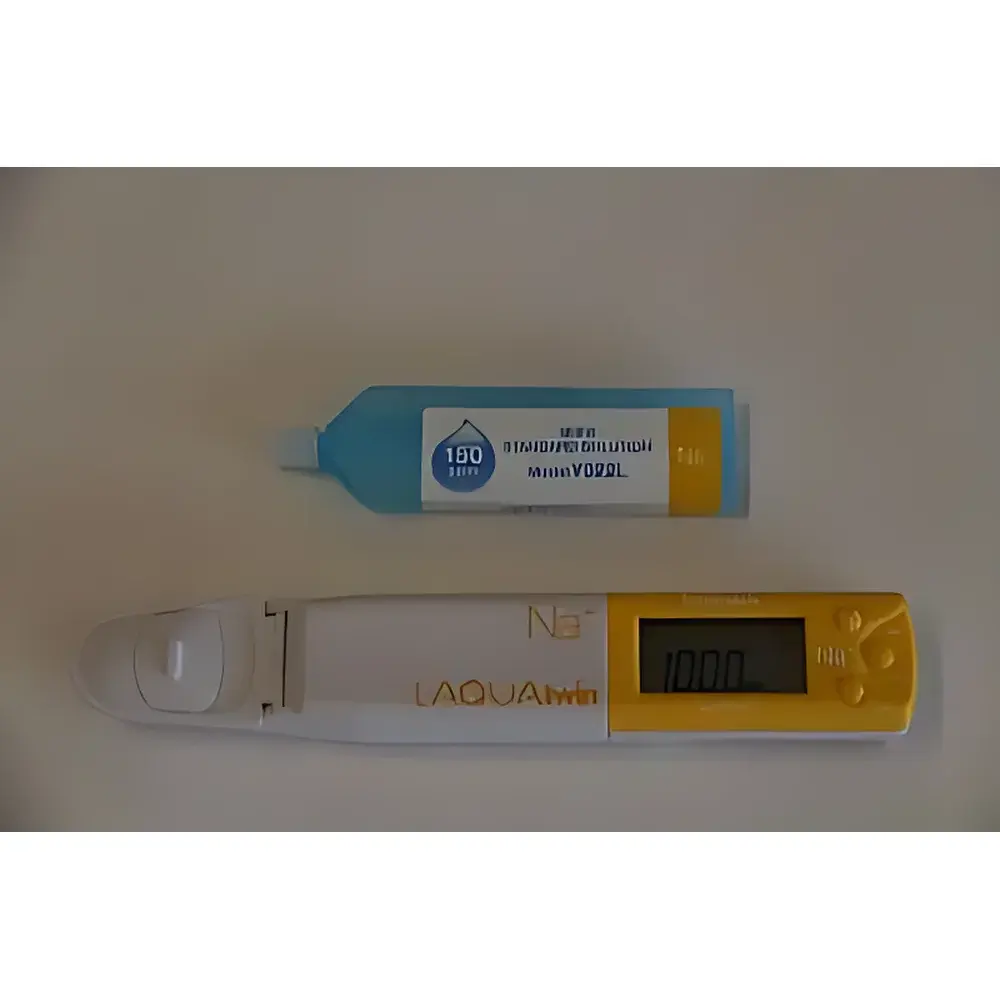
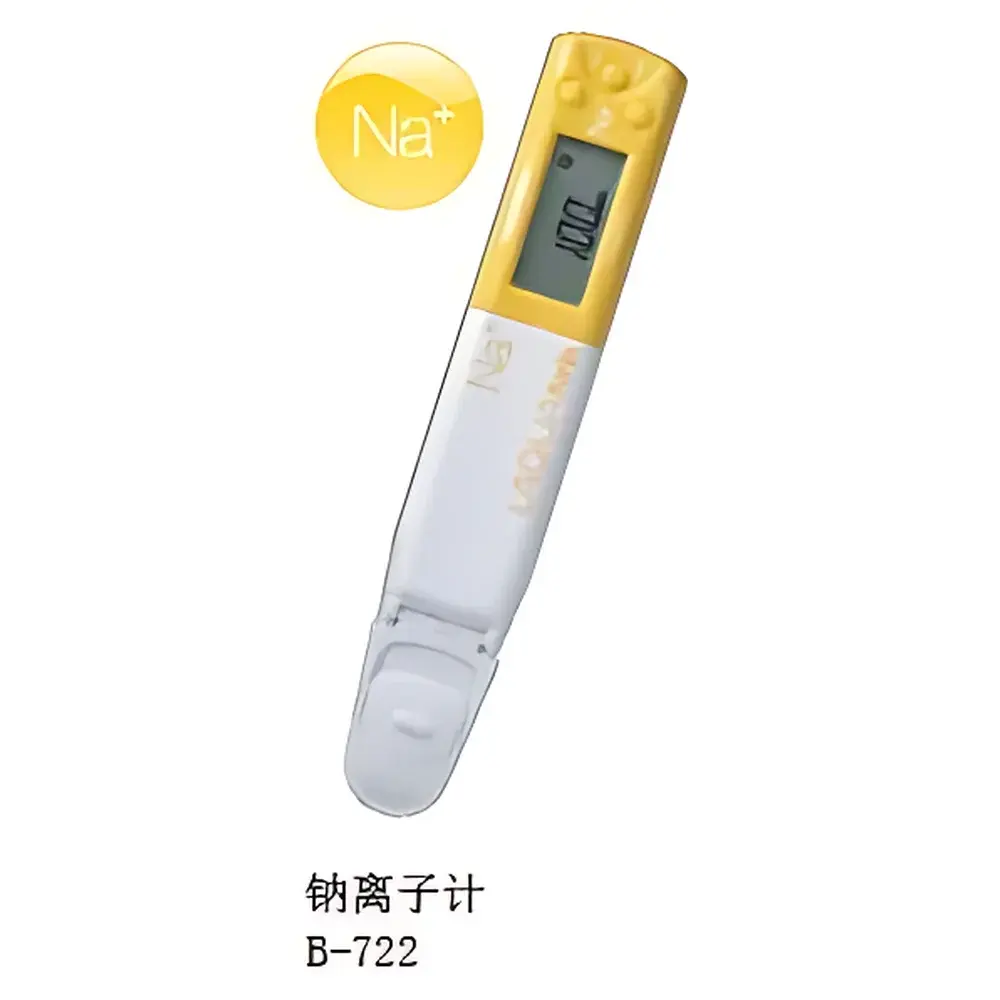
HORIBA B-722 Compact Sodium Ion Meter
| Brand | HORIBA |
|---|---|
| Origin | Japan |
| Model | B-722 |
| Measurement Principle | Ion-Selective Electrode (ISE) Method |
| Measurement Range | 23–2300 ppm (mg/L) [1.0 × 10⁻³ – 1.0 × 10⁻¹ mol/L] |
| Minimum Sample Volume | 0.05 mL × 2 or ≥0.3 mL |
| Calibration | Two-Point Calibration |
| Accuracy | ±10% of reading |
| Temperature Compensation | Automatic (2%/°C fixed coefficient) |
| Auto-Hold Function | Yes |
| Ingress Protection | IP67 |
| Operating Environment | 5–40 °C, <85% RH (non-condensing) |
| Power Supply | Two CR2032 batteries |
| Dimensions (L×W×H) | 164 × 29 × 20 mm (excl. protrusions) |
| Weight | Approx. 50 g (instrument only, batteries excluded) |
Overview
The HORIBA B-722 Compact Sodium Ion Meter is a handheld, field-deployable ion-selective electrode (ISE)-based analyzer engineered for rapid, on-site quantification of sodium ion concentration in aqueous samples. Designed with metrological rigor and ergonomic portability in mind, the B-722 implements a solid-state sodium-selective membrane electrode coupled with a built-in reference system to deliver stable potentiometric response per the Nernst equation. Its compact cylindrical form factor—measuring just 164 mm in length and weighing approximately 50 g—enables single-handed operation in constrained environments such as wastewater treatment influent channels, drinking water distribution points, boiler feedwater sampling stations, and environmental field surveys. Unlike laboratory-grade benchtop ISE systems requiring temperature-controlled cells and multi-point calibration protocols, the B-722 integrates automatic temperature compensation (fixed 2%/°C coefficient), auto-hold stabilization, and robust signal conditioning optimized for real-time field use without compromising measurement traceability.
Key Features
- Ion-selective electrode (ISE) sensing technology compliant with ASTM D1129 and ISO 10523 principles for potentiometric ion analysis
- IP67-rated enclosure ensuring full protection against dust ingress and immersion in water up to 1 m for 30 minutes—validated for outdoor and industrial site deployment
- Two-point calibration capability using certified Na⁺ standard solutions (e.g., 100 ppm and 1000 ppm NaCl), supporting traceable adjustment across the operational range
- Automatic endpoint hold function that locks the stabilized reading upon signal convergence, minimizing operator-induced variability
- Integrated temperature sensor enabling real-time compensation within the specified operating range (5–40 °C)
- Low-power architecture powered by two replaceable CR2032 coin-cell batteries, providing >200 hours of continuous operation under typical usage conditions
- Compact dimensions (164 × 29 × 20 mm) and lightweight design (≈50 g) compatible with glove use and confined-space access
Sample Compatibility & Compliance
The B-722 is validated for direct measurement in clarified aqueous matrices including potable water, surface water, groundwater, effluent streams, and low-TDS industrial process waters. It is not intended for use in viscous, highly turbid, or strongly oxidizing solutions without prior filtration or dilution. Sample volume requirements are minimal—either two 0.05 mL aliquots or a single 0.3 mL sample—reducing consumable demand and enabling analysis where sample availability is limited. While the instrument itself does not generate audit trails or electronic records, its calibration procedure and measurement output align with GLP-aligned field data collection workflows. Users performing regulated testing (e.g., municipal water compliance per US EPA Method 300.0 or ISO 10304-1 for cation analysis) should document calibration dates, standard lot numbers, and environmental conditions manually or via external logging tools.
Software & Data Management
The B-722 operates as a standalone, embedded-system device with no onboard memory, Bluetooth, or USB connectivity. All measurements are displayed in real time on a high-contrast LCD screen and must be manually recorded. This architecture eliminates firmware update dependencies, cybersecurity vulnerabilities, and battery drain associated with wireless modules—enhancing long-term reliability in remote deployments. For laboratories requiring digital data capture, the B-722 is compatible with external barcode-scanned logbooks or mobile data collection platforms (e.g., Fulcrum, GoCanvas) via manual entry. Though it does not comply with FDA 21 CFR Part 11 electronic record requirements due to absence of user authentication and audit trail functionality, its mechanical robustness and measurement consistency support routine QA/QC checks in non-GxP environments.
Applications
- Routine monitoring of sodium levels in municipal drinking water distribution networks to verify softening efficiency and detect chloride/sodium intrusion
- Field verification of reverse osmosis (RO) and ion exchange (IX) system performance in industrial pretreatment circuits
- Environmental assessment of sodium leaching from road de-icing agents into adjacent soil pore water or shallow aquifers
- Boiler feedwater quality control to prevent caustic stress corrosion cracking in high-pressure steam systems
- Educational laboratory exercises demonstrating Nernstian response, selectivity coefficients, and ISE calibration fundamentals
- Emergency response screening during saltwater intrusion events in coastal aquifers or storm surge-affected wells
FAQ
What sample preparation is required before measurement?
Samples must be free of suspended solids and oils. Filtration through a 0.45 µm membrane filter is recommended for turbid or particulate-laden waters. No pH adjustment is needed, though extreme pH (12) may affect electrode response stability.
Can the B-722 measure sodium in seawater or brine?
No. The upper limit of 2300 ppm Na⁺ corresponds to ~0.1 mol/L—well below seawater concentration (~10,500 ppm). High ionic strength matrices cause significant activity coefficient deviation and junction potential errors; dedicated high-range sensors or dilution protocols are required.
How often should calibration be performed?
Calibration is recommended before each measurement session and after extended storage (>72 hours). If used continuously in stable environmental conditions, recalibration every 4–6 hours is sufficient for ≤±10% accuracy maintenance.
Is electrode replacement possible, and what is the expected service life?
The sodium ISE is integrated and non-replaceable. Under normal field use (≤5 measurements/day), functional lifespan exceeds 18 months. Performance degradation manifests as prolonged response time (>30 s) or failure to stabilize within ±5% across repeated standards.
Does the B-722 meet any international standard specifications?
While not certified to a specific standard, its measurement principle, calibration methodology, and accuracy specification conform to foundational requirements outlined in ISO 10304-1 (determination of dissolved ions by liquid chromatography) and ASTM D1129 (standard terminology relating to water), serving as a field-complementary tool to lab-based validation methods.
Related Products







