
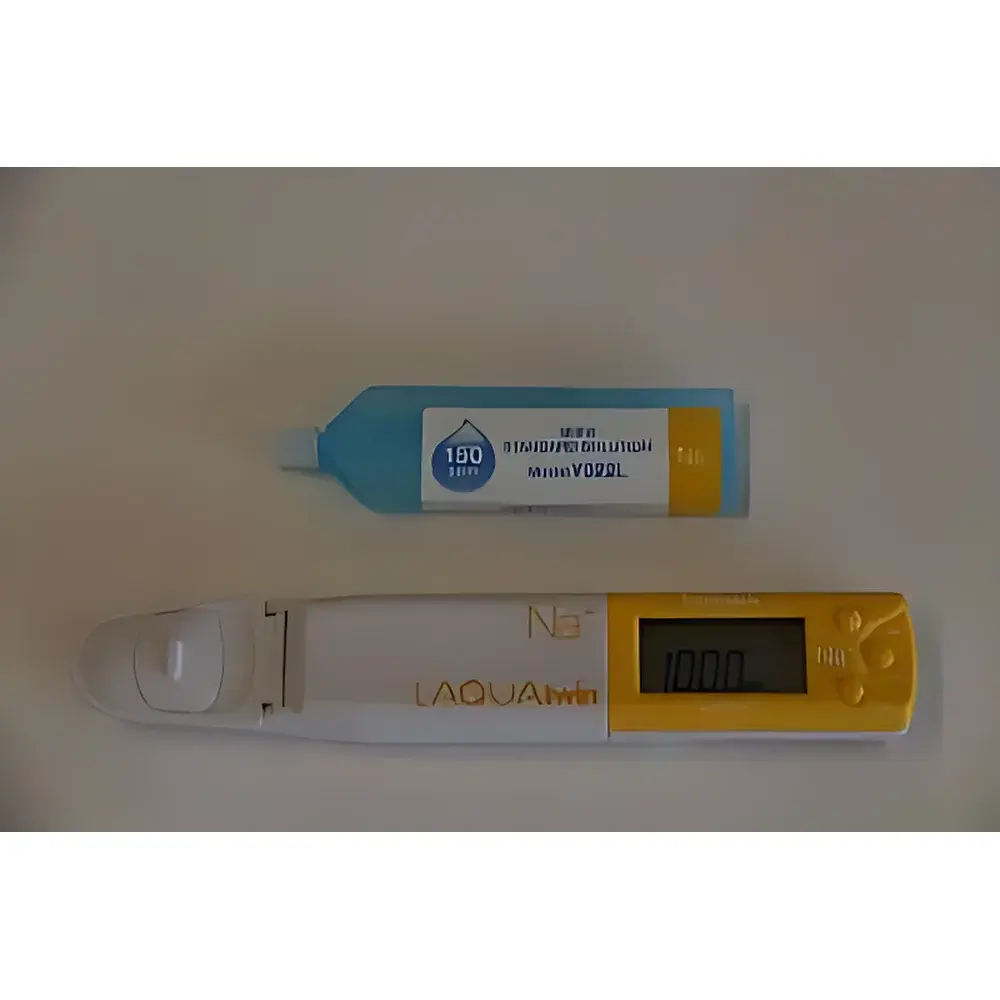
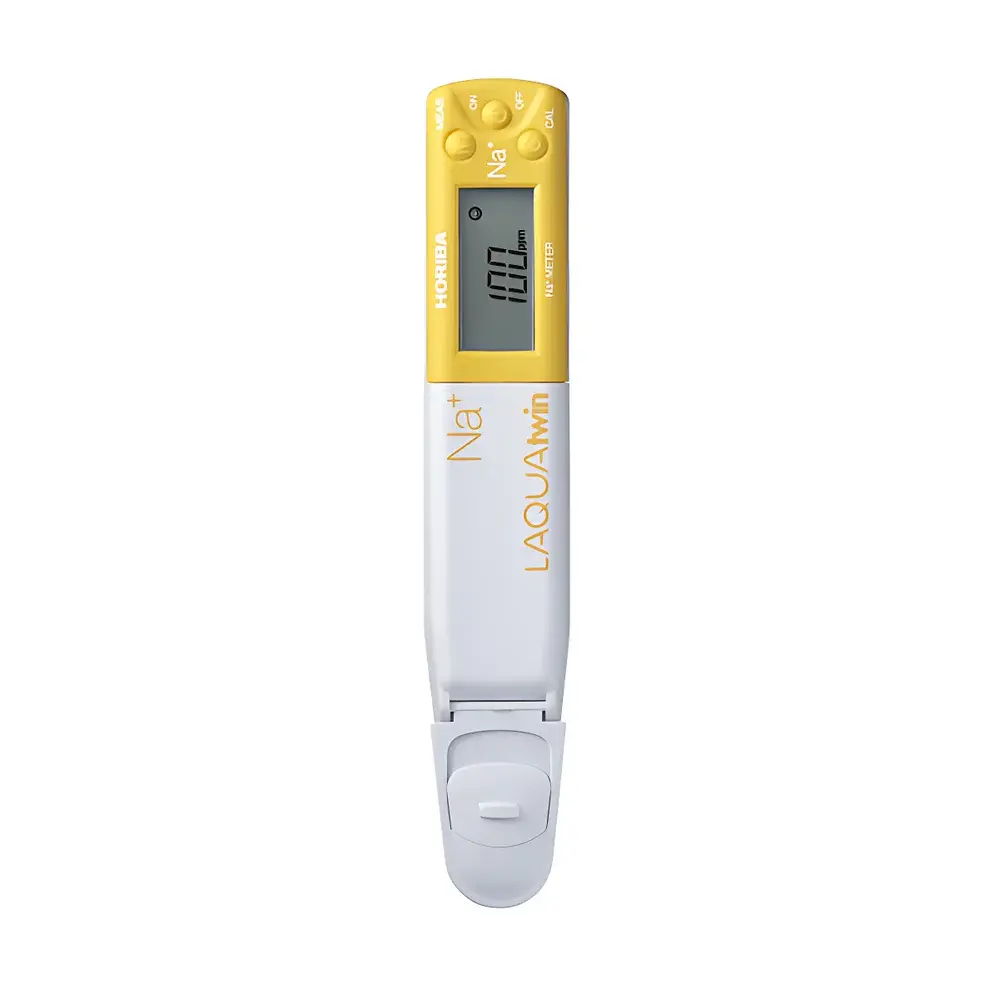
HORIBA B-722 Portable Sodium Ion Meter
| Brand | HORIBA |
|---|---|
| Origin | Japan |
| Model | B-722 |
| Measurement Principle | Ion-Selective Electrode (ISE) Method |
| Measurement Range | 23–2300 ppm (mg/L) [1.0 × 10⁻³ – 1.0 × 10⁻¹ mol/L] |
| Minimum Sample Volume | 0.05 mL × 2 or ≥0.3 mL |
| Calibration | Two-Point Calibration |
| Accuracy | ±10% of reading |
| Temperature Compensation | Automatic (fixed coefficient: 2%/°C) |
| Auto-Hold Function | Yes |
| Ingress Protection Rating | IP67 |
| Operating Environment | 5–40 °C, <85% RH (non-condensing) |
| Power Supply | Two CR2032 batteries |
| Dimensions (L×W×H) | 164 × 29 × 20 mm (excl. protrusions) |
| Weight | Approx. 50 g (instrument only, excl. batteries) |
Overview
The HORIBA B-722 Portable Sodium Ion Meter is a compact, field-deployable ion-selective electrode (ISE)-based analyzer engineered for rapid, on-site quantification of sodium ion concentration in aqueous samples. Designed around a solid-state sodium-selective membrane electrode, the instrument operates on the principle of potentiometric measurement—detecting the Nernstian potential shift induced by Na⁺ activity in solution relative to a built-in reference electrode. Its miniaturized pen-style form factor and robust mechanical architecture enable reliable use in demanding environmental monitoring scenarios, including wastewater effluent screening, boiler feedwater testing, desalination plant process control, and surface water quality assessment. Unlike laboratory-grade benchtop ISE systems, the B-722 integrates essential signal conditioning, temperature compensation, and data stabilization logic into a single handheld unit—eliminating the need for external meters or junction boxes while maintaining traceable electrochemical performance.
Key Features
- True portable design: Pen-form factor (164 × 29 × 20 mm), lightweight (≈50 g), and ergonomic grip for one-handed operation in confined or outdoor settings.
- IP67-rated enclosure: Fully protected against dust ingress and immersion in water up to 1 m for 30 minutes—validated per IEC 60529—ensuring operational integrity during field sampling in rain, high-humidity labs, or splash-prone industrial zones.
- Ion-selective electrode technology: Utilizes a proprietary sodium-specific sensing membrane with stable response across pH 4–10; no interference from common cations (e.g., K⁺, Ca²⁺, Mg²⁺) within typical environmental matrices when used per manufacturer guidelines.
- Two-point calibration protocol: Supports bracketed calibration using standard solutions (e.g., 100 ppm and 1000 ppm Na⁺), enabling linearization of the Nernst slope and correction for electrode drift—critical for regulatory-compliant field measurements.
- Automatic temperature compensation (ATC): Fixed 2%/°C coefficient applied to measured mV output, referenced to 25 °C—aligned with ASTM D1129 and ISO 10523 conventions for ion activity reporting.
- Auto-hold function: Freezes stabilized readings after signal convergence (±0.5 mV/3 sec), reducing operator dependency and minimizing transcription errors during multi-sample surveys.
Sample Compatibility & Compliance
The B-722 is validated for direct measurement in low-turbidity, non-viscous aqueous media—including drinking water, treated wastewater, cooling tower blowdown, and freshwater sources—with total dissolved solids (TDS) ≤ 5000 ppm and conductivity 5 µm), oils, or strong chelating agents (e.g., EDTA) that may foul the ISE membrane. While not intended for high-precision GLP/GMP environments requiring audit trails, the device supports basic data integrity practices: calibration records (date/time, standard concentrations), ambient temperature logging, and manual annotation of sample IDs. It complies with general electrical safety standards (IEC 61010-1) and electromagnetic compatibility (IEC 61326-1). For regulatory submissions under EPA Method 300.0 or ISO 10304-1, users are advised to validate method performance per site-specific matrix interferences and document calibration verification with certified reference materials.
Software & Data Management
The B-722 operates as a standalone instrument without embedded Bluetooth, USB, or cloud connectivity. All measurements are displayed on a high-contrast LCD and retained only as transient visual output—no internal memory or export capability is provided. Users must manually record results in field notebooks or LIMS-compatible spreadsheets. This design prioritizes mechanical reliability and battery longevity (typical 1000+ measurements per CR2032 pair) over digital integration. However, its calibration protocol and documented accuracy (±10% of reading) align with QA/QC requirements for Tier 2 environmental monitoring where real-time decision support—not archival compliance—is the primary objective. For laboratories requiring 21 CFR Part 11–compliant electronic records, HORIBA recommends pairing the B-722 with external data loggers or transitioning to the LAQUA twin series for full traceability.
Applications
- Routine sodium surveillance in municipal water distribution networks to verify softening efficiency and detect chloride/sodium intrusion.
- Boiler and steam-cycle water chemistry control—monitoring Na⁺ breakthrough in mixed-bed demineralizers to prevent turbine corrosion.
- Field verification of reverse osmosis (RO) membrane integrity in desalination pre-treatment trains.
- Ecological assessments of salinity-driven habitat shifts in estuarine and coastal wetlands.
- Educational demonstrations of ion-selective potentiometry principles in undergraduate analytical chemistry laboratories.
FAQ
What sample volume is required for accurate measurement?
A minimum of 0.05 mL per measurement is sufficient when using the dual-sample mode; however, ≥0.3 mL is recommended for optimal electrode wetting and reproducibility in heterogeneous or low-conductivity samples.
Does the B-722 require routine membrane replacement?
No—the sodium-selective sensing element is integrated and non-serviceable; HORIBA specifies a functional lifespan of ≥12 months under normal field use (≤5 measurements/day, proper storage in KCl solution).
Can the B-722 measure sodium in seawater or brine?
Not reliably: The upper detection limit (2300 ppm) is exceeded in seawater (~10,500 ppm Na⁺); for such matrices, dilution and verification against certified reference materials are mandatory—and accuracy degrades significantly above 3000 ppm.
Is temperature compensation adjustable?
No—compensation uses a fixed 2%/°C coefficient, consistent with classical Nernst equation assumptions for monovalent ions at near-ambient conditions; manual offset correction is not supported.
How is calibration verified between standard points?
Users should perform periodic check standards (e.g., mid-range 500 ppm Na⁺) and reject calibrations yielding >±15% deviation from expected value—per HORIBA’s recommended QC frequency of once per 10 field measurements.
Related Products







