
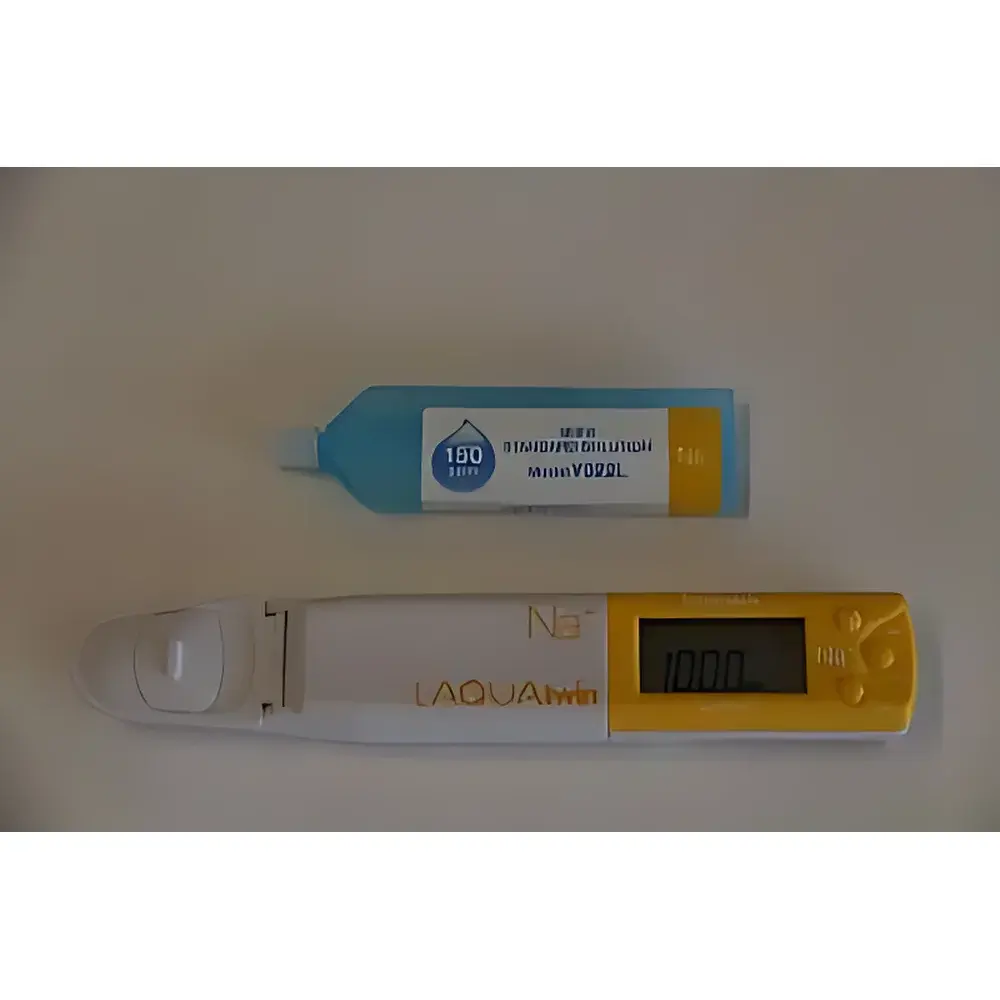
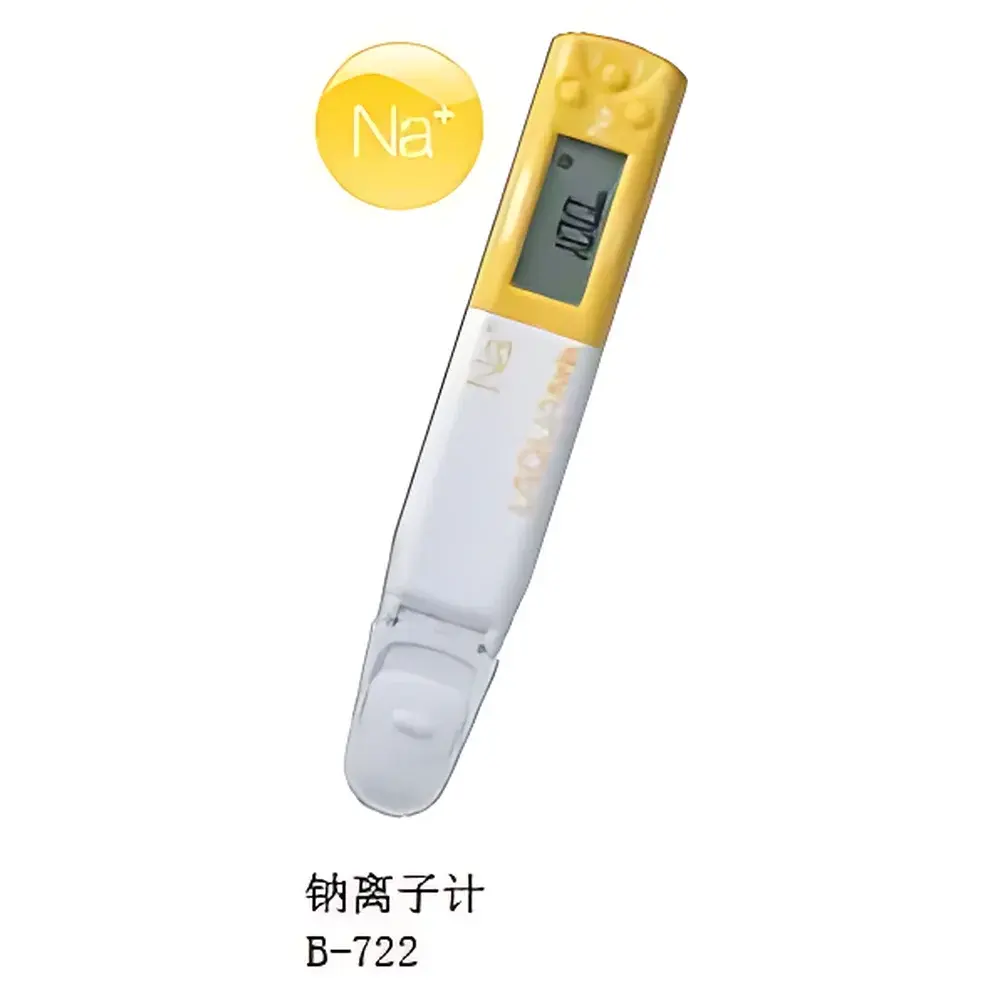
HORIBA B-722 Portable Sodium Ion Meter
| Brand | HORIBA |
|---|---|
| Origin | Japan |
| Model | B-722 |
| Measurement Principle | Ion-Selective Electrode (ISE) Method |
| Measurement Range | 23–2300 ppm (mg/L) / 1.0 × 10⁻³ – 1.0 × 10⁻¹ mol/L Na⁺ |
| Minimum Sample Volume | 0.05 mL × 2 or ≥0.3 mL |
| Calibration | Two-Point Calibration |
| Accuracy | ±10% of reading |
| Temperature Compensation | Automatic (fixed coefficient: 2%/°C) |
| Auto-Hold Function | Yes |
| Ingress Protection | IP67 |
| Operating Environment | 5–40 °C, RH <85% (non-condensing) |
| Power Supply | Two CR2032 batteries |
| Dimensions (L×W×H) | 164 × 29 × 20 mm (excl. protrusions) |
| Weight | Approx. 50 g (instrument only, batteries excluded) |
Overview
The HORIBA B-722 is a compact, handheld sodium ion meter engineered for rapid, on-site quantification of sodium concentration in aqueous samples using the potentiometric ion-selective electrode (ISE) principle. Unlike optical or colorimetric methods, the B-722 relies on a solid-state sodium-selective membrane electrode that generates a Nernstian potential response proportional to the logarithm of Na⁺ activity in solution. This electrochemical measurement approach ensures direct, reagent-free analysis with minimal sample preparation—ideal for field-deployed environmental monitoring, wastewater treatment verification, boiler water quality control, and laboratory spot-checking. Its miniaturized pen-style form factor integrates the sensor, electronics, and display into a single robust unit, eliminating the need for external cables, reference electrodes, or benchtop controllers. The device operates within a defined thermodynamic window (5–40 °C), with built-in temperature compensation to correct for the inherent thermal dependence of ISE response, ensuring consistent accuracy across variable ambient conditions.
Key Features
- Ion-selective electrode (ISE) technology optimized specifically for Na⁺ detection, minimizing interference from K⁺, Ca²⁺, and Mg²⁺ under typical environmental matrices
- Ultra-low sample requirement: as little as 0.05 mL per measurement (dual-point sampling mode) or ≥0.3 mL for standard single-measurement operation
- Wide dynamic range: 23–2300 ppm (1.0 × 10⁻³ – 1.0 × 10⁻¹ mol/L), covering applications from freshwater monitoring to high-salinity industrial effluents
- Two-point calibration protocol using certified Na⁺ standard solutions (e.g., 100 ppm and 1000 ppm), enabling linearization across the full operational span
- Automatic endpoint hold function freezes stable readings on-screen, reducing operator error during manual field recording
- IP67-rated enclosure provides full protection against dust ingress and immersion in up to 1 m of water for 30 minutes—suitable for outdoor, humid, or splash-prone environments
- Integrated temperature sensor with fixed 2%/°C compensation coefficient, aligned with standard ISE thermodynamic behavior per ISO 17025-compliant practice
- Low-power design powered by two replaceable CR2032 coin cells, delivering >2000 measurements per battery set under typical usage
Sample Compatibility & Compliance
The B-722 is validated for use with clear, low-turbidity aqueous samples including drinking water, surface water, groundwater, treated wastewater, cooling tower water, and desalination brine. It is not intended for viscous, highly suspended, or strongly acidic/alkaline media (pH 12) without prior dilution or matrix-matched calibration. While the instrument itself does not carry CE marking for medical devices or FDA 510(k) clearance, its measurement methodology conforms to principles outlined in ASTM D1129 (Standard Terminology Relating to Water) and supports data integrity practices required under ISO/IEC 17025:2017 for testing laboratories. For regulated environments requiring audit trails, users are advised to pair the B-722 with external logging protocols compliant with 21 CFR Part 11 when used in GLP/GMP contexts.
Software & Data Management
The B-722 operates as a standalone, embedded-system instrument with no onboard memory or digital interface (e.g., USB, Bluetooth, or RS-232). All measurements are displayed in real time on a high-contrast LCD screen and must be manually recorded. This architecture eliminates firmware update dependencies, cybersecurity risks, or software validation burdens—making it suitable for resource-constrained field teams and QA/QC personnel requiring traceable, deterministic output. For organizations requiring electronic data capture, third-party barcode scanners or mobile apps may be used to log serial-numbered readings alongside time/date stamps and location metadata.
Applications
- Environmental field surveys: Rapid screening of sodium contamination near road salt application zones or agricultural runoff areas
- Drinking water distribution systems: Verification of post-treatment Na⁺ levels following softening or desalination processes
- Power plant chemistry control: Monitoring sodium breakthrough in condensate polishing units and steam-cycle purity assurance
- Food & beverage process water: Spot-checking rinse water or ingredient water for sodium compliance with internal specifications
- Educational laboratories: Teaching core concepts of ion-selective potentiometry, Nernst equation derivation, and calibration best practices
- Regulatory support: Supplementing certified lab analyses with rapid field triage to prioritize sample submission for ICP-MS or IC confirmation
FAQ
What sample volume is required for a valid measurement?
A minimum of 0.05 mL is required when using the dual-point sampling mode; for standard single-measurement operation, ≥0.3 mL is recommended to ensure stable electrode contact and minimize air bubble interference.
Can the B-722 measure other ions such as potassium or nitrate?
No—the B-722 is configured exclusively for sodium detection via its dedicated Na⁺-selective electrode. Other HORIBA B-series models (e.g., B-712, B-731) are designed for K⁺, NO₃⁻, or Ca²⁺, but cross-sensor compatibility is not supported.
Is temperature compensation adjustable or fixed?
Temperature compensation uses a fixed 2%/°C coefficient, consistent with the theoretical slope of sodium ISEs at 25 °C per ISO 7872 and IUPAC recommendations for monovalent cations.
How often should calibration be performed?
Calibration is required before each measurement session and after prolonged storage (>24 hours) or exposure to extreme temperatures; frequent users performing >10 measurements/day should verify calibration every 2–3 hours using a mid-range standard.
Does the instrument meet any international standards for field instrumentation?
While the B-722 does not bear formal certification to IEC 61000 or EN 61326, its IP67 rating complies with IEC 60529, and its measurement principle aligns with ASTM D1129 and ISO 17025 foundational requirements for method validation and uncertainty estimation.
Related Products







