
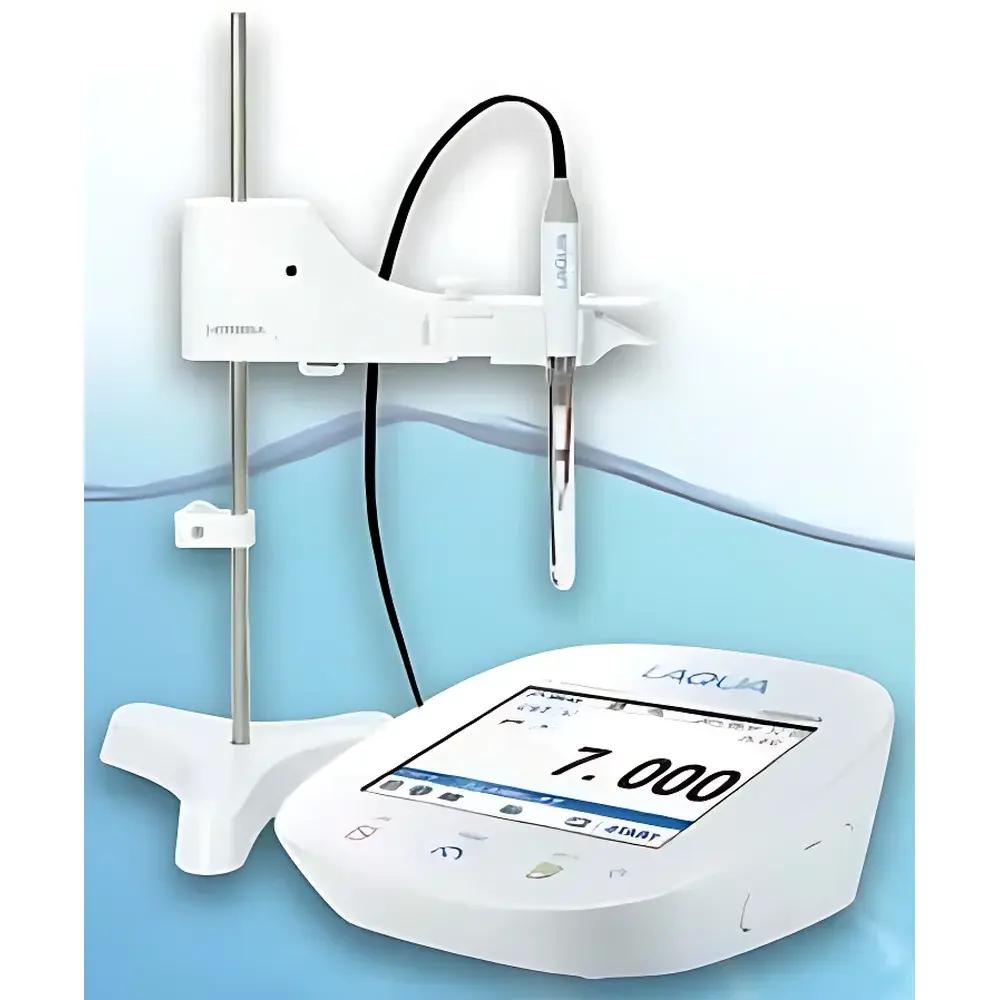
HORIBA F-73 Dual-Channel Benchtop Water Quality Analyzer with Touchscreen Interface
| Brand | HORIBA |
|---|---|
| Origin | Japan |
| Model | F-73 |
| Instrument Type | Laboratory Water Quality Analyzer |
| Measured Parameters | pH, ORP, Ion Concentration, Temperature |
| pH Range | 0.000–14.000 |
| pH Resolution | 0.001 pH |
| pH Repeatability | ±0.001 pH ±1 digit |
| ORP Range | ±1999.9 mV |
| ORP Resolution | 0.1 mV |
| ORP Repeatability | ±0.1 mV ±1 digit |
| Ion Concentration Range | 0.00 µg/L – 999 g/L (mol/L) |
| Ion Resolution | 3 significant digits |
| Ion Repeatability | ±0.5% F.S. ±1 digit |
| Temperature Range | −30.0–130.0 °C |
| Temperature Resolution | 0.1 °C |
| Temperature Repeatability | ±0.1 °C ±1 digit |
| Data Storage Capacity | 2000 datasets |
| Power Supply | AC adapter 100–240 V, 50/60 Hz |
| Power Consumption | ~9.8 VA |
| Net Weight | ~700 g |
| Compliance | JIS, USP <645>, EP 2.2.38, JP XVIII, CP 2020 |
| Language Support | English, Japanese, Korean, Chinese |
| Connectivity | USB interface for PC communication and data export |
Overview
The HORIBA F-73 is a dual-channel benchtop water quality analyzer engineered for precision laboratory applications requiring simultaneous, high-fidelity measurement of pH, oxidation-reduction potential (ORP), ion concentration, and temperature. Built upon HORIBA’s legacy of electrochemical sensor excellence, the F-73 implements potentiometric detection principles: pH and ORP are measured using calibrated glass and noble-metal reference electrodes, respectively; ion concentration is determined via selective ion electrodes (ISEs) following the Nernst equation; and temperature is acquired using a high-stability Pt1000 thermistor integrated into the electrode assembly or probe. Its architecture conforms to ISO/IEC 17025 traceability frameworks and supports method validation under pharmaceutical water specifications defined in USP , EP 2.2.38, JP XVIII, and Chinese Pharmacopoeia (CP) 2020. Designed for regulated environments—including QC labs in biopharma, contract testing organizations, and municipal water research facilities—the F-73 delivers metrological rigor without compromising operational efficiency.
Key Features
- Dual-channel independent measurement capability: Channel 1 supports concurrent pH/ORP/ion/temperature acquisition; Channel 2 is reserved for future expansion or auxiliary sensor integration (e.g., conductivity modules on higher-tier models).
- 10.1-inch capacitive touchscreen interface with multi-language UI (English, Japanese, Korean, Chinese), enabling intuitive navigation, real-time parameter visualization, and contextual on-screen guidance.
- Integrated calibration and diagnostic navigation: Step-by-step prompts for electrode conditioning, 1–3 point pH calibration, standard addition for ISE, and ORP verification—aligned with JIS Z 8401 and ASTM D1293 protocols.
- GLP/GMP-compliant data management: Automatic timestamping, user ID logging, electrode ID tracking, and measurement metadata capture (e.g., slope, offset, temperature compensation status).
- Modular electrode design: Quick-release glass pH electrodes with replaceable reference junctions and ruggedized ISE housings compatible with routine cleaning, storage, and recalibration.
- Robust power architecture: Universal AC input (100–240 V, 50/60 Hz) with low-noise linear regulation ensures stable operation during extended batch analyses and minimizes electromagnetic interference with sensitive electrochemical signals.
Sample Compatibility & Compliance
The F-73 accommodates aqueous samples across a broad physicochemical spectrum—from ultrapure water (UPW) in semiconductor rinse validation to high-ionic-strength industrial effluents and biological buffers. Its pH electrode system operates reliably in solutions with conductivity as low as 0.055 µS/cm (Type I water per ISO 3696) and tolerates moderate suspended solids when paired with flow-through or immersion cells. All measurement algorithms incorporate automatic temperature compensation (ATC) based on NIST-traceable polynomial coefficients. Regulatory alignment includes full support for pharmacopeial water testing workflows: automated pass/fail evaluation against USP conductivity limits, EP 2.2.38 resistivity thresholds, and JP XVIII total organic carbon (TOC)-correlated conductivity allowances. The instrument’s firmware and data handling routines meet FDA 21 CFR Part 11 requirements for electronic records and signatures when used with validated third-party software or HORIBA’s optional LabSolutions suite.
Software & Data Management
Data acquisition and reporting are managed through an embedded operating system supporting USB-host connectivity for direct transfer to Windows-based PCs or external USB flash drives (FAT32 formatted). Up to 2000 complete measurement records—including raw mV values, calculated concentrations, calibration history, operator notes, and environmental conditions—are stored with ISO 8601 timestamps and immutable sequence numbering. Export formats include CSV (for LIMS ingestion) and PDF (for audit-ready reports). Optional HORIBA LabSolutions software provides advanced features: statistical process control (SPC) charting, multi-instrument fleet monitoring, automated report generation compliant with ISO 17025 clause 7.8.2, and secure role-based access control (RBAC) for multi-user laboratories. Audit trails record all configuration changes, calibration events, and data deletions with user attribution and time stamps—fully satisfying GLP Annex 11 and GMP Annex 11 requirements.
Applications
- Pharmaceutical water system qualification: Routine monitoring of purified water (PW), water for injection (WFI), and clean steam condensate per USP/EP/JP monographs.
- Environmental compliance testing: Field-deployable lab verification of surface water, groundwater, and wastewater effluent parameters prior to discharge reporting (EPA Method 150.1, ISO 10523).
- Academic and R&D laboratories: Kinetic studies of acid-base equilibria, redox reactions, and ion-exchange processes requiring sub-millivolt stability and drift-corrected ISE response.
- Food and beverage QC: pH and salt activity (via Na+/Cl− ISE) verification in brines, dairy formulations, and fermentation broths.
- Electroplating and metal finishing: Real-time bath monitoring of pH, fluoride (F−), and cyanide (CN−) concentrations to maintain process consistency and regulatory compliance.
FAQ
Does the F-73 support automatic temperature compensation for all measured parameters?
Yes—ATC is applied to pH, ORP, and ion concentration measurements using either built-in Pt1000 sensing or external temperature probes, with selectable compensation curves (linear, Nernstian, or custom polynomials).
Can the F-73 be integrated into a LIMS environment?
Yes—via USB serial emulation (CDC ACM class) or optional RS-232 interface, enabling bidirectional communication with LIMS platforms using ASTM E1384 or HL7-compatible drivers.
What electrode certifications are available for GMP-regulated use?
HORIBA provides CoA (Certificate of Analysis) and CoC (Certificate of Conformance) for all OEM electrodes, including ISO/IEC 17025-accredited calibration certificates traceable to NIST SRMs.
Is firmware update capability included?
Yes—field-upgradable firmware is distributed via HORIBA’s secure customer portal and installed via USB drive; version history and release notes comply with IEC 62304 Class B software lifecycle requirements.
How does the F-73 handle electrode diagnostics and failure alerts?
It performs continuous impedance monitoring, slope validation, and asymmetry potential checks—triggering context-aware warnings and stepwise troubleshooting guidance directly on the touchscreen interface.
Related Products







