
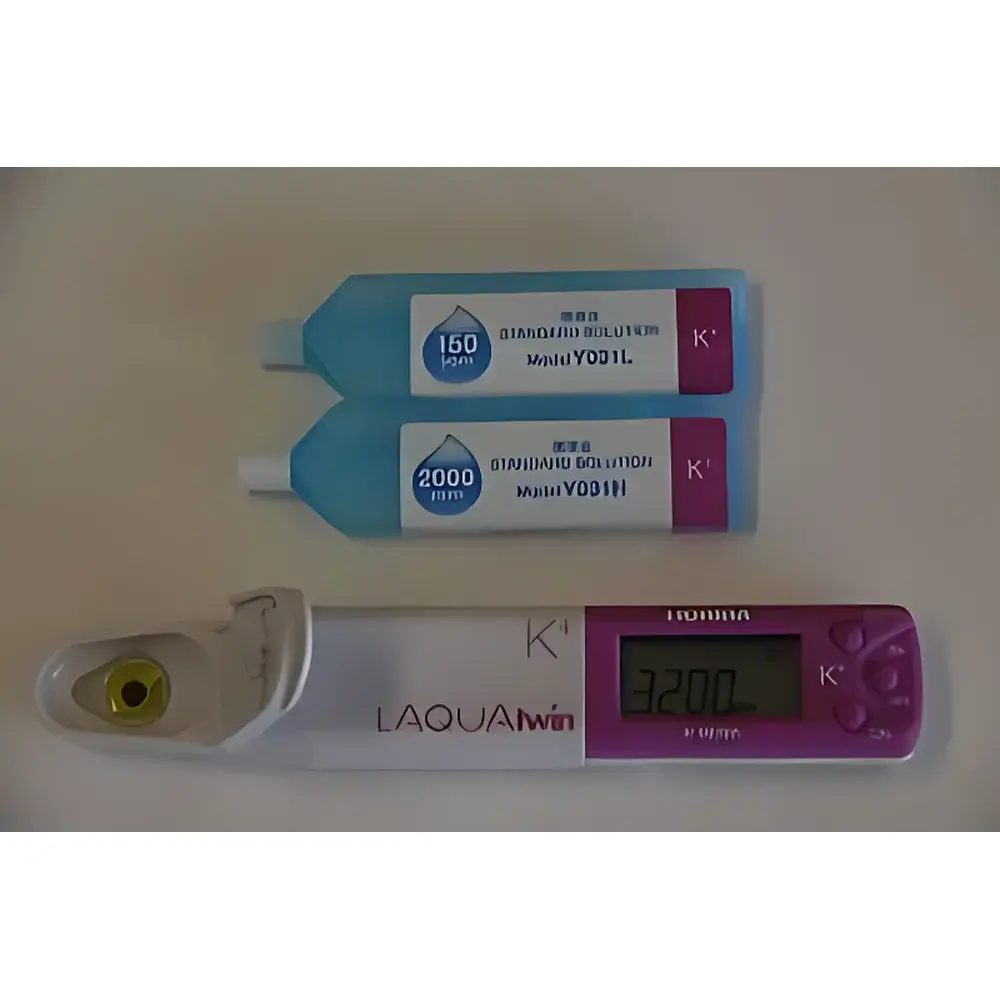
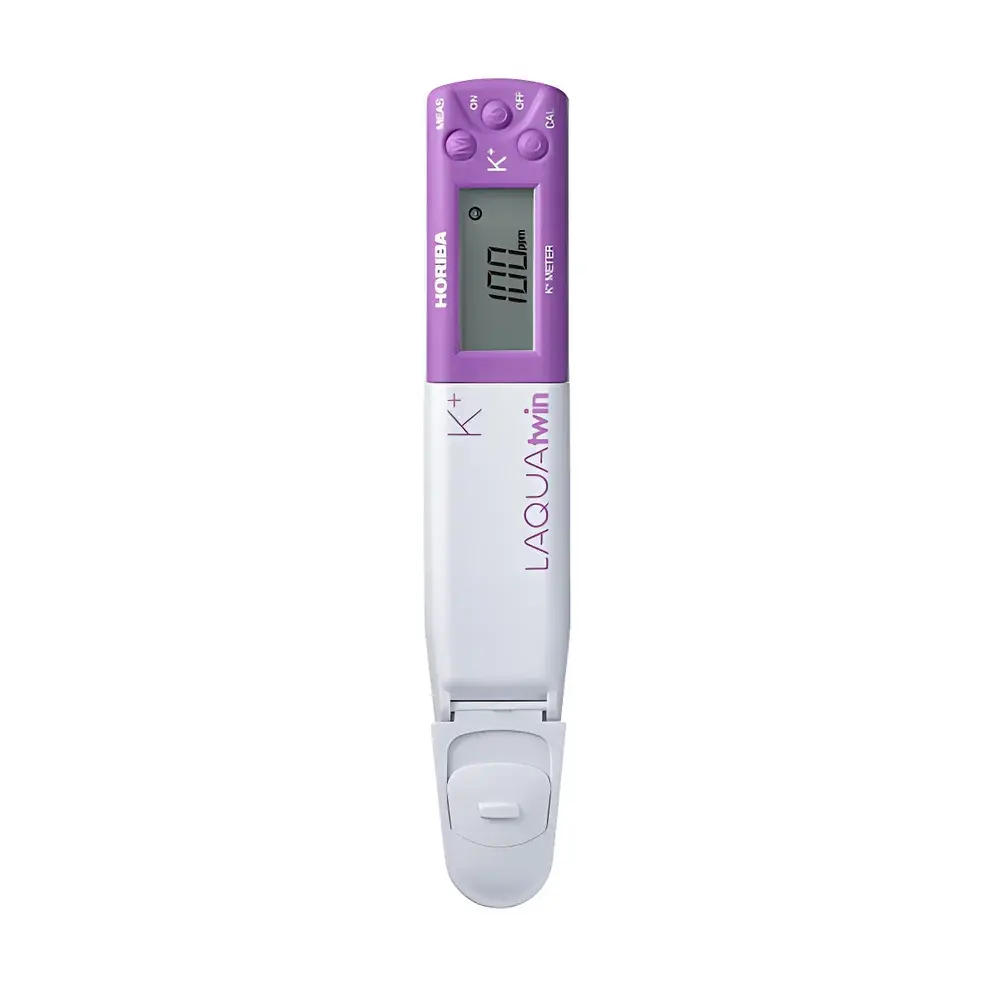
HORIBA B-731 Portable Potassium Ion Meter
| Brand | HORIBA |
|---|---|
| Origin | Japan |
| Model | B-731 |
| Measurement Principle | Solid-State Ion-Selective Electrode (ISE) Method |
| Measuring Range | 39–3900 ppm (mg/L) [10⁻³–10⁻¹ mol/L] |
| Accuracy | ±10% of reading |
| Minimum Sample Volume | 0.05 mL × 2 or ≥0.3 mL |
| Temperature Compensation | Automatic (NTC thermistor) |
| Environmental Rating | IP67 |
| Operating Temperature | 5–40 °C |
| Relative Humidity | <85% RH (non-condensing) |
| Power Supply | Two CR2032 batteries |
| Dimensions | 164 × 29 × 20 mm (excl. protrusions) |
| Weight | ~50 g (instrument only) |
Overview
The HORIBA B-731 Portable Potassium Ion Meter is a compact, field-deployable ion-selective electrode (ISE)-based analyzer engineered for rapid, on-site quantification of potassium (K⁺) concentration in aqueous environmental and agricultural samples. Unlike optical or colorimetric methods, the B-731 employs a solid-state potassium-selective membrane electrode operating on the Nernst principle—generating a millivolt potential proportional to the logarithm of K⁺ activity in solution. This electrochemical transduction enables direct, reagent-free measurement without sample digestion or dilution in most routine applications. Designed for compliance with standard water quality monitoring workflows, the instrument delivers trace-level sensitivity within the physiologically and ecologically relevant range of 39–3900 mg/L (10⁻³–10⁻¹ mol/L), covering natural waters, irrigation runoff, nutrient solutions, and wastewater effluents. Its pen-style form factor and lightweight construction (<50 g) support handheld operation in remote field locations, mobile laboratories, or classroom settings where portability and battery autonomy are critical.
Key Features
- Ion-selective electrode (ISE) technology with integrated temperature sensor for real-time Nernstian slope correction
- IP67-rated enclosure ensuring dust-tightness and immersion resistance up to 1 m for 30 minutes—validated per IEC 60529
- Auto-hold function stabilizes readings upon signal convergence, reducing operator dependency during field measurements
- Low-volume sampling capability: compatible with as little as 0.05 mL per measurement (dual-point verification mode) or ≥0.3 mL for single-point analysis
- Integrated temperature compensation (2%/°C fixed coefficient) aligned with ASTM D1129 and ISO 7888 guidelines for ionic strength correction
- CR2032 coin-cell power architecture enabling >2000 measurements per battery set under typical usage conditions
- Compact ergonomic design (164 × 29 × 20 mm) optimized for glove-compatible operation in outdoor or controlled-environment settings
Sample Compatibility & Compliance
The B-731 is validated for use with freshwater, surface water, groundwater, hydroponic nutrient solutions, and treated effluents exhibiting pH 2–12 and conductivity ≤10 mS/cm. It is not intended for highly viscous, suspended-solid-laden, or organic-solvent-based matrices without prior filtration (≤5 µm) or dilution. The instrument meets IEC 61010-1 safety requirements for portable electrical equipment and complies with RoHS Directive 2011/65/EU. While not certified for regulatory reporting under EPA Methods or ISO 17025, its performance characteristics align with QA/QC protocols specified in APHA Standard Methods 4500-K⁺ B (ion-selective electrode method) and supports GLP documentation when used with traceable calibration standards (e.g., NIST-traceable KCl solutions).
Software & Data Management
The B-731 operates as a standalone instrument with no embedded memory or Bluetooth connectivity. All measurements are displayed in real time on a high-contrast LCD screen with dual-unit readout (ppm and mol/L). Calibration is performed manually using two-point bracketing with certified K⁺ standards (e.g., 100 ppm and 1000 ppm KCl). Though it lacks digital data export, the device supports audit-ready manual logging in accordance with FDA 21 CFR Part 11 principles when paired with standardized field notebooks or LIMS-integrated templates. Users are advised to record calibration dates, standard lot numbers, ambient temperature, and sample identification for traceability.
Applications
- Field assessment of potassium leaching in agricultural soils and irrigation return flows
- Monitoring K⁺ stability in municipal drinking water distribution systems post-treatment
- Quality control of fertilizer stock solutions in greenhouse and vertical farming operations
- Educational demonstrations of ion-selective potentiometry and Nernst equation validation
- Rapid screening of potassium enrichment in eutrophic lakes and reservoirs
- Pre-screening step prior to laboratory-based ICP-OES or IC analysis to optimize sample submission strategy
FAQ
What calibration standards are recommended for the B-731?
NIST-traceable potassium chloride (KCl) solutions at 100 ppm and 1000 ppm are recommended for two-point calibration. Use deionized water (conductivity <1 µS/cm) for rinsing between standards.
Can the B-731 measure potassium in seawater or brine?
No—high ionic strength (>10,000 ppm TDS) and competing ions (e.g., Na⁺, Mg²⁺, Ca²⁺) cause significant interference and deviation from Nernstian response. Dilution to <2000 ppm TDS is required for acceptable accuracy.
How often should the electrode be cleaned and conditioned?
Rinse with deionized water after each measurement. Soak the sensing tip in 100 ppm KCl solution for 30 minutes before first use or after prolonged storage (>48 h).
Does the B-731 require electrode replacement?
Yes—the solid-state potassium ISE has a typical service life of 12–18 months under routine field use. Performance degradation is indicated by slow response time (>15 s), reduced slope (<50 mV/decade), or calibration drift exceeding ±15% across two points.
Is temperature compensation adjustable?
No—the B-731 applies a fixed 2%/°C compensation coefficient per ISO 5725-2:2019 Annex C for aqueous K⁺ measurement; manual offset adjustment is not supported.







