
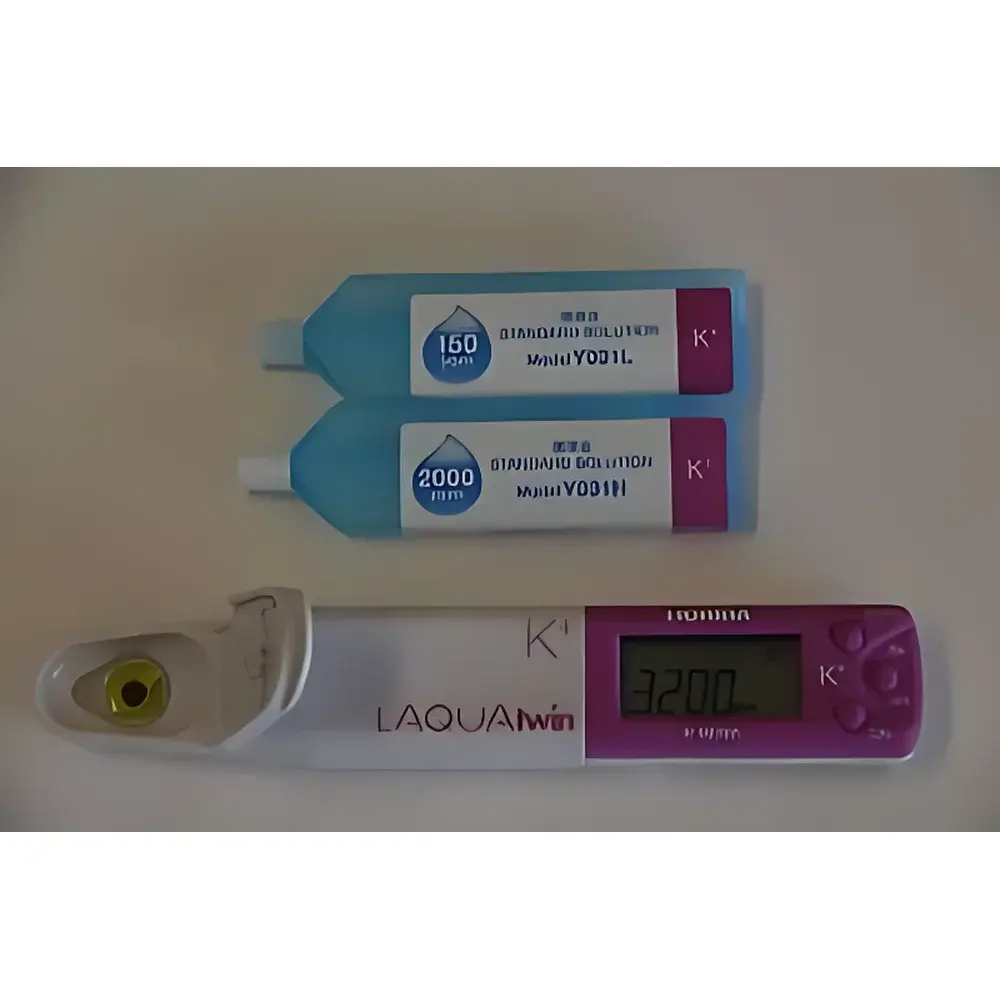
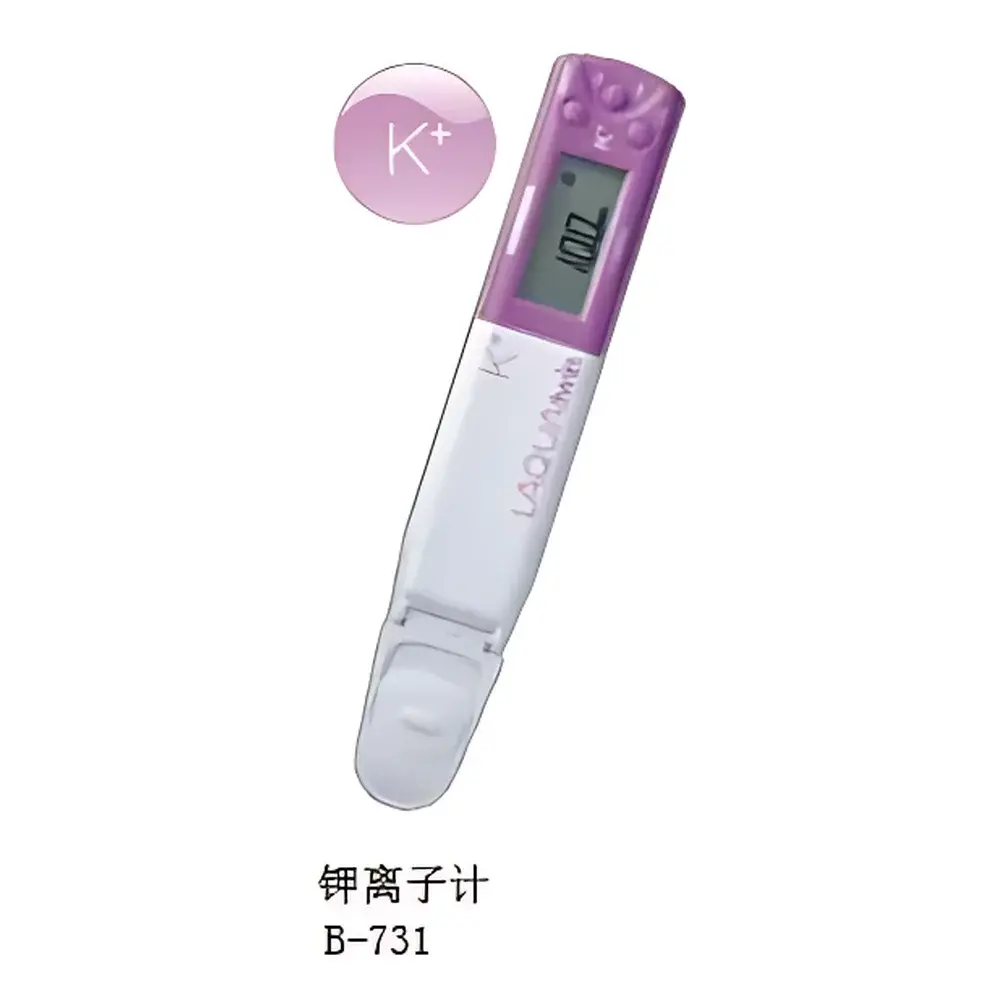
HORIBA B-731 Portable Potassium Ion Meter
| Brand | HORIBA |
|---|---|
| Origin | Japan |
| Model | B-731 |
| Measurement Principle | Solid-State Ion-Selective Electrode (ISE) Method |
| Measurement Range | 39–3900 ppm K⁺ (10⁻³–10⁻¹ mol/L) |
| Minimum Sample Volume | 0.05 mL × 2 or ≥0.3 mL |
| Calibration | Two-Point Calibration |
| Accuracy | ±10% of reading |
| Temperature Compensation | Automatic (NTC sensor, 2%/°C fixed coefficient) |
| Environmental Rating | IP67 |
| Operating Temperature | 5–40 °C |
| Relative Humidity | <85% RH (non-condensing) |
| Power Supply | Two CR2032 lithium batteries |
| Dimensions | 164 × 29 × 20 mm (excluding protrusions) |
| Weight | ~50 g (instrument only, excluding batteries) |
Overview
The HORIBA B-731 is a compact, handheld potassium ion meter engineered for field-deployable and on-site water quality analysis. It employs a solid-state ion-selective electrode (ISE) based on selective membrane technology optimized for K⁺ detection in aqueous solutions. Unlike traditional glass-membrane electrodes, the B-731’s ISE architecture eliminates liquid-filled reference systems, enhancing mechanical robustness and minimizing maintenance—critical for routine environmental monitoring in variable outdoor conditions. The instrument operates on the Nernst principle, converting the electrochemical potential difference between the sample and internal reference into a stable, temperature-compensated concentration reading. Designed for rapid, single-parameter quantification, the B-731 delivers reliable K⁺ data across freshwater, wastewater effluents, agricultural runoff, hydroponic nutrient solutions, and soil leachates—without requiring laboratory infrastructure or skilled operator intervention.
Key Features
- True portable form factor: 164 mm × 29 mm × 20 mm; weight ≈ 50 g (instrument only), enabling one-handed operation and extended field use.
- IP67-rated enclosure ensures full protection against dust ingress and immersion in water up to 1 m for 30 minutes—validated per IEC 60529.
- Two-point calibration protocol supports traceable adjustment using standard K⁺ solutions (e.g., 100 ppm and 1000 ppm), facilitating compliance with ISO 17025-aligned QA/QC procedures.
- Automatic temperature compensation (ATC) via integrated NTC thermistor applies a fixed 2%/°C correction factor, reducing systematic error from thermal drift in ambient deployments.
- Auto-hold function freezes the stabilized reading upon signal convergence—essential for consistent data capture in turbulent or low-volume sampling scenarios.
- Low-power design powered by two replaceable CR2032 coin-cell batteries, delivering >10,000 measurements per set under typical usage (based on HORIBA internal testing at 25 °C).
Sample Compatibility & Compliance
The B-731 is validated for direct measurement in non-viscous, low-turbidity aqueous matrices with pH 2–12 and conductivity <10 mS/cm. It is not intended for organic solvents, high-fat emulsions, or strongly chelating media (e.g., EDTA-rich samples), which may interfere with ISE surface kinetics. While the device itself does not carry CE marking or FDA 510(k) clearance, its measurement methodology aligns with ASTM D1293 (pH), ASTM D5391 (conductivity), and ISO 10523 (electrochemical ion determination) principles. For GLP/GMP environments, users must document calibration records, environmental conditions, and operator identity per 21 CFR Part 11 Annex 11 requirements—though the B-731 lacks built-in audit trail functionality.
Software & Data Management
The B-731 operates as a standalone instrument with no onboard memory or digital interface (no Bluetooth, USB, or IR). All data are recorded manually or transcribed into external LIMS or spreadsheet platforms. This design prioritizes reliability and electromagnetic immunity over connectivity—making it suitable for RF-noisy industrial zones or explosion-hazard areas where wireless transmission is restricted. Calibration verification logs and field notes should be maintained separately in accordance with ISO/IEC 17025 clause 7.7 (results reporting) and EPA Method 1600 series documentation standards.
Applications
- Environmental field surveys: Monitoring potassium leaching from fertilized soils into adjacent streams or groundwater wells.
- Aquaculture management: Verifying K⁺ levels in recirculating aquaculture systems (RAS) to support osmoregulation in sensitive species.
- Wastewater treatment: Tracking potassium removal efficiency across tertiary treatment stages, particularly in ion-exchange or reverse osmosis units.
- Hydroponics and greenhouse operations: Ensuring optimal K⁺ concentrations (150–250 ppm) in nutrient reservoirs to prevent deficiency or toxicity in leafy greens and fruiting crops.
- Educational laboratories: Introducing students to ion-selective electrochemistry principles without requiring benchtop potentiostats or pH/mV meters.
FAQ
What sample volume is required for a valid measurement?
A minimum of 0.05 mL per electrode (two electrodes used simultaneously) is sufficient; however, ≥0.3 mL is recommended to ensure stable junction potential and minimize air bubble interference.
Can the B-731 measure potassium in seawater or brine?
No. High ionic strength (>10,000 µS/cm) and elevated Na⁺ concentrations cause significant activity coefficient deviation and electrode interference; use dedicated marine-grade ISEs or ICP-OES instead.
Is electrode replacement possible?
Yes—the K⁺-selective electrode module is a field-replaceable consumable (HORIBA part number: B-731-ISE-K). Electrode lifespan averages 12–18 months under proper storage (dry, capped, 5–30 °C) and weekly calibration.
Does the device comply with ISO/IEC 17025 requirements?
The B-731 provides metrologically sound measurements when operated within specifications and calibrated per manufacturer instructions—but full ISO/IEC 17025 compliance requires user-established uncertainty budgets, traceable standards, and documented procedural controls.
How often should calibration be performed?
Daily calibration is recommended for critical applications; otherwise, before each sampling session or after exposure to extreme temperatures or contamination events.







