
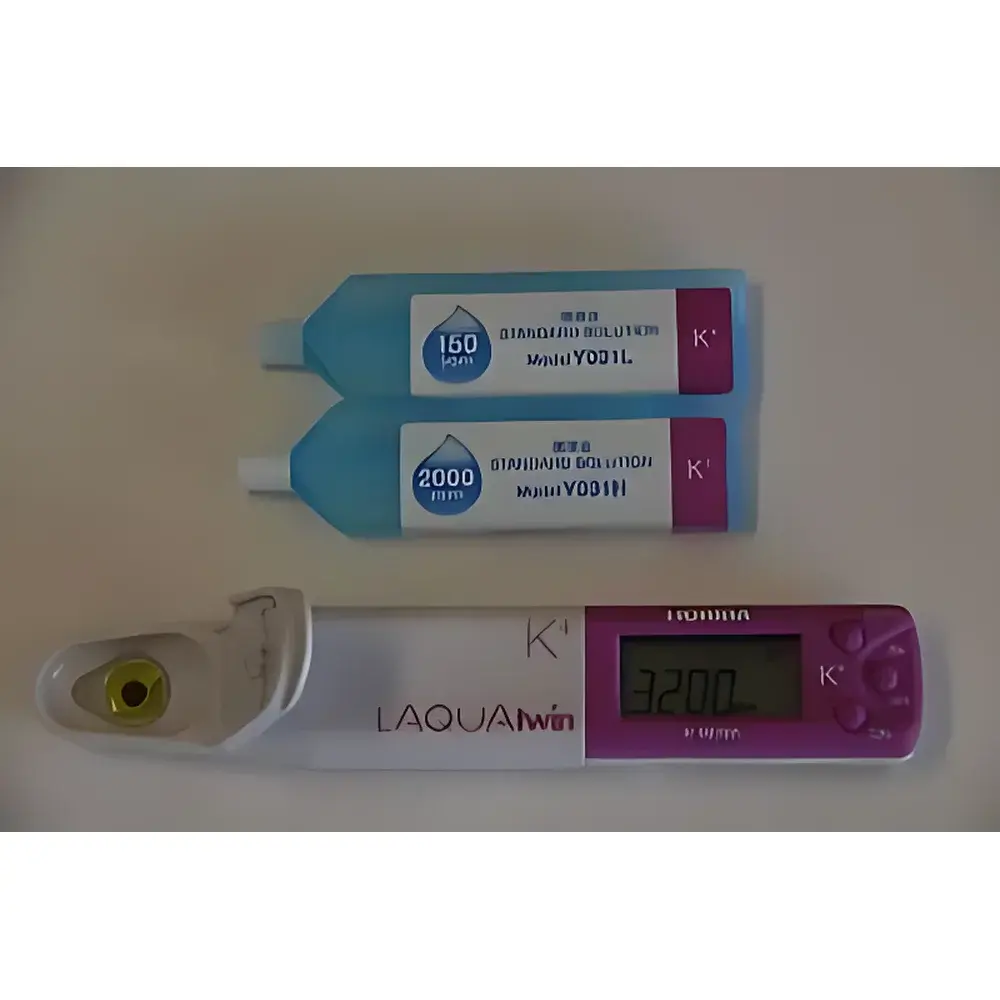
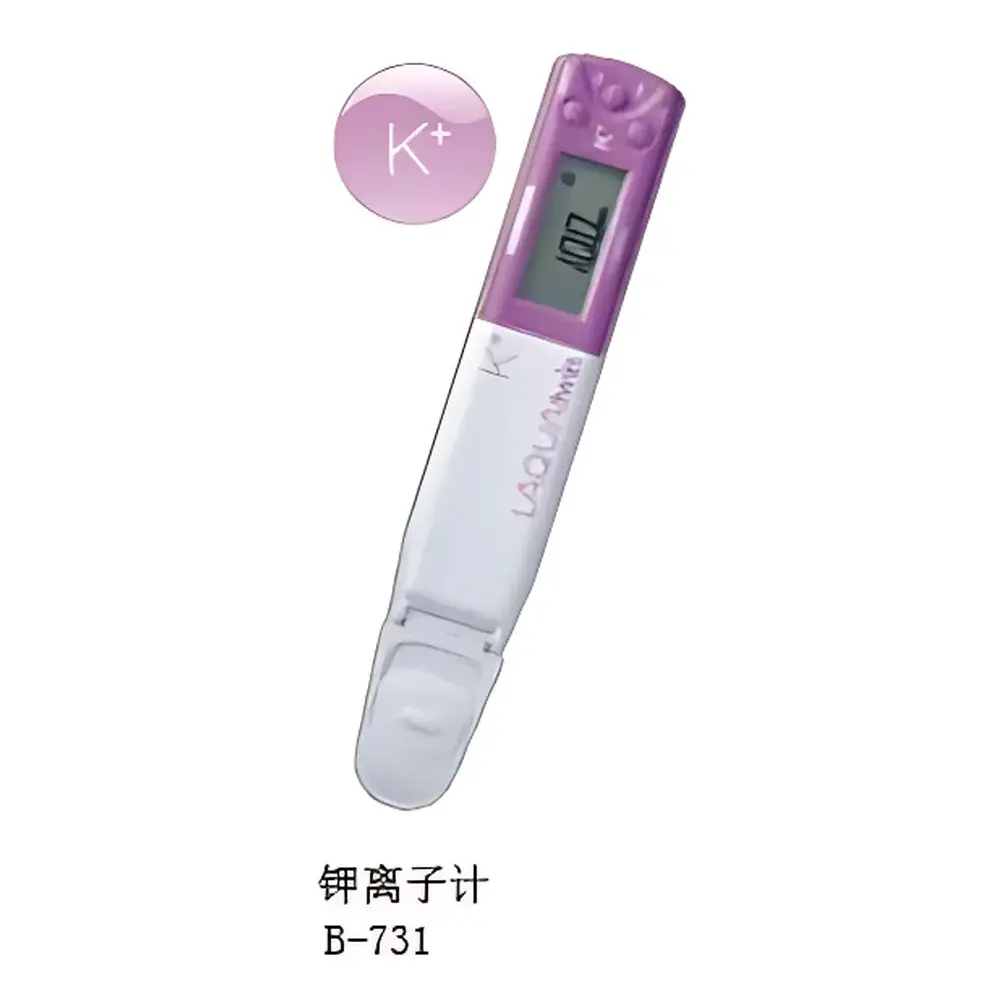
HORIBA B-731 Portable Potassium Ion Meter
| Brand | HORIBA |
|---|---|
| Origin | Japan |
| Model | B-731 |
| Measurement Principle | Solid-State Ion-Selective Electrode (ISE) Method |
| Measuring Range | 39–3900 ppm (mg/L) [10⁻³–10⁻¹ mol/L] |
| Accuracy | ±10% of reading |
| Calibration | Two-point calibration |
| Temperature Compensation | Automatic (NTC sensor) |
| IP Rating | IP67 |
| Operating Environment | 5–40 °C, <85% RH (non-condensing) |
| Power Supply | Two CR2032 batteries |
| Dimensions | 164 × 29 × 20 mm (excl. probe protrusion) |
| Weight | ~50 g (instrument only) |
Overview
The HORIBA B-731 is a compact, handheld potassium ion meter engineered for rapid, on-site water quality assessment using solid-state ion-selective electrode (ISE) technology. Unlike traditional glass-membrane electrodes, the B-731 employs a robust, maintenance-free potassium-selective membrane optimized for field deployment in environmental monitoring, agricultural runoff testing, hydroponics management, and wastewater effluent verification. Its measurement principle relies on the Nernstian response of the ISE to potassium activity in aqueous solution, enabling direct potentiometric quantification without sample dilution or reagent addition. With a minimum sample volume of just 0.05 mL (dual measurement mode) or 0.3 mL (standard mode), the B-731 supports high-throughput screening in resource-constrained settings—such as remote sampling stations or mobile lab vans—while maintaining analytical integrity across its calibrated range of 39–3900 mg/L (10⁻³–10⁻¹ mol/L). The instrument’s microprocessor-controlled circuitry integrates automatic temperature compensation (via integrated NTC thermistor), real-time signal stabilization, and auto-hold functionality to ensure repeatable readings under variable ambient conditions.
Key Features
- Compact pen-style form factor (164 × 29 × 20 mm; ~50 g) designed for one-handed operation and pocket portability
- IP67-rated enclosure ensures full protection against dust ingress and immersion in water up to 1 m for 30 minutes—validated per IEC 60529
- Two-point calibration protocol compliant with ISO 17025 traceability requirements when used with certified K⁺ standard solutions (e.g., 100 ppm and 1000 ppm KCl)
- Automatic temperature compensation (ATC) with fixed 2%/°C coefficient, referenced to 25 °C—supports accurate reporting across 5–40 °C operating range
- Low-power architecture powered by two replaceable CR2032 coin cells, delivering >2000 measurements per battery set under typical usage
- Digital LCD with backlight (optional activation) for legibility in low-light field environments
- No warm-up time required; stable readings achieved within 3–5 seconds after sample contact
Sample Compatibility & Compliance
The B-731 is validated for use with freshwater, surface water, groundwater, irrigation water, nutrient solutions, and treated effluents. It exhibits minimal interference from common cations—including Na⁺ (selectivity coefficient log KK,Na ≈ −2.1), Ca²⁺, and Mg²⁺—within typical environmental matrices. Performance conforms to ASTM D1293 (pH of water) and ASTM D512 (chloride ion) methodological frameworks for portable ion analysis. While not a GLP-certified laboratory instrument, its calibration log capability (via manual notation) and documented ATC implementation support data integrity in field-based QA/QC programs aligned with EPA Guidance for Field Measurements (EPA/600/R-12/580). The device meets RoHS Directive 2011/65/EU and REACH SVHC compliance standards for restricted substances.
Software & Data Management
The B-731 operates as a standalone, embedded-system instrument with no Bluetooth, USB, or PC connectivity. All measurement data are displayed in real time and retained only during active session (no internal memory or data logging). Users are expected to manually record results—consistent with ISO/IEC 17025 Clause 7.7 (Reporting of Results) for field instruments where electronic audit trails are impractical. For laboratories requiring digital traceability, HORIBA recommends pairing the B-731 with external documentation tools such as LIMS-integrated field tablets or validated paper-based logbooks meeting FDA 21 CFR Part 11 signature requirements via wet-ink annotation protocols.
Applications
- Field verification of potassium concentration in agricultural drainage water and soil leachates
- Routine monitoring of K⁺ levels in hydroponic nutrient reservoirs to prevent deficiency or toxicity
- Pre-screening of industrial wastewater prior to discharge compliance testing (e.g., NPDES permit thresholds)
- Educational demonstrations of ion-selective sensing principles in university environmental science labs
- Emergency response assessments following fertilizer spills or manure lagoon breaches
- Baseline surveys for watershed-scale nutrient load modeling (paired with NO₃⁻ and Ca²⁺ measurements using B-771/B-722 units)
FAQ
Does the B-731 require electrode storage solution between uses?
No. The solid-state potassium ISE does not require hydration or liquid storage; it may be air-dried and stored at room temperature in its protective cap.
Can the B-731 measure potassium in seawater or high-salinity samples?
Not recommended. Ionic strength above 0.5 mol/L (e.g., seawater ≈ 0.6 mol/L total dissolved ions) induces significant activity coefficient deviation and cross-sensitivity—use only in freshwater or low-TDS matrices (<1000 µS/cm).
What calibration standards are compatible with the B-731?
Certified potassium chloride (KCl) solutions at 100 mg/L and 1000 mg/L concentrations, prepared gravimetrically per ISO 6497, are optimal for two-point calibration.
Is the B-731 suitable for regulatory reporting?
It serves as a screening tool—not a definitive compliance instrument. Final regulatory submissions must reference data from laboratory-grade ISE systems (e.g., HORIBA LAQUA twin series) validated per EPA Method 300.1 or ISO 10523.
How often should calibration be performed?
Before each field session, and after every 10–15 measurements if analyzing heterogeneous samples; more frequent calibration is advised when transitioning between low- and high-concentration ranges.
Related Products







