
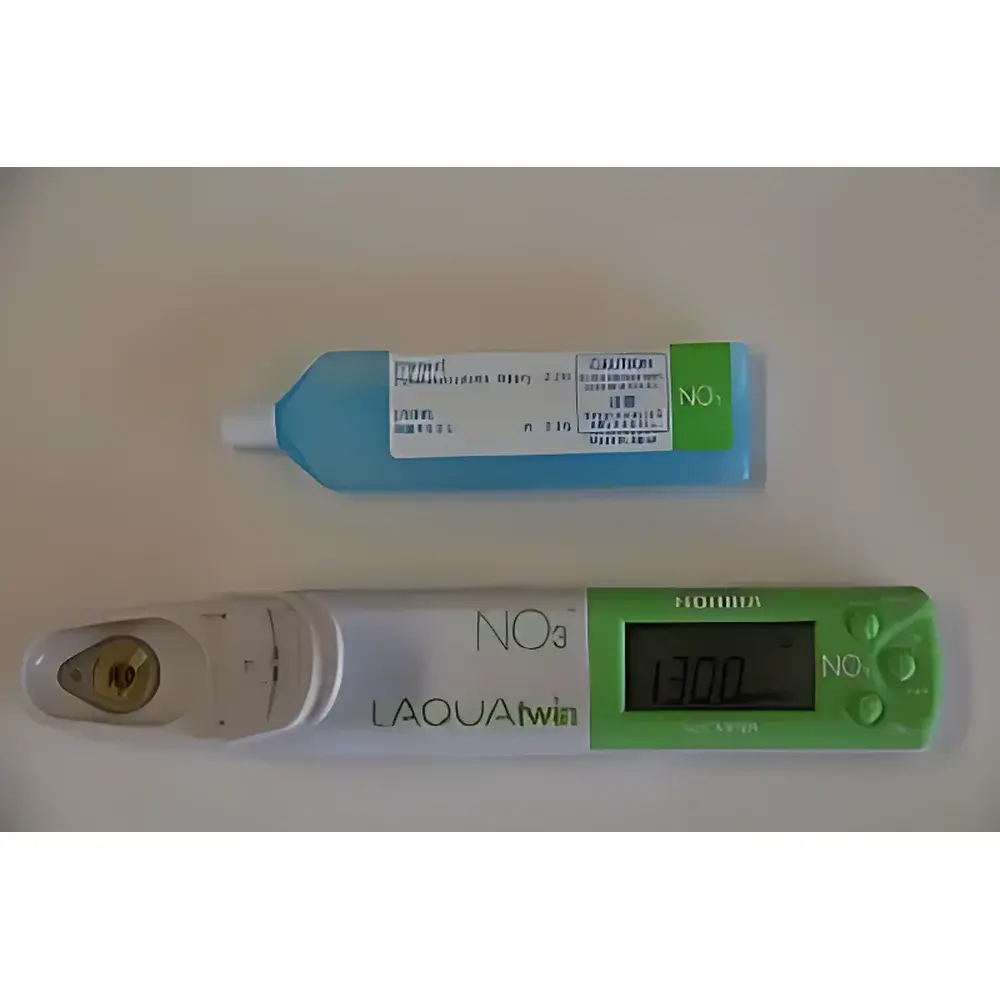
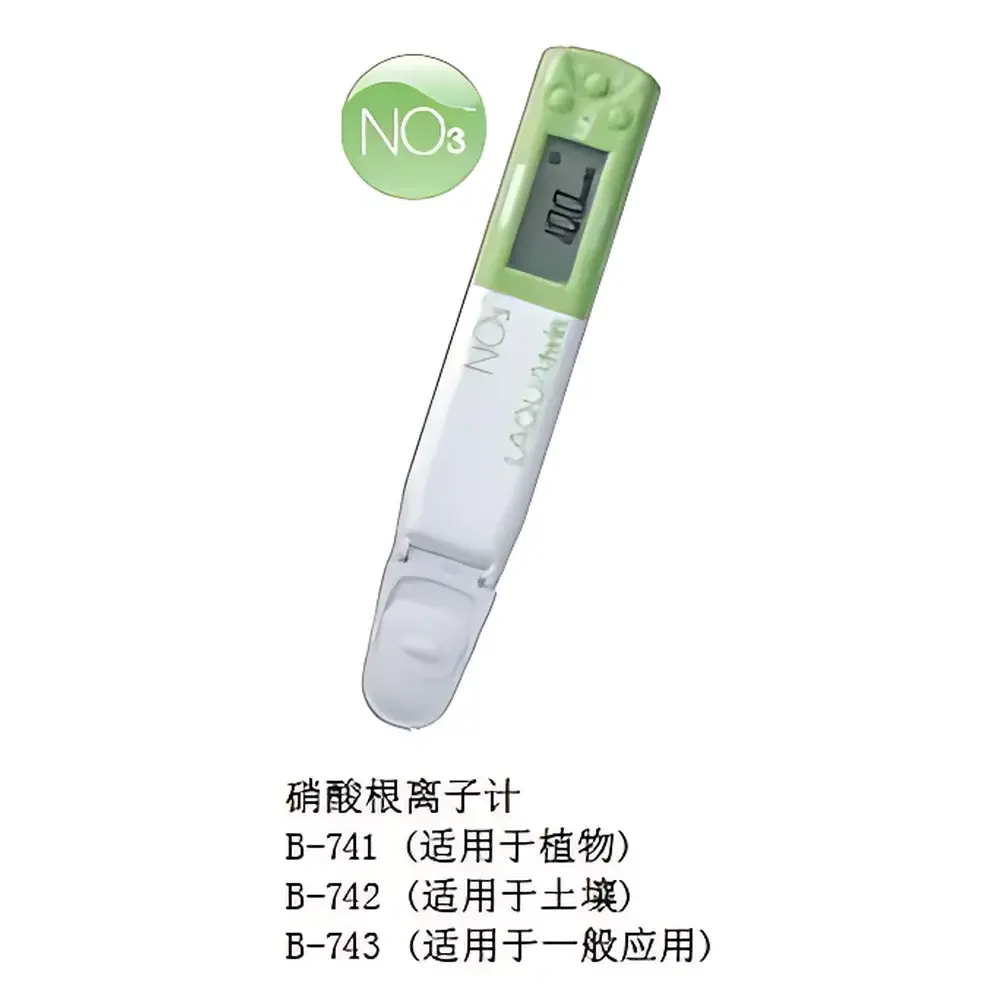
HORIBA B-743 Portable Nitrate Ion Meter
| Brand | HORIBA |
|---|---|
| Origin | Japan |
| Model | B-743 |
| Instrument Type | Portable Ion Meter |
| Ion Measured | Nitrate (NO₃⁻) |
| Measurement Range | 62–6200 ppm (mg/L) NO₃⁻ / 14–1400 ppm NO₃⁻–N |
| Detection Limit | Not specified |
| Response Time | 20 s |
| Accuracy | ±10% of reading |
| Operating Temperature | 5–40 °C |
| IP Rating | IP67 |
| Power Source | Two CR2032 batteries |
| Dimensions | 164 × 29 × 20 mm (excl. protrusions) |
| Weight | ~50 g (instrument only) |
Overview
The HORIBA B-743 Portable Nitrate Ion Meter is a compact, field-deployable electrochemical analyzer engineered for rapid, on-site quantification of nitrate ions (NO₃⁻) in aqueous environmental samples. It operates on the principle of potentiometric ion-selective electrode (ISE) measurement, utilizing a solid-state nitrate-selective membrane that generates a Nernstian potential response proportional to the logarithm of NO₃⁻ activity in solution. Designed for routine water quality surveillance—particularly in surface water, groundwater, wastewater effluents, agricultural runoff, and drinking water distribution systems—the B-743 delivers reliable semi-quantitative data without requiring laboratory infrastructure. Its pen-style form factor, combined with true handheld ergonomics and minimal sample volume requirements (as low as 0.05 mL per measurement), enables efficient spot-checking across diverse sampling locations, including remote field sites, irrigation channels, and municipal monitoring stations.
Key Features
- Ion-Selective Electrode Technology: Integrated solid-contact nitrate ISE ensures stable potential output and reduced drift over time, optimized for freshwater and low-ionic-strength matrices.
- Two-Point Calibration Protocol: Supports standardized calibration using certified nitrate reference standards (e.g., 100 ppm and 1000 ppm NO₃⁻), enabling traceable accuracy within ±10% of reading across the operational range.
- Automatic Temperature Compensation (ATC): Built-in thermistor corrects for thermal effects on electrode potential at a fixed coefficient of 2%/°C, maintaining measurement consistency across the 5–40 °C operating envelope.
- Ruggedized Field Design: Rated IP67 for full dust ingress protection and immersion resistance up to 1 m for 30 minutes—validated for use in humid, rainy, or splashed environments typical of environmental fieldwork.
- Low-Power Operation: Dual CR2032 coin-cell batteries provide >1000 measurements per set under typical usage; auto-power-off minimizes unnecessary drain.
- Auto-Hold Function: Stabilizes and locks the displayed value once signal variation falls below ±0.5% over 3 seconds—critical for consistent readings in turbulent or shallow-water sampling scenarios.
Sample Compatibility & Compliance
The B-743 is validated for direct measurement in clarified natural waters, treated effluents, and nutrient-enriched agricultural drainage. It is not intended for highly turbid, viscous, or strongly oxidizing matrices (e.g., undiluted industrial process streams or chlorinated disinfectant residuals >5 mg/L), which may interfere with membrane selectivity or cause electrode fouling. While not certified to ISO/IEC 17025 or ASTM D3370 for definitive regulatory reporting, the instrument supports GLP-aligned field data collection when used with documented calibration logs, standard traceability, and operator training records. Its performance aligns with EPA Method 353.2 (colorimetric) screening thresholds for preliminary nitrate assessment, and its ±10% accuracy meets WHO and EU Drinking Water Directive indicative action levels for rapid triage applications.
Software & Data Management
The B-743 operates as a standalone analog-digital hybrid meter with no Bluetooth, USB, or proprietary software interface. All measurement data remain on-device only—displayed numerically on the LCD screen—and are not stored, timestamped, or exportable. This architecture intentionally prioritizes simplicity, reliability, and battery longevity over digital connectivity. For audit-ready workflows, users are expected to manually record results—including date, time, location, calibration status, and sample ID—in field notebooks or LIMS-integrated mobile forms. Though lacking 21 CFR Part 11-compliant electronic signatures or audit trails, the device supports paper-based GLP/GMP documentation practices when paired with standardized SOPs for calibration verification, blank checks, and inter-operator repeatability assessments.
Applications
- Field screening of nitrate contamination in rivers, lakes, and springs prior to lab confirmation
- Monitoring nitrogen loading in agricultural tile drains and irrigation return flows
- Verifying compliance with local discharge limits during construction dewatering operations
- Educational demonstrations of ion-selective sensing principles in environmental science curricula
- Emergency response triage for suspected fertilizer spills or manure lagoon breaches
- Baseline surveys in watershed management and nutrient reduction planning initiatives
FAQ
What sample volume is required for a valid measurement?
A minimum of 0.05 mL per measurement is sufficient when using the dual-sample protocol; however, 0.3 mL or more is recommended for improved signal stability in variable conductivity matrices.
Does the B-743 measure nitrate-nitrogen (NO₃⁻–N) directly or derive it mathematically?
The instrument displays both NO₃⁻ (mg/L) and NO₃⁻–N (mg/L) simultaneously via internal stoichiometric conversion (NO₃⁻–N = NO₃⁻ × 0.226), eliminating manual calculation errors.
Can the electrode be cleaned or regenerated if performance degrades?
Yes—the nitrate ISE tip may be gently polished with 0.3 µm alumina slurry and rinsed thoroughly with deionized water; full regeneration requires manufacturer-recommended storage solution (HORIBA Part No. 085-743-001) and 24-hour rehydration.
Is temperature compensation adjustable or fixed?
Compensation follows a fixed 2%/°C coefficient per the Nernst equation for monovalent anions; no user adjustment is provided.
How often should calibration be performed during extended field use?
Calibration is recommended before each sampling session and repeated every 2 hours during continuous operation—or immediately after exposure to extreme pH (10) or high-salinity samples (>5000 µS/cm).







