
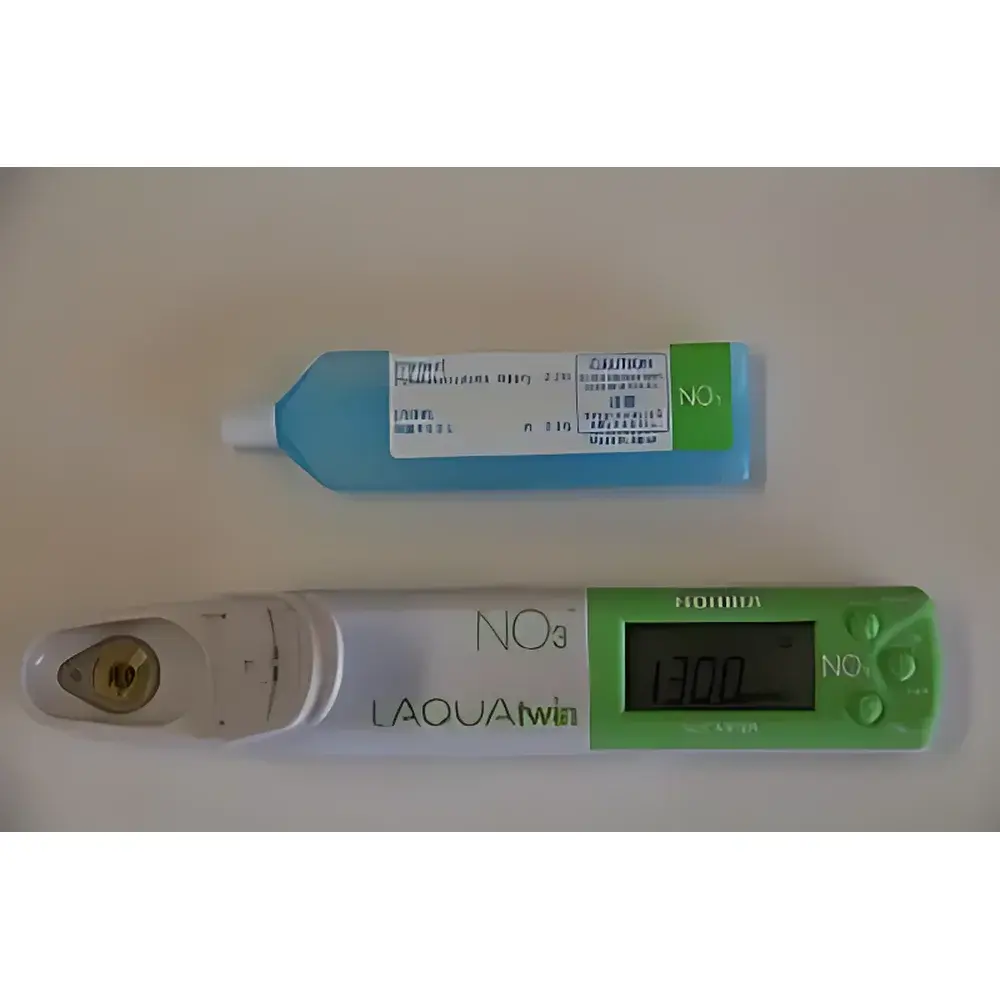
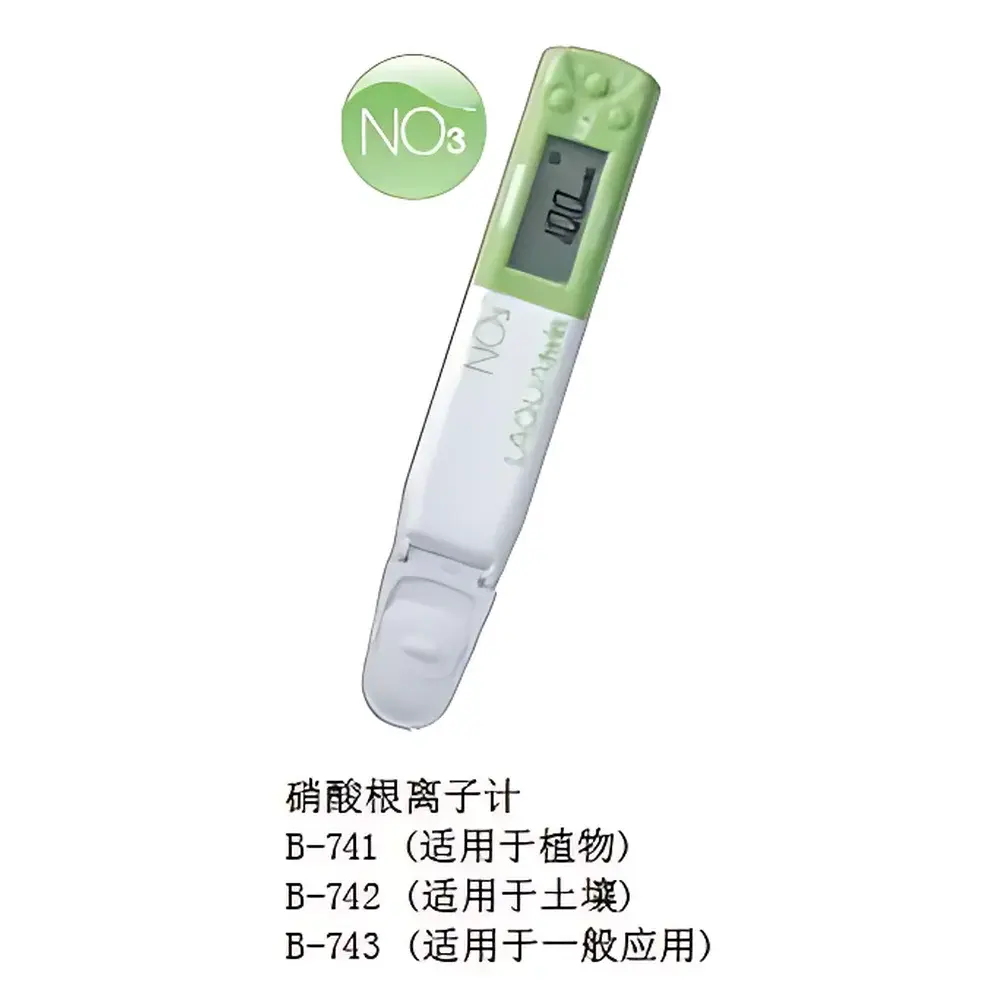
HORIBA B-743 Portable Nitrate Ion Meter
| Brand | HORIBA |
|---|---|
| Origin | Japan |
| Model | B-743 |
| Measurement Principle | Ion-Selective Electrode (ISE) Method |
| Measuring Range | NO₃⁻: 62–6,200 ppm (mg/L) [1.0 × 10⁻³ – 1.0 × 10⁻¹ mol/L] |
| NO₃⁻–N | 14–1,400 ppm (mg/L) |
| Minimum Sample Volume | 0.05 mL × 2 or ≥0.3 mL |
| Calibration | Two-point calibration |
| Accuracy | ±10% of reading |
| Temperature Compensation | Automatic (2%/°C fixed coefficient) |
| Auto-Hold Function | Yes |
| Ingress Protection | IP67 |
| Operating Environment | 5–40 °C, RH <85% (non-condensing) |
| Power Supply | Two CR2032 batteries |
| Dimensions (L×W×H) | 164 × 29 × 20 mm (excl. protrusions) |
| Weight | Approx. 50 g (instrument only, excl. batteries) |
Overview
The HORIBA B-743 Portable Nitrate Ion Meter is a compact, field-deployable electrochemical analyzer engineered for rapid, on-site quantification of nitrate ion (NO₃⁻) concentration in aqueous environmental samples. It operates on the principle of potentiometric measurement using a solid-state, membrane-type nitrate-selective electrode (ISE), which generates a stable Nernstian response proportional to the logarithm of NO₃⁻ activity in solution. The instrument integrates a built-in temperature sensor and applies fixed-coefficient temperature compensation (2%/°C) to correct for thermal effects on electrode potential—ensuring consistent readings across typical ambient field conditions (5–40 °C). Designed specifically for environmental monitoring workflows, the B-743 delivers reliable semi-quantitative data without requiring laboratory infrastructure, making it suitable for routine screening of surface water, groundwater, wastewater effluents, agricultural runoff, and drinking water distribution systems.
Key Features
- True portable form factor: 164 mm × 29 mm × 20 mm; mass ≈ 50 g (instrument only), enabling one-handed operation and extended field use.
- Ion-selective electrode architecture with optimized membrane composition for selective NO₃⁻ detection in complex matrices containing common interferents (e.g., Cl⁻, SO₄²⁻, HCO₃⁻) at environmentally relevant concentrations.
- Low-volume sampling capability: supports measurements with as little as 0.05 mL × 2 replicate aliquots or ≥0.3 mL single-volume analysis—minimizing sample waste and enabling testing in constrained environments (e.g., shallow wells, microcosms).
- Two-point calibration protocol compliant with standard ISE validation practices per ASTM D1129 and ISO 10523, supporting traceable adjustment using certified nitrate standard solutions (e.g., 100 ppm and 1,000 ppm NO₃⁻).
- IP67-rated enclosure ensures full protection against dust ingress and immersion in water up to 1 m for 30 minutes—validated for durability in humid, rainy, or splash-prone outdoor settings.
- Auto-hold function freezes the stabilized reading upon signal convergence, reducing operator dependency and improving repeatability during manual field deployment.
- CR2032 battery power system (2 × cells) provides >2,000 measurements per set under typical usage, with low-battery indicator and automatic shutdown to preserve calibration memory.
Sample Compatibility & Compliance
The B-743 is validated for direct measurement in clear, low-turbidity aqueous samples with pH 2–12 and conductivity <10 mS/cm. It exhibits minimal interference from chloride (<1,000 ppm), sulfate (<500 ppm), and bicarbonate (<200 ppm) under standard calibration conditions. For regulatory reporting contexts, the device supports documentation of calibration dates, standard lot numbers, and measurement timestamps—aligning with GLP documentation requirements for preliminary screening data. While not intended for final compliance reporting under EPA Method 300.0 or ISO 10304-1, its output serves as a technically defensible triage tool preceding confirmatory lab analysis (e.g., ion chromatography or UV spectrophotometry). The instrument conforms to IEC 60529 (IP67), RoHS Directive 2011/65/EU, and JIS Z 8401 (accuracy notation standards).
Software & Data Management
The B-743 operates as a standalone, embedded-system meter with no external software dependency. All calibration coefficients, temperature compensation parameters, and unit preferences (ppm NO₃⁻ vs. ppm NO₃⁻–N) are stored non-volatile memory. No USB or Bluetooth interface is included; data recording requires manual transcription or integration with third-party field loggers via visual readout. For laboratories operating under FDA 21 CFR Part 11 or EU Annex 11 frameworks, the device may be incorporated into controlled procedures as a “non-critical” screening tool—provided calibration logs, environmental records, and operator training documentation are maintained separately in accordance with site-specific SOPs.
Applications
- Rapid assessment of nitrate contamination in rural well water and spring sources prior to microbiological or heavy metal testing.
- Field verification of denitrification efficiency in constructed wetlands and bioreactor outflows.
- Pre-screening of irrigation return flows for nutrient management planning in precision agriculture programs.
- Education and outreach: classroom demonstrations of ion-selective sensing principles and water quality parameter interrelationships (e.g., NO₃⁻ vs. EC vs. pH).
- Emergency response: immediate estimation of nitrate levels following fertilizer spills or septic system failures.
FAQ
What sample pretreatment is required before measurement?
No filtration or acidification is necessary for clear samples. Turbid or particulate-laden samples should be filtered through a 0.45 µm membrane prior to analysis to prevent electrode fouling.
Can the B-743 measure nitrate in seawater or high-salinity brines?
No. Elevated ionic strength (>10,000 µS/cm) causes significant activity coefficient deviation and electrode drift; use is restricted to freshwater and low-conductivity wastewater matrices.
Is the electrode replaceable, and what is its typical service life?
The integrated nitrate ISE module is not user-replaceable; the entire instrument is serviced or replaced after ~12 months of weekly field use or upon failure to pass two-point calibration verification.
Does the B-743 comply with ISO/IEC 17025 requirements?
As a portable screening device without audit-trail logging or electronic data export, it does not satisfy full ISO/IEC 17025 analytical instrument criteria—but may be used within accredited labs for non-reportable preliminary assessments under documented risk-based protocols.
How frequently must calibration be performed?
Calibrate before each measurement session and revalidate mid-session if ambient temperature shifts >5 °C or if consecutive readings deviate >15% from expected values using control standards.







