
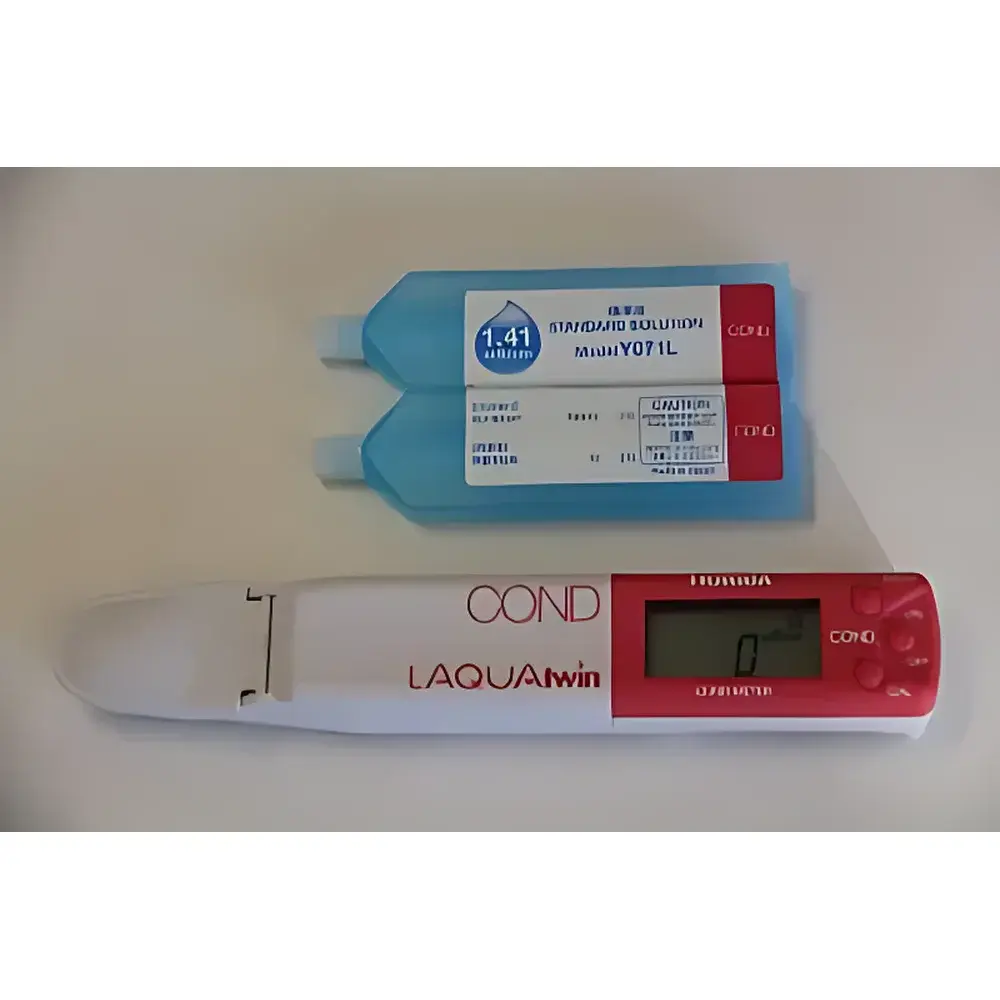
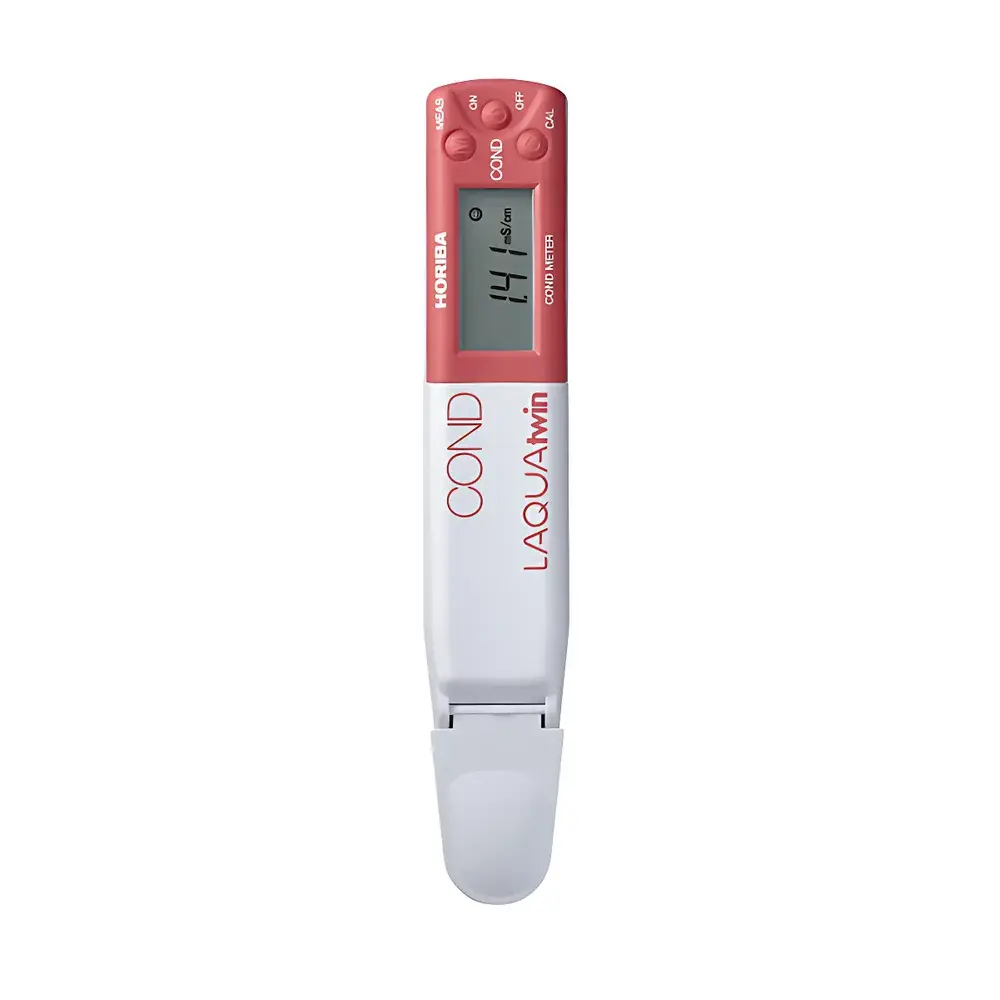
HORIBA B-771 Portable Conductivity Meter
| Brand | HORIBA |
|---|---|
| Origin | Japan |
| Model | B-771 |
| Portability | Pen-type |
| Conductivity Range | 0–19.9 mS/cm |
| TDS Range | 0–9900 ppm |
| Salinity Range | 0–1.1% NaCl |
| Temperature Range | 5–40 °C |
| Accuracy | ±2% F.S. |
| Resolution | 0.1 (for conductivity, salinity, TDS, and temperature) |
| IP Rating | IP67 |
| Power | Two CR2032 batteries |
| Dimensions | 164 × 29 × 20 mm (excluding protrusions) |
| Weight | ~45 g (instrument only) |
Overview
The HORIBA B-771 is a compact, pen-type portable conductivity meter engineered for rapid, field-deployable measurement of electrical conductivity (EC), total dissolved solids (TDS), salinity (as % NaCl), and temperature in aqueous solutions. It employs a robust two-electrode AC conductometric principle—utilizing alternating current to minimize electrode polarization and ensure stable readings across varying sample conductivities. Unlike potentiometric pH or ion-selective measurements, the B-771 operates without liquid junctions or reference electrodes; its dual graphite electrodes are integrated into the probe tip and optimized for low-maintenance, high-reproducibility performance in routine water quality assessment. Designed for simplicity and ruggedness, it delivers laboratory-grade reliability in an IP67-rated housing suitable for humid, dusty, or splash-prone environments—including greenhouse irrigation channels, hydroponic nutrient tanks, aquaculture ponds, and municipal water distribution points.
Key Features
- Pen-form factor with ergonomic grip and one-handed operation—ideal for spot-checking in confined or outdoor settings.
- Simultaneous real-time display of conductivity (mS/cm), TDS (ppm), salinity (% NaCl), and temperature (°C) on a high-contrast LCD screen.
- Automatic temperature compensation (ATC) with fixed 2%/°C coefficient, compliant with standard EC-to-TDS conversion protocols per ASTM D1125 and ISO 7888.
- IP67 ingress protection: fully dust-tight and submersible up to 1 m for 30 minutes—validated per IEC 60529.
- No calibration fluid required for basic operation; single-point calibration supported via standard KCl solution (e.g., 1413 µS/cm or 12.88 mS/cm).
- Auto-hold function freezes the stabilized reading after signal convergence—reducing operator variability during handheld use.
- Low-power design powered by two replaceable CR2032 coin cells, providing >10,000 measurements per set under typical usage conditions.
Sample Compatibility & Compliance
The B-771 is validated for use with clean to moderately turbid aqueous samples, including freshwater, brackish water, nutrient solutions, and wastewater effluents where suspended solids do not exceed 50 mg/L. It is not intended for highly viscous, oily, or strongly oxidizing media. Electrode fouling is minimized through AC excitation and graphite’s chemical inertness—though periodic cleaning with mild detergent and deionized water is recommended after exposure to organic or calcium-rich matrices. The instrument conforms to general-purpose electrochemical measurement requirements outlined in ISO/IEC 17025 for field instrumentation used in environmental monitoring labs. While not individually certified for GLP or FDA 21 CFR Part 11 compliance, its ATC algorithm, traceable calibration capability, and stable analog front-end support integration into auditable QC workflows when paired with documented calibration logs and SOPs.
Software & Data Management
The B-771 operates as a standalone, firmware-based instrument with no onboard memory or Bluetooth/Wi-Fi connectivity. All measurements are displayed in real time and must be manually recorded. This architecture eliminates firmware update dependencies and ensures deterministic response latency—critical for time-sensitive field assessments. For laboratories requiring digital data capture, the B-771 can be paired with external logging systems via manual transcription or optical character recognition (OCR) tools. Its consistent output formatting (e.g., “12.4 mS/cm / 8250 ppm / 0.87% / 22.3°C”) facilitates structured entry into LIMS platforms or Excel-based QA/QC spreadsheets aligned with ISO 17025 documentation standards.
Applications
- Hydroponics and controlled-environment agriculture: monitoring EC drift in recirculating nutrient solutions to prevent osmotic stress in leafy greens and fruiting crops.
- Aquaculture management: verifying salinity stability in hatchery tanks and estuarine nursery systems prior to stock transfer.
- Drinking water safety screening: rapid verification of post-treatment conductivity against WHO guideline values (< 2500 µS/cm).
- Educational laboratories: introducing core concepts of ionic strength, dissociation, and colligative properties using standardized salt solutions.
- Field-based environmental surveys: assessing anthropogenic impact via EC anomalies in surface runoff or groundwater seepage zones.
FAQ
What is the recommended calibration frequency for the B-771?
Calibration should be performed before each daily use session or whenever measurement drift exceeds ±5% of full scale—especially after prolonged storage or exposure to extreme temperatures.
Can the B-771 measure resistivity?
No—the B-771 does not compute or display resistivity (Ω·cm); it reports conductivity only. Resistivity may be derived manually as the reciprocal of conductivity (after unit conversion), but no built-in calculation is provided.
Is temperature compensation adjustable?
No—the B-771 applies a fixed 2%/°C linear temperature coefficient, consistent with standard NaCl-based EC reference tables per ISO 7888. It does not support user-defined β coefficients.
How should the electrode be cleaned after measuring fertilizer solutions?
Rinse thoroughly with deionized water, then gently wipe the electrode surface with a lint-free cloth. For persistent deposits, soak for 2–3 minutes in 0.1 M HCl, followed by triple rinsing with DI water.
Does the B-771 meet CE or RoHS requirements?
Yes—the instrument complies with EU Directive 2014/53/EU (RED) for radio equipment exemption status and satisfies RoHS 2011/65/EU restrictions on hazardous substances in electrical equipment.




