
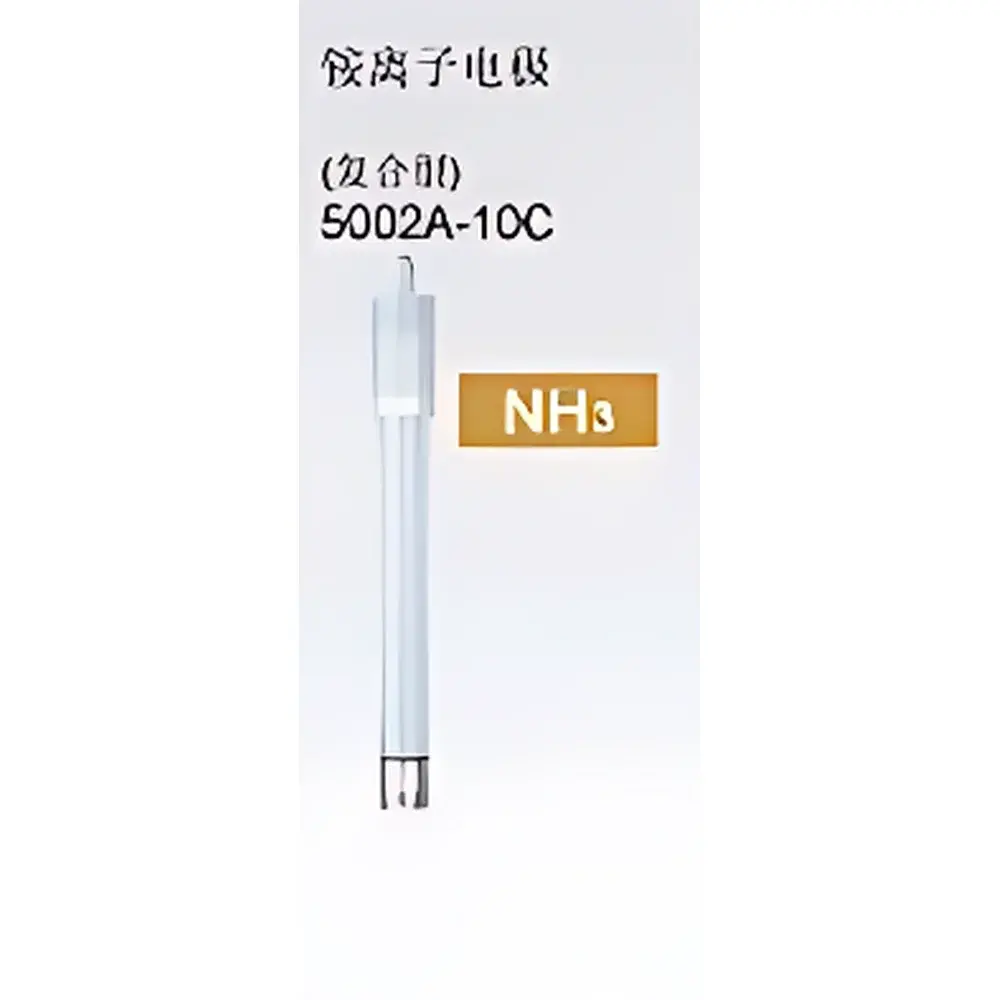
HORIBA Ammonium Ion-Selective Electrode (Composite Type) Model 5002A-10C
| Brand | HORIBA |
|---|---|
| Origin | Japan |
| Model | 5002A-10C |
| Measuring Range | 0.1–1000 ppm NH₃ |
| Electrode Type | Composite ISE (integrated reference) |
| Compatible Instruments | HORIBA F-72, F-73, F-74, F-74BW benchtop analyzers |
| Regulatory Compliance | Designed for ISO 5667-3, ASTM D1426, and EPA Method 350.1 applications |
Overview
The HORIBA Ammonium Ion-Selective Electrode (ISE) Model 5002A-10C is a robust, composite-type potentiometric sensor engineered for reliable, direct measurement of dissolved ammonium ion (NH₄⁺) concentration in aqueous environmental samples—primarily natural waters, wastewater effluents, drinking water sources, and aquaculture systems. Unlike conventional ammonium electrodes requiring external reference electrodes and frequent maintenance, the 5002A-10C integrates a stable internal reference system with a gas-permeable membrane and pH-sensitive inner electrolyte, enabling selective detection of unprotonated ammonia (NH₃) via diffusion-controlled equilibrium. This design conforms to the principle of the ammonia-selective electrode method defined in ISO 5667-3 (water quality — sampling — guidance on preservation and handling of samples) and aligns with EPA Method 350.1 (determination of ammonia nitrogen by ion-selective electrode), ensuring traceability and regulatory acceptability in routine monitoring and compliance reporting.
Key Features
- Composite construction eliminates need for separate reference electrode, reducing setup complexity and inter-electrode junction errors
- Optimized polymeric membrane with selective permeability to NH₃ gas, minimizing interference from common cations (e.g., Na⁺, K⁺, Ca²⁺) and anions (e.g., Cl⁻, NO₃⁻)
- Stable potential response over wide pH range (pH 9.5–12.0); requires sample alkalization (e.g., addition of NaOH or Na₂CO₃) to convert NH₄⁺ → NH₃ prior to measurement
- Fast response time (< 60 seconds to 95% of final reading) and high reproducibility (±2% RSD at 10 ppm NH₃ across repeated measurements)
- Integrated temperature sensor enables automatic temperature compensation (ATC) when used with compatible HORIBA meters (F-series, D-53)
- Durable epoxy body and stainless-steel threaded connector ensure mechanical resilience in field and laboratory environments
- Designed for seamless integration with HORIBA’s standardized ISE calibration protocol using two-point calibration (e.g., 1 ppm and 100 ppm NH₃ standards)
Sample Compatibility & Compliance
The 5002A-10C is validated for use with low-ionic-strength to moderately conductive aqueous matrices (conductivity < 20 mS/cm). It is routinely deployed in surface water, groundwater, treated wastewater, and industrial process streams. For high-turbidity or organic-rich samples (e.g., raw sewage), filtration (0.45 µm membrane) and appropriate matrix-matched calibration are recommended to mitigate fouling and drift. The electrode complies with performance criteria outlined in ISO/IEC 17025-accredited laboratories for environmental testing, supports GLP documentation requirements, and meets data integrity expectations under FDA 21 CFR Part 11 when paired with HORIBA’s compliant data acquisition software. It is not intended for non-aqueous solvents, highly acidic media (pH < 8), or samples containing volatile amines that may cross-react with the membrane.
Software & Data Management
When connected to HORIBA F-72/F-73/F-74/F-74BW benchtop analyzers or the D-53 portable unit, the 5002A-10C leverages built-in ISE measurement algorithms—including slope verification, linear/nonlinear calibration curve fitting (Nernstian or multi-point), and real-time error diagnostics (e.g., out-of-range potential, unstable signal). All measurement data—including timestamp, temperature, electrode potential (mV), calculated concentration (ppm NH₃), calibration history, and operator ID—are stored internally and exportable via USB or RS-232 to LIMS or Excel-compatible formats. Audit trails meet ISO 17025 and EPA QA/QC requirements, including immutable records of calibration events, user actions, and instrument configuration changes.
Applications
- Regulatory compliance monitoring for NH₃-N discharge limits under NPDES permits
- Process control in municipal wastewater treatment plants (e.g., nitrification/denitrification optimization)
- Drinking water safety assessment following chloramination or breakpoint chlorination
- Ecotoxicological studies evaluating ammonia toxicity thresholds in aquatic ecosystems
- Quality assurance in pharmaceutical manufacturing where residual ammonium must be controlled per USP
- Research-grade nutrient profiling in limnology, hydrology, and environmental chemistry laboratories
FAQ
What is the difference between NH₃ and NH₄⁺ measurement with this electrode?
The 5002A-10C measures gaseous NH₃ diffusing through its membrane; therefore, samples must be adjusted to alkaline pH (≥9.5) to shift the NH₄⁺ ⇌ NH₃ + H⁺ equilibrium toward NH₃. Reported results are typically expressed as ppm NH₃, but can be converted to NH₄⁺ or total ammonia nitrogen (TAN) using standard stoichiometric factors.
Can the electrode be used with non-HORIBA meters?
Yes—if the meter supports composite ISE input (BNC or proprietary connector), provides mV readout, and allows manual slope entry (typically −58 ± 2 mV/decade at 25°C). However, full functionality (e.g., auto-calibration, ATC, and compliance reporting) is only guaranteed with HORIBA F-series and D-53 instruments.
How often should the membrane be replaced?
The replaceable NH₃ membrane (part no. 3014067083, 6-pk) should be changed every 3–6 months under continuous use or immediately after exposure to heavily contaminated or sulfide-rich samples to maintain accuracy and response stability.
Is cleaning required between samples?
Rinsing with deionized water for 10–15 seconds is sufficient between measurements. For fouled membranes, gentle wiping with lint-free tissue and optional soaking in 0.1 M HCl for ≤2 minutes (followed by thorough rinsing) may restore performance.
Does temperature compensation affect accuracy?
Yes—temperature directly influences both the Nernst slope and NH₃/NH₄⁺ equilibrium. The integrated sensor ensures accurate ATC; manual temperature entry introduces ≥5% error above ±2°C deviation from actual sample temperature.
Related Products







