
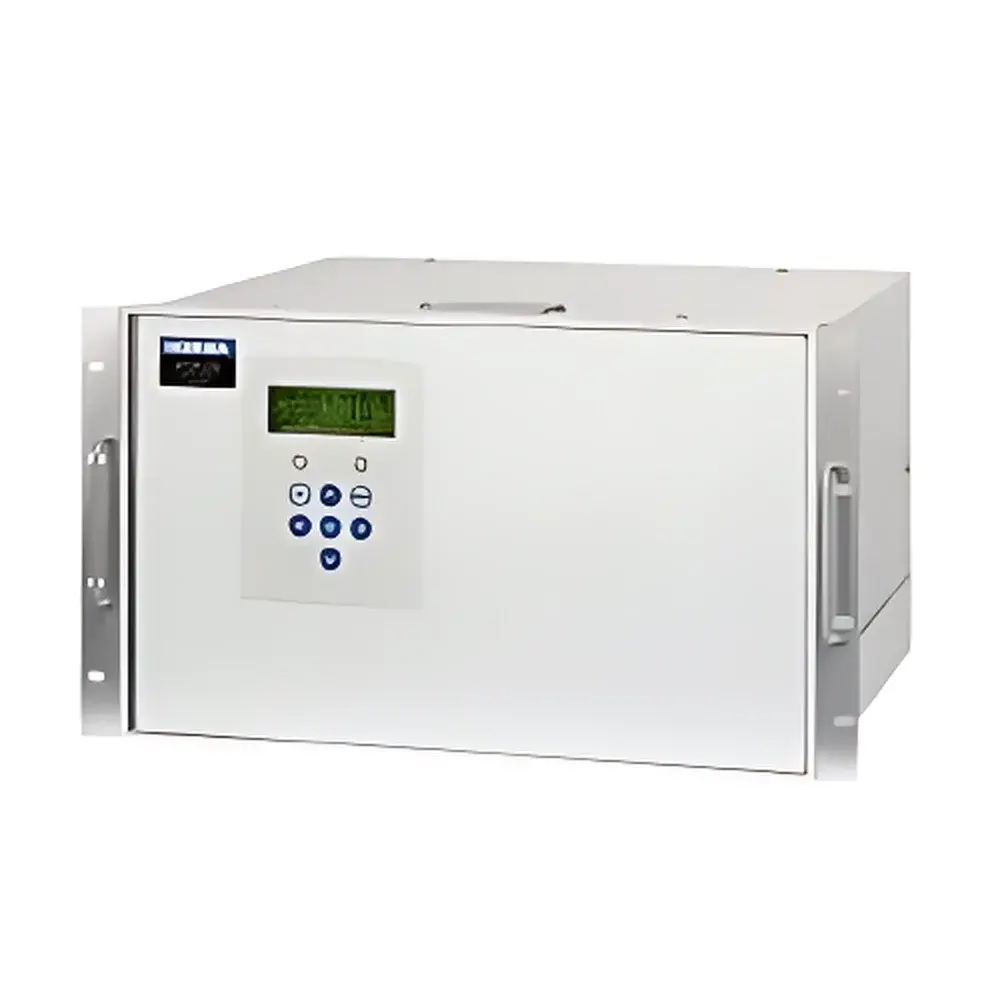
HORIBA APDA-370 Atmospheric Particulate Matter Monitor
| Brand | HORIBA |
|---|---|
| Origin | Japan |
| Model | APDA-370 |
| Measurement Principle | Beta-ray Attenuation Method |
| Measured Parameter | PM₁₀ |
| Range | 0–1000 / 5000 µg/m³ (standard) |
| Repeatability | ±20 µg/m³ @ 200/500 µg/m³ |
| Linearity | ±30 µg/m³ @ 200/500 µg/m³ |
| Zero Drift | ±20 µg/m³/day across all ranges |
| Span Drift | ±30 µg/m³/day @ low ranges |
| Sampling Flow Rate | ~16.7 L/min |
| Measurement Interval | 1 hour |
| Data Output | RS-232C, optional LAN (TCP/IP), analog 0–1 V, pulse & contact I/O |
| Power Supply | AC 100 V ±10 V, 50/60 Hz, ~200 VA |
| Dimensions | 430 × 483.5 × 266 mm (W×D×H) |
| Weight | Monitor unit: ~19 kg |
| Sampling pump | ~5 kg |
Overview
The HORIBA APDA-370 is a fully automated, continuous atmospheric particulate matter monitor engineered for regulatory-grade PM₁₀ mass concentration measurement in ambient air quality monitoring networks. It operates on the beta-ray attenuation principle: airborne particles are collected onto a moving filter tape at a constant volumetric flow rate (~16.7 L/min), and the attenuation of beta radiation (from a 14C source) through the deposited particulate layer is quantified to determine mass loading. This method provides traceable, gravimetrically correlated results without reliance on optical assumptions or particle density estimates. Designed for unattended operation over extended periods—up to 60 days—the APDA-370 meets the performance criteria specified in ISO 10473, EN 12341, and U.S. EPA Reference Method EQPM-0899 for PM₁₀ continuous ambient monitors. Its robust architecture supports deployment in fixed-site national air quality networks, industrial fence-line monitoring stations, and research-grade field campaigns requiring long-term data integrity and minimal maintenance intervention.
Key Features
- Automated hourly calibration verification via integrated span/zero checks, ensuring ongoing measurement validity without manual intervention.
- Modular filter tape system with programmable collection intervals and automatic tape advancement, minimizing operator dependency and reducing contamination risk.
- Real-time diagnostics including capture tape status, flow rate deviation, and radiation source stability—triggering configurable alarm outputs (contact closure, analog voltage, pulse signal).
- Multi-level data output capability: native RS-232C interface for direct PC or data logger connection; optional Ethernet (TCP/IP) module for networked remote access and centralized telemetry integration.
- Onboard non-volatile memory and removable CF card storage support audit-ready data logging with timestamped records of concentration, flow rate, temperature, pressure, and system health parameters.
- Compact 19-inch rack-mountable chassis (430 × 483.5 × 266 mm) optimized for space-constrained monitoring shelters; total system weight under 25 kg facilitates transport and installation.
Sample Compatibility & Compliance
The APDA-370 is validated for continuous sampling of ambient outdoor air across diverse climatic conditions, including high-humidity, low-temperature, and dust-prone environments. Its heated inlet option (available upon request) mitigates condensation-related artifacts during cold/humid operation. The instrument complies with international regulatory frameworks governing ambient particulate monitoring: it satisfies the technical requirements of ISO 10473:2001 (Ambient air — Determination of PM₁₀ and PM₂.₅ — Gravimetric measurement), EN 12341:2014 (Ambient air quality — Standardization of measurement methods for PM₁₀), and aligns with U.S. EPA’s Performance Specification 11 (PS-11) for beta-attenuation PM monitors. While not certified as a Federal Equivalent Method (FEM) by the U.S. EPA, its measurement protocol is widely accepted in EU Member States and APAC regions for compliance reporting under national air quality directives.
Software & Data Management
Data acquisition and system control are managed via HORIBA’s proprietary APDA Manager software suite (Windows-based), supporting real-time visualization, historical trend analysis, and export to CSV or XML formats compatible with national air quality databases (e.g., EEA AirBase, China MEP AQMS). All data entries include embedded metadata—date/time stamps, instrument ID, calibration history, and diagnostic flags—enabling full traceability per GLP and ISO/IEC 17025 requirements. Optional firmware upgrades provide enhanced security features, including user-access levels and encrypted data transmission. For integration into SCADA or enterprise environmental management systems (EMS), the TCP/IP module supports Modbus TCP and HTTP API protocols, facilitating seamless interoperability with third-party platforms while maintaining audit trail integrity per FDA 21 CFR Part 11 guidelines where applicable.
Applications
- National and municipal ambient air quality monitoring networks requiring long-term, stable PM₁₀ time-series data for regulatory reporting and public health assessment.
- Industrial emissions monitoring at stack exits or perimeter locations to verify compliance with local particulate emission limits (e.g., ISO 9001/14001 environmental objectives).
- Scientific field studies investigating aerosol dynamics, urban pollution dispersion modeling, and source apportionment using high-temporal-resolution PM₁₀ datasets.
- Construction site and mining operation dust monitoring, where rapid response to exceedance events is critical for occupational safety and community impact mitigation.
- Calibration reference and co-location validation for optical particle counters (OPCs) and low-cost sensor networks, leveraging its gravimetric traceability.
FAQ
What is the recommended maintenance schedule for the APDA-370?
Routine maintenance includes bi-weekly visual inspection of the filter tape path, quarterly replacement of the beta source collimator window (if exposed to corrosive atmospheres), and annual recalibration against NIST-traceable standard filters.
Can the APDA-370 measure PM₂.₅?
No—the APDA-370 is configured exclusively for PM₁₀ measurement using an EN 12341-compliant size-selective inlet. A separate PM₂.₅-capable model (e.g., APDA-360) is available from HORIBA.
Is the instrument suitable for indoor air quality monitoring?
It is designed for ambient outdoor applications; indoor use is not recommended due to insufficient dynamic range at low concentrations (<10 µg/m³) and lack of built-in humidity compensation for recirculated air streams.
Does the system support remote firmware updates?
Yes—when equipped with the LAN module, secure over-the-air (OTA) firmware updates can be deployed via authenticated HTTPS connections, preserving configuration integrity and version control logs.
How is data integrity ensured during power interruptions?
The internal backup capacitor sustains RAM and real-time clock operation for >10 minutes during outage; all active measurements and timestamps are preserved, and the system resumes scheduled operation automatically upon power restoration without data loss.







