
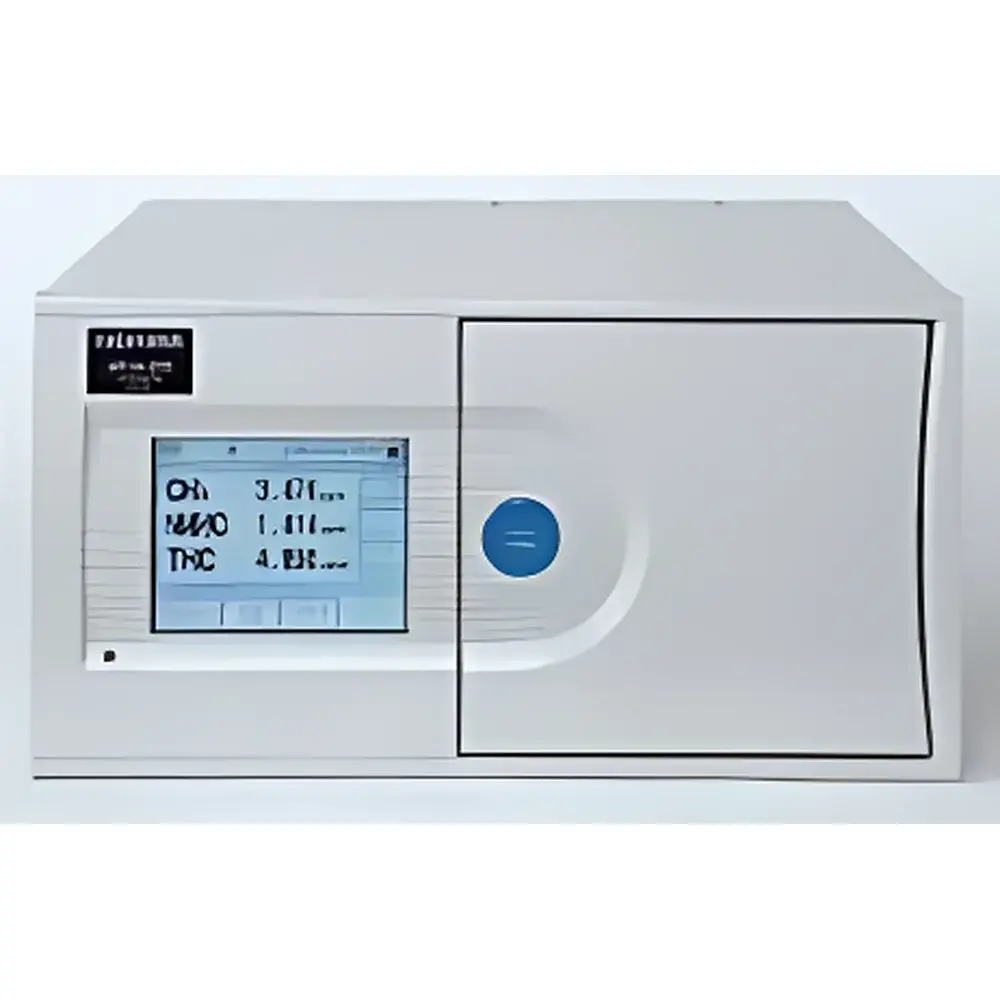
HORIBA APHA-370 THC Ambient Air Quality Monitor
| Brand | HORIBA |
|---|---|
| Origin | Japan |
| Model | APHA-370 |
| Instrument Type | Online Gas Analyzer |
| Target Analytes | Total Hydrocarbons (THC), Methane (CH₄), Non-Methane Hydrocarbons (NMHC) |
| Measurement Principle | Flame Ionization Detection (FID) with Selective Combustion Technology |
| Detection Limit | 0.050 ppmC (2σ, ≤5 ppmC range) or 0.5% F.S. (2σ, >5 ppmC range) |
| Repeatability | ±1.0% F.S. |
| Linearity | ±2.0% F.S. |
| Zero Drift | ±0.1 ppmC/day or ±2.0% F.S./day (whichever is greater) |
| Span Drift | ±2.0% F.S./day |
| Response Time (T90) | ≤60 s |
| Sample Flow Rate | ~0.9 L/min |
| Operating Temperature | 5–40 °C |
| Power Supply | 100–240 VAC, 50/60 Hz (configurable) |
| Dimensions | 430 W × 550 D × 221 H mm |
| Weight | ~33 kg |
| Output Signals | 0–1 V / 0–10 V / 4–20 mA (user-selectable) |
| Data Storage | CF card (optional) |
| Communication | Ethernet/LAN interface (optional) |
| Display Language | English, German, French, Japanese |
Overview
The HORIBA APHA-370 is a high-stability, online ambient air quality monitor engineered for continuous, zero-drift measurement of total hydrocarbons (THC), methane (CH4), and non-methane hydrocarbons (NMHC) in atmospheric monitoring applications. It integrates flame ionization detection (FID) — a well-established, highly sensitive technique for carbon-containing compounds — with proprietary selective combustion technology. This dual-method architecture enables discrimination between CH4 and NMHC without requiring separate analytical channels or complex gas chromatographic separation. The instrument operates on the principle that hydrocarbons are pyrolyzed in a hydrogen-fueled flame, generating ions proportional to carbon mass flow; selective catalytic oxidation upstream allows differential quantification by removing CH4 prior to FID detection. Designed for regulatory-grade environmental monitoring stations, the APHA-370 meets the functional requirements of ISO 8573-1 (compressed air purity), ASTM D6348 (gaseous emissions analysis), and supports compliance with national ambient air quality standards (e.g., China’s HJ 604–2017, EU Directive 2008/50/EC) when deployed in fixed-site networks.
Key Features
- Single-FID architecture with integrated selective combustion catalysts for simultaneous, real-time CH4, NMHC, and THC quantification
- Zero-point stability optimized via dual catalytic units: one for reference gas generation, another for combustion air conditioning — eliminating baseline drift under variable ambient conditions
- Automatically selectable or remotely configurable measurement ranges (0–5, 0–10, 0–20, 0–50 ppmC standard; optional 0–100 ppmC in four segments, max 10:1 range ratio)
- Robust mechanical design: all critical subsystems — sample pump, catalytic reactors, FID chamber, and electronics — housed within a compact 430 × 550 × 221 mm chassis (33 kg)
- Minimal auxiliary gas requirement: only high-purity H2 needed for flame operation; no zero air compressor or external calibration gas manifold required
- Configurable analog outputs (0–1 V, 0–10 V, or 4–20 mA) supporting dual signal modes: instantaneous + integrated values, or dynamic moving-average output
- Embedded diagnostics with on-screen alarm logging for ignition failure, zero-gas purifier temperature deviation, span calibration error, and zero calibration timeout
Sample Compatibility & Compliance
The APHA-370 is validated for use with ambient air samples containing particulate matter <5 µm and humidity levels up to 90% RH (non-condensing). Integrated heated sampling lines (optional) mitigate condensation-induced adsorption losses. Its measurement traceability aligns with NIST-traceable hydrocarbon standards and supports audit-ready data integrity under GLP and ISO/IEC 17025 frameworks. While not intrinsically safe for Zone 1 hazardous areas, it complies with IEC 61000-6-2 (EMC immunity) and IEC 61000-6-3 (EMC emission) standards. For regulatory reporting, the instrument supports 21 CFR Part 11-compliant data handling when paired with HORIBA’s certified data acquisition software (e.g., DAQ-LINK v4.x), including electronic signatures, audit trails, and user-access controls.
Software & Data Management
- Front-panel LCD with multilingual UI (English, German, French, Japanese) and real-time parameter visualization
- Optional CF card module enables standalone data logging at user-defined intervals (1 s to 1 h resolution), storing raw signals, diagnostic flags, and calibration logs
- Standard RS-232C port for local configuration and firmware updates; optional Ethernet interface enables remote access via TCP/IP for SCADA integration or cloud-based telemetry
- Compatible with HORIBA’s centralized monitoring platforms (e.g., EMMS-3000), supporting MODBUS TCP, OPC UA, and custom API endpoints for interoperability with municipal air quality management systems
- All stored data include timestamps synchronized to internal RTC (±2 s/month accuracy) and retain full metadata: range mode, detector voltage, flame status, and catalyst temperature history
Applications
The APHA-370 serves as a core analyzer in urban air quality monitoring networks (AQMN), industrial fence-line monitoring systems, landfill gas surveillance, and roadside emission assessment studies. Its ability to resolve CH4 from NMHC makes it particularly valuable for distinguishing biogenic (e.g., wetland, agriculture) from anthropogenic (e.g., vehicle exhaust, solvent use) VOC sources. It is routinely deployed in EPA Method TO-15–compatible ambient monitoring sites where speciated hydrocarbon data feed into photochemical modeling (e.g., CMAQ, CAMx). In Japan, the unit fulfills JIS K 0127 requirements for continuous THC monitoring in Class I–III ambient zones. Additional use cases include stack testing support (when interfaced with dilution samplers), cleanroom hydrocarbon background verification, and research on atmospheric oxidation kinetics.
FAQ
What gases does the APHA-370 measure, and how are they differentiated?
The instrument measures total hydrocarbons (THC) as carbon-equivalent concentration (ppmC), then calculates CH4 and NMHC concentrations using sequential selective oxidation — CH4 passes unreacted through the first catalyst, while NMHC is oxidized upstream of the FID; difference yields CH4 content.
Is hydrogen the only required auxiliary gas?
Yes. Only ultra-high-purity H2 (≥99.999%) is required for flame operation. No zero air, synthetic air, or calibration gases are consumed during normal operation.
Can the APHA-370 operate unattended for extended periods?
Yes. With optional CF card logging and Ethernet connectivity, it supports fully autonomous operation for ≥30 days with scheduled zero/span checks via remote command or programmable timer.
Does the system meet international calibration traceability requirements?
All factory calibrations are performed using NIST-traceable propane-in-air standards (certified per ISO/IEC 17025); certificate of calibration includes uncertainty budgets per GUM guidelines.
What maintenance intervals are recommended for routine field operation?
Catalyst cartridges require replacement every 12 months under typical ambient conditions; FID jet cleaning and electrode inspection are recommended every 6 months; annual full performance verification per ISO 10724–2 is advised for regulatory deployments.
Related Products







